Miller 3D & Alfred University Collaborate to 3D Print Chinamania Exhibit for Smithsonian Installation


 By now, most of us are aware of the place 3D printing has established in the world of manufacturing. From the home business to the massive industrial operation, this technology has sprung into the mainstream offering a host of benefits that are indeed changing everything from jewelry making to the creation of automotive parts and medical devices.
And while museums and the items they protect and display may not run the world, they tell us about it, giving a history throughout the ages. 3D printing is actually revolutionizing this arena as well, allowing for ancient bones to be studied more easily, and shared. Many scientists are in strong support of the democratization of artifacts that 3D printing is offering, diminishing the idea of ownership of a find in place of sharing information around the world. We’ve seen the amazing results of this information sharing in paleontologists’ dream studies such as that of Homo naledi and the famed Australopithecus afarensis, Lucy, as well as in progressive museums where they are able to educate and replicate like never before with the power of 3D printing.
[Photo: Miller 3D]
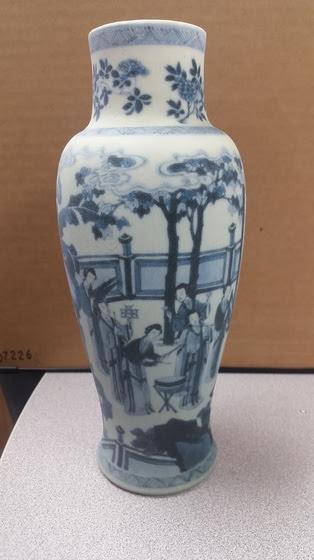
This wasn’t just any exhibit either, as it was meant for display at the Smithsonian Institute. Titled ‘Chinamania,’ the porcelain-based installation shows a type of pottery that many may be familiar with, in the classic blue and white painted style. What’s even more fascinating, however, is that they were working with replicas to make further replicas of vessels harkening back to the China’s Kangxi period of 1622-1722.
Obviously these weren’t just plastic pieces being churned out quickly and set out on display. The replicas for the Chinamania display required fastidious production as well as finishing. Miller 3D explained that the process included a number of steps, beginning at the Smithsonian, where they used 3D photogrammetry to capture images of the original collection. Next, McConnell cleaned up the scans, correcting issues such as shadows and varying colors. Once that process was complete, he transferred them to Miller 3D where the design team was responsible for scaling down the replica files down to 40% of the size of the originals.

[Photo: Arthur M. Sackler Gallery]
“Those blue-and-white ceramics… ” states the Arthur M. Sackler Gallery on their web page describing the exhibit, “… also inspired McConnell to create a new work based on 3D-printed replicas. His interest in replication and in the serialized mass production of ceramic forms began after he visited China more than a decade ago. The large kilns and busy factories at Jingdezhen prompted McConnell to look at China as an enduring resource for ceramic production.”
According to the team, as they continued into the 3D printing, the work was still manually intensive due to the intricate attention that had to be paid to detail as the installation was readied for the public. If you are interested in seeing Chinamania in person, these amazing 3D printed replicas are on display at the Arthur M. Sackler Gallery at the Smithsonian Institution.
You can learn more about Miller 3D, a division of AW Miller, here. Discuss in the Chinamania forum at 3DPB.com.
[Sources: Miller 3D; Arthur M. Sackler Gallery]Subscribe to Our Email Newsletter
Stay up-to-date on all the latest news from the 3D printing industry and receive information and offers from third party vendors.
Print Services
Upload your 3D Models and get them printed quickly and efficiently.













You May Also Like
3D Printing News Briefs, October 10, 2026: Drones, WAAM, Ceramics, & More
We have a packed 3D Printing News Briefs for you this weekend! First, America Makes celebrated the recent National Manufacturing Day with 3D printed drones, and then it’s on to...
3D Printing News Briefs, October 3, 2026: Hypersonics, Hotends, & More
We’re starting off with defense in this weekend’s 3D Printing News Briefs, as Titomic was awarded a $5 million U.S. defense contract, and VulcanForms announced a partnership with Specter Aerospace...
The Part Is Only Half the Story: Why 3D Printing Needs a Digital Thread
A 3D printed part can generate a lot of information. The challenge is keeping track of it. Manufacturers need to know which design was used, what material went into the...
Advanced Manufacturing at IMTS 2026: 3D Printing and AI and Drones, Oh My!
Last week’s International Manufacturing Technology Snow (IMTS) in Chicago welcomed over 90,000 attendees to the jungle that is McCormick Place. With over 1.17 million square feet of exhibit space, and...