Shark Tank: High School Students Win $50,000 for Brilliant Ice Cream Cone Device, with Help from The 3D Printing Store


Even the President isn’t immune to ice cream drippage.
There’s nothing like an ice cream cone on a summer day, is there? Except for that one pesky factor – the melting. It doesn’t take long for a scoop of frosty, creamy goodness to turn into a river of sticky nastiness running down your arm or dripping onto the ground as you frantically speed-lick to try and catch some of it before it all turns into a soggy mess. I’m an easily grossed-out person, so I hadn’t even reached adulthood before I decided I wasn’t dealing with it anymore and just started ordering my ice cream in a bowl.
Of course, that means that I haven’t had a delicious, crunchy waffle cone in ages, but that’s the tradeoff, I suppose. A couple of students, however, have come up with an idea for ice cream fans to have the best of both worlds. The Drip Drop is the invention of Sam Nassif and Oliver Greenwald, who were only ten years old when they entered the Gates Invention and Innovation Competition, which challenges kids to design products that solve practical problems or improve daily life. While thinking about what they could invent for the competition, the then-fifth-grade boys walked past an ice cream shop and saw a woman struggling to clean up her two ice cream-coated children with a handful of napkins.
 Nassif and Greenwald had their concept then. After some brainstorming, they came up with the Drip Drop – a saucerlike ring that slides over an ice cream cone to catch the drips from melting ice cream. The ring would be made from the same material as the cone, making it a zero-waste solution, and the Gates Competition judges liked it so much that they awarded the boys funding for a patent attorney. In April 2015, they were awarded a US Design Patent for the invention, with two additional patents pending.
One year after that, Nassif and Greenwald were selected out of 50,000 applicants to pitch their idea on the ABC show Shark Tank. To demonstrate their idea, they would need an actual product model. The boys had previously created models out of clay, as well as printing a few designs on their school’s 3D printer, but they weren’t satisfied; they needed more professional resources, so they turned to The 3D Printing Store.

3D printed model
Within a day, The 3D Printing Store worked up a design and 3D printed a model of the Drip Drop, but Nassif and Greenwald wanted to take the product to the next level and actually create waffle cones with their design. The 3D Printing Store suggested creating a mold from a food-safe material in which waffle batter could be poured and baked. The boys went out and bought the necessary materials, then used the 3D printed model to cast a food-safe, oven-safe mold.
It took a lot of trial and error to get the perfect combination of ingredients for their ringed cone, but once they perfected the mold and the cone, they presented the idea to Shark Tank:
Nassif and Greenwald, now in 9th grade and the youngest applicants to ever pitch their idea on Shark Tank without adult accompaniment, were awarded a $50,000 investment. Their next step is to license the invention to ice cream shops everywhere in hopes of preserving the environment through reduced need for napkins, bowls and spoons – and improving the ice cream cone-eating experience for kids and adults alike. Discuss further over in the Drip Drop Gets Help from 3D Printing Store forum at 3DPB.com.
[Source/Images: Drip Drop / The 3D Printing Store]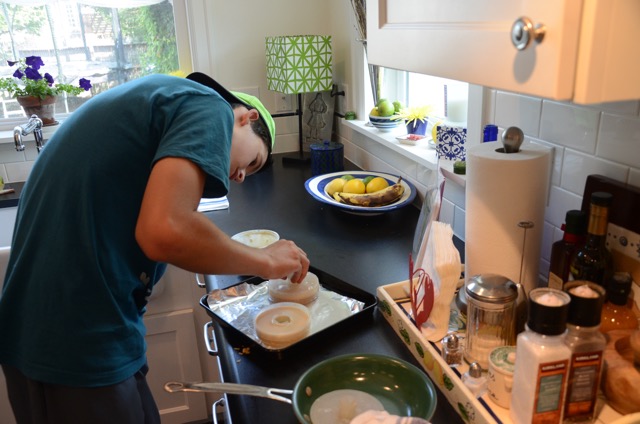
Sam Nassif works with the molds cast from the 3D printed model.
Subscribe to Our Email Newsletter
Stay up-to-date on all the latest news from the 3D printing industry and receive information and offers from third party vendors.
Print Services
Upload your 3D Models and get them printed quickly and efficiently.











You May Also Like
Printing Money Episode 36: Recent 3DP/AM Deals and More with John Barnes (TBGA & MPW)
Welcome to Printing Money Episode 36! For this episode Danny is joined by a new guest, John Barnes (Founder and President, The Barnes Global Advisors, Founder and CEO, Metal Powder...
Friendshoring and Additive Manufacturing: Turning Australia’s Research Strength into Commercial Impact
Global supply chains are being re-written. After decades of globalisation driven primarily by cost efficiency, geopolitical tensions, trade disputes and pandemic-era disruptions have exposed the risks of concentrating manufacturing and...
Velo3D’s $32.6M Defense Contract Highlights Why U.S.-Made 3D Printing Is Suddenly Critical
When the U.S. government talks about supply chain security, it’s no longer theoretical. It’s now written directly into law and into defense contracts. That detail matters for Velo3D, which this...
Northrop Grumman & Titomic Achieve Successful Hot Fire Test with 3D Printed Thrust Chamber
Back in April, leading Australian cold spray additive manufacturing (CSAM) original equipment manufacturer (OEM) Titomic announced that the company was partnering with defense giant Northrop Grumman to test the use...