
King Tut on the Tablet: Does the Creaform 3D Scanning Project Signal a Transition in Museum Exhibits?

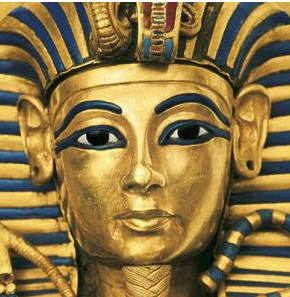 Our fascination with King Tutankhamun (ruling circa mid-1300s BC), the young pharaoh, the boy king, is as infinite as are the options continually being discovered with the new technologies today—all becoming intricately tied with the world of archaeology and relics—and allowing us to gain much greater access to the history of our world.
This process begins, however, with a world of scientists who have begun working together in a much more democratized fashion from continent to continent. And as they share, the public benefits. Today we are able to see so much more at an accelerated rate in the world of paleontology, anthropology, and more, via 3D technology, from a complete resurrection of T. Rex to the uncovering of a new Homo species. And playing a major part in much of this sharing, as well as offering permissions, are the museums of the world—offering us numerous ways to enjoy seeing ancient worlds. This is a creative crowd, all working together, and as technology allows for so many options, we the public are enjoying many new benefits.
If you want to draw a crowd at your museum, just bring in some King Tut. That’s a sure recipe to bring in large volumes of visitors of every age, and from everywhere, with the fascination regarding his life, the uncovering of his tomb in 1922, the talk of curses and such enduring, and even his burial mask, all bringing lasting attention. Recently though at an exhibit in the Milwaukee Public Museum, there was concern that patrons would not have an experience that was quite up close and personal enough.
As the Crossroads of Civilization exhibit drew closer, it seemed that one of the major highlights, a life-size replica of King Tut riding his chariot drawn by two horses, would not allow the viewers enough up-close access. While it’s completely understandable that for reasons of preservation, those at the event would not be able to venture close to the actual piece, the museum administrators wanted to give viewers the greatest experience possible. They decided to go big—and go virtual.
 Enter Creaform, a company from Québec that we’ve followed for quite some time now from new technology releases to large-scale scanning solutions. With the King Tut project, the team was faced with finding another solution on the same life-size scale, to be transferred to tablet. In the largest color 3D scanning project they’ve ever done, the team set to work at offering viewers something incredible—and all to be viewed virtually.
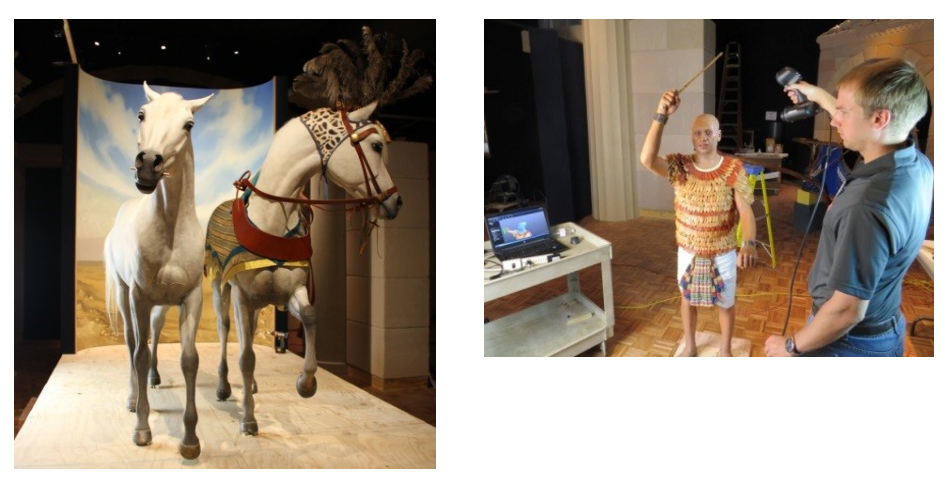
In this new application, Creaform was to be responsible for seeing that visitors would be able to see many items from King Tut’s time, to include elaborate clothing and jewelry as well as the horses. Using their famed Go!SCAN 20 and the Go!SCAN 50 scanners, the team collaborated with both Vince Anewenter and Jordan Weston from the Rapid Prototyping Center (RPC) at Milwaukee School of Engineering (MSOE). Together, these experts began working to scan almost 30 items.
The project took three days as they scanned the exhibit—with Weston learning the ropes with a Go!SCAN 50, technology used in the past to scan very large objects. Due to its large light pattern, that particular scanner allows for speed as well. This was a positive attribute for sure as they had to scan Tut’s horses several times, adorned with a variety of different accessories from leather straps to hats, and more. It was, of course, extremely important to the team that everything look perfect for the digital exhibit (and certainly young King Tut himself would have expected no less).
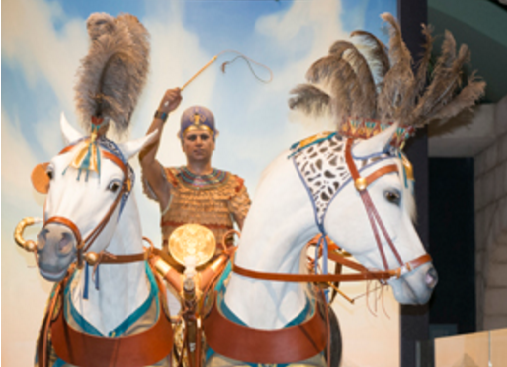 So as the hours passed and they could hear the faint sounds of a whip cracking in time with the clock, the team continued on. For smaller, less detailed, and thinner objects, they used the Go!SCAN 20. Employing a ‘Natural Features’ function, the team was able to work with the challenge of integrating color as they used both the scanner and a color camera. They aligned the scans, and used VXmodel to smooth surfaces and fill holes. This software is a Creaform product that is easy to use but offers powerful features as a post-treatment tool.
Texture was added easily and then the team transferred the files so they could be converted into squares and finalized, adding further color in harder to get to areas. Once the 2D image was projected onto the model and all the objects were in alignment, they were near the end, reporting that even with very thin objects the project turned out beautifully. This was in part thanks to the new scan merge “matching point” function which allows for the merging of two sides with common targets. Everyone working on the project reported that due to the technology in use, the results were not only amazing—they were easy to attain.
Also shown in the exhibit was an interactive timeline spanning 4,000 years of history from early Egypt to the fall of Rome, a scaled model of the temple of Pharaoh Ramesses III, two Egyptian mummies, Padi-Heru and Djed-Hor, as well as a large video showing off maps from empires over a time period of 5,000 years. Over 200 artifacts from the Museum’s collections were shown in this exhibit, along with the new electronic technology and other interpretive content.
This type of exhibit certainly offers a new way for everyone to share the museum experience in a magnified way, and it will be interesting to see how virtual visits themselves evolve; for instance, you may not even have to travel to the museum to see what interests you, certainly adding to the mission of greater accessibility and affordability for all, and allowing for us to see the past with the streamlined technology and vibrant technicolor of the future. Be sure to check out the video below produced by the museum on how and why they chose what they did to be displayed in this exhibit. It’s very informative and detailed, and offers many fascinating tidbits regarding not just the exhibit itself but also how such a process is handled by everyone involved. Is this an exhibit you would enjoy? Discuss further in the 3D Scanning for King Tut forum over at 3DPB.com.
[Source: Lidar News ]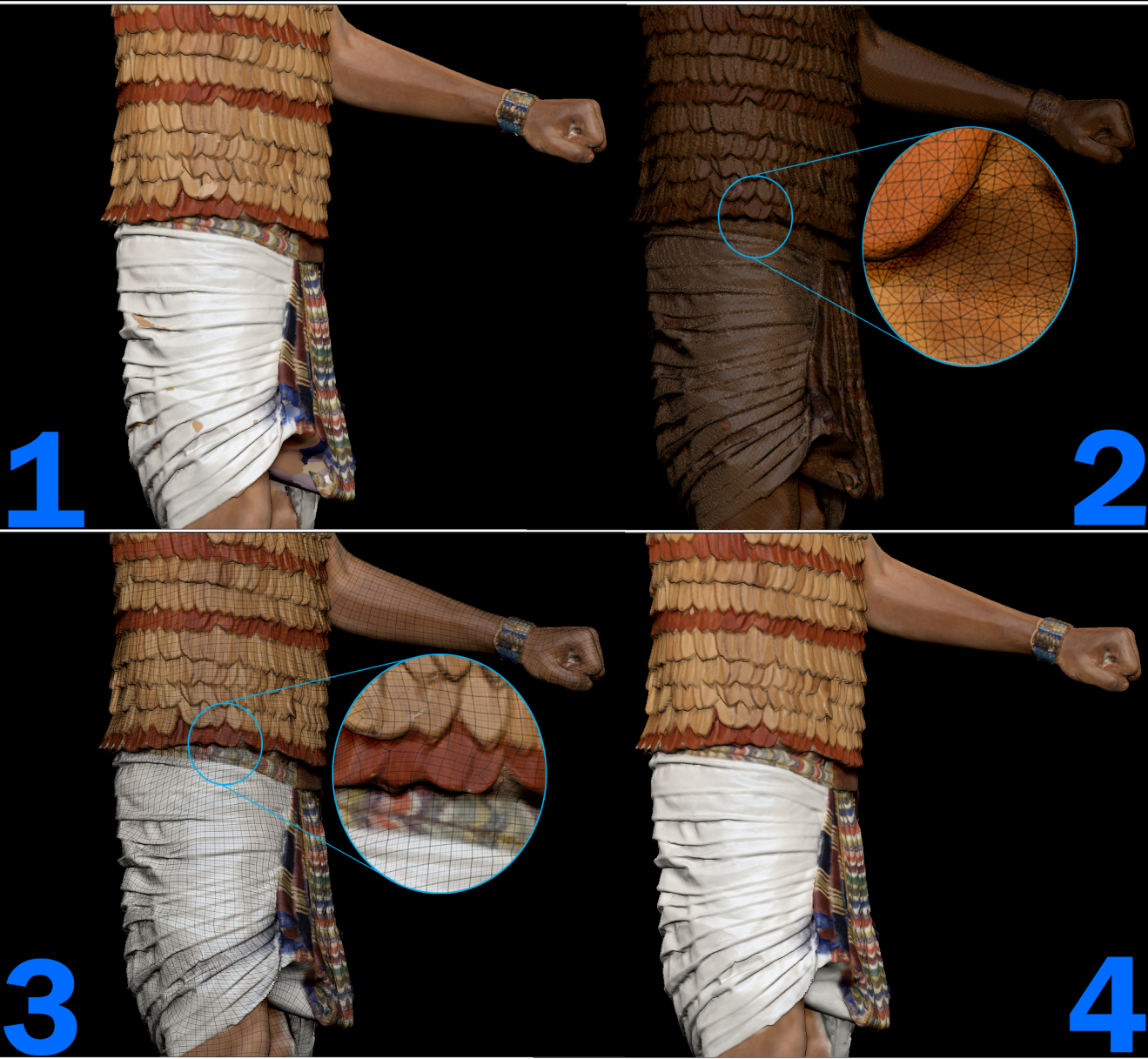
Subscribe to Our Email Newsletter
Stay up-to-date on all the latest news from the 3D printing industry and receive information and offers from third party vendors.
Print Services
Upload your 3D Models and get them printed quickly and efficiently.













You May Also Like
The Manufacturing Race Behind the Drone Revolution
We are in the middle of a major manufacturing shift focused on the production speed and payload capacity of uncrewed aerial systems (UAS), or drones. A recent Manufacturing Dive article...
ADDMAN to Buy Up to $10.8M in Nickel 718 Powder from 6K Additive Over 30 Months
After years of buildup, we’re finally starting to see what the US metal additive manufacturing (AM) market could look like at scale. To be sure, it’s still not quite there,...
Metal AM in a Multipolar World, Part 2: How PBF and DED Could Change by 2035
The first decades of PBF development were heavily shaped by machine capability: more power, more lasers, larger build volumes, better recoating, and improved process monitoring. These developments will continue, but...
Advanced Manufacturing at IMTS 2026: 3D Printing and AI and Drones, Oh My!
Last week’s International Manufacturing Technology Snow (IMTS) in Chicago welcomed over 90,000 attendees to the jungle that is McCormick Place. With over 1.17 million square feet of exhibit space, and...

























































