Rosatom to Develop Russia’s First Industrial Metal 3D Printer for Nuclear Industry

 From Sweden to the United States, a number of tech-trailblazing countries have been looking at 3D printing technology as an emerging tool for the development of parts for nuclear power plants. The nuclear energy source certainly has its perks, but is also controversial due to the potential disaster that could come from mismanagement of these power plants. But, as metal 3D printing technology continues to advance, additive manufacturing becomes a more viable and secure option to produce housing and other components for these nuclear energy facilities.
Now, Russia’s nuclear energy corporation, Rosatom, will attempt to usher in their recently develop advanced metal additive manufacturing technology by producing 3D printed parts for the country’s nuclear industry. Rosatom’s production of nuclear components will be done on their industrial metal 3D printer, the first-ever developed by a Russian company. The company will focus on ensuring the reliability and safety of their 3D printed nuclear power components, making sure that they can withstand irradiation by neutron fluxes. After their experimentation and testing in the nuclear industry is completed, Rosatom will begin branching out into other industries.
“Over two and a half years 3D printing became one of the leading areas for Rosatom’s non-nuclear business. Today, a roadmap and strategy of additive technology development in the nuclear industry have been formulated,” said Aleksey Dub, the state corporation’s science and innovations division deputy director. “By the end of 2018, Rosatom should have the full set of expertise needed to offer additive technology services. There are plans to have equipment, materials and technologies in order to offer the possibility of implementing any design ideas in the form of finished products.”
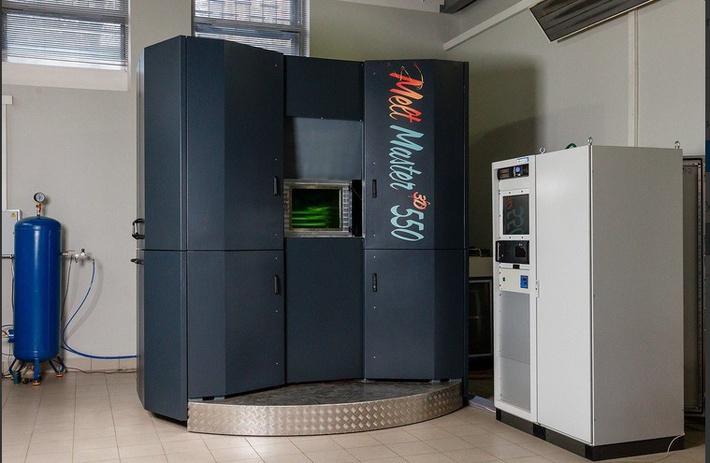
Rosatom’s industrial metal 3D printer [Source: RusNews]
In general, Russia has been increasingly adapting 3D printing technology into their most innovative projects. Back in March, the country sent the first-ever 3D printed nanosatellite up to the International Space Station, marking a major moment for the Russian space industry. In addition,the Russian United Instrument Manufacturing Corporation (UIMC) presented their first 3D printed unmanned aerial vehicle (UAV) at the Innoprom trade fair. Currently, Rosatom is developing eight nuclear reactors in Russia, as well as 36 others abroad. So, it seems safe to say that this new metal 3D printing technology will be utilized, at least to some extent, in their upcoming nuclear energy projects.

If you want to see Russia’s first-ever industrial metal 3D printer in action, check out the video from the Innoprom industrial trade fair below, which was uploaded by the new multimedia brand Sputnik. Discuss further in the Rosatom Additive Manufacturing forum over at 3DPB.com.
[Source: Sputnik]
Subscribe to Our Email Newsletter
Stay up-to-date on all the latest news from the 3D printing industry and receive information and offers from third party vendors.
Print Services
Upload your 3D Models and get them printed quickly and efficiently.











You May Also Like
From “Magic” to Metal: How Intrepid Automation Wants to Make 3D Printing Matter at Scale
Ben Wynne still talks about 3D printing the way people do when they’ve felt that “wow” moment up close. Back in the early 2000s, he was working at HP’s advanced...
From Vision to Volume: The Next Chapter for Additive Manufacturing
Additive manufacturing has spent years navigating skepticism, hype cycles, and industrial validation. Now, the industry finds itself at a decisive turning point. The conversation has shifted away from futuristic possibilities...
Nikon Records $591M Metal AM Write-Down, Maintains Long-Term Focus
Nikon (OTCMKTS: NINOY) has announced a large impairment loss tied to its Digital Manufacturing business, the part of the company that includes metal 3D printing and advanced manufacturing operations. This...
3D Printing Financials: Protolabs Reports a Steady 2025 as Digital Manufacturing and Metal Printing Gain Ground
Protolabs (NYSE: PRLB) ended 2025 with overall revenue down slightly year over year, but its digital manufacturing and 3D printing services continued to grow. For the quarter ending in December,...