Avante Technology Releases Emendo 1.1 File Repair Software, Now Faster and More Accurate Than Ever

 I think most people would agree that 3D printing is not only useful but fun – except when it’s frustrating and infuriating, and I also think everyone who’s ever tried 3D printing has had those days where they just want to throw their printer out the window. If you’re a 3D printing hobbyist, you’ve likely dealt with error-riddled files, either your own or someone else’s, and trying to repair those files can be a nightmare. That doesn’t have to be the case, though – if you have the right software, fixing your messed-up STL files can be a lot less stressful.
In December 2014, Wyoming’s Avante Technology introduced Emendo, an automated file repair software that promised to fix your files quickly and easily with just the push of a button. This week, the company is releasing Emendo Version 1.1, which Avante states is 10 times faster and just as accurate – a rare combination, according to the Avante team. With most software, they say, you’re forced to choose between speed and accuracy, but Emendo gives you the best of both.
“Emendo uses discreet math to provide more accurate repairs than the leading brands that use floating point calculations,” said Bob Zollo, President of Avante Technology. “With larger, complex files, the rounding errors resulting from floating point calculations add up and can cause serious problems with the file. Floating point calculations run faster, at the expense of precision.”
Emendo 1.1 offers two modes of operation to accommodate different types of STL files. The default Surface Reconstruction mode, designed for CAD files, is a sharply precise algorithm that repairs the seven types of commonly occurring errors in CAD models – which other repair software does as well, but without the collateral errors caused by floating point calculations. Lattice Reconstruction mode works on “mashup” files created with multiple components from different source applications, as well as any particularly tricky CAD files not fully repaired by Surface Reconstruction mode.
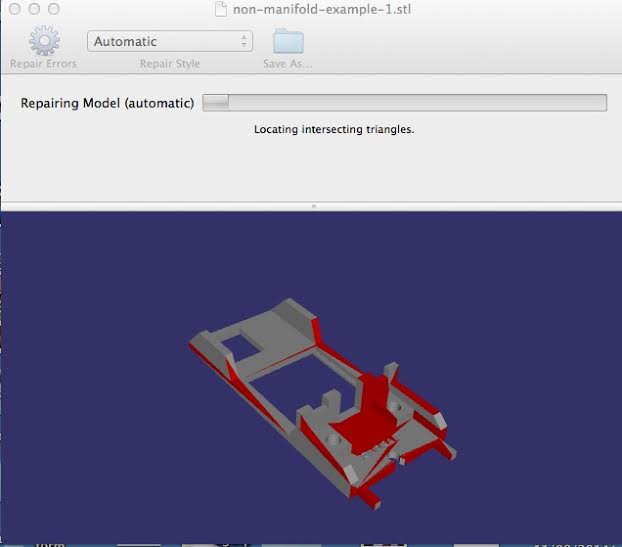
Like the original version, Emendo 1.1 is ridiculously easy to use – just open it up, double click on the file you want to repair, and Emendo goes to work, checking and validating the file and displaying any errors as different colors on the rotatable 3D rendering of the file. Click repair, and Emendo repairs – simple as that.
 Emendo 1.1 now supports Windows 10, as well as 7 and 8, and a Mac version is available as well. The price has gone up a bit, but is still very reasonable at $79.95 for single end users; end user licenses can be purchased here. Volume pricing and OEM pricing is available upon request, and an SDK version is also available for licensing for integration within third party applications. For more information about SDK and commercial licensing, contact bobz@avante-technology.com in North and South America and Japan; for European users, contact ekkart.wegeleben@pdoeurope.com. Discuss further in the Emendo 1.1 3D File Repair Software Update forum over at 3DPB.com.
Subscribe to Our Email Newsletter
Stay up-to-date on all the latest news from the 3D printing industry and receive information and offers from third party vendors.
Print Services
Upload your 3D Models and get them printed quickly and efficiently.











You May Also Like
Velo3D Becomes First Qualified AM Vendor for US Army’s Ground Vehicles Program
One indicator that I’ve used to help me track the additive manufacturing (AM) industry’s progress in terms of its technical maturity is the relative progress that each U.S. military branch...
Lululemon SoHo Store Installs Large-Format 3D Printed Benches
Shoppers visiting the new Lululemon flagship store in SoHo might notice something new and original when they sit down. Several of the seating elements inside the space were not carved...
3D Printing News Briefs, February 5, 2026: Advisory Board, Virtual Twins, & More
We’re starting with business in today’s 3D Printing News Briefs, including a new website launched by Metamorphic AM. Massivit appointed two senior leaders to its advisory board, and Dassault Systèmes...
Printerior Launches Circdal to Build a Sustainable Architectural Ecosystem with 3D Printing
Robotic arm systems gradually gained traction for years in the large-format additive manufacturing (AM) space, before experiencing a legitimate breakout year in 2025. Pellet extrusion has been the clear winner...