Japanese Tech Firm, Miraisens, Unveils New “Touchable” 3D Technology Which May Influence 3D Printing

Japanese high-tech firm, Miraisens, announced that it has developed haptic technology, which closes the tactility gap that formerly existed with the virtual reality experience. Haptic technology or “haptics” simulates the sense of touch by applying vibrations, forces, or motions to the user. The company, based in Tsukuba, just outside of Tokyo, says its haptic technology “will give you a sense that you can touch objects in the 3D world.”
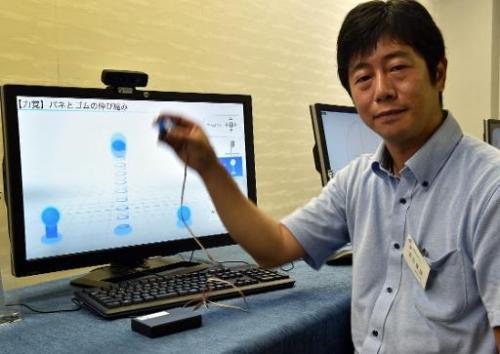
Japan’s high-tech venture Miraisens CEO Natsuo Koda demonstrates “3D-Haptics Technology” at a press preview.
More familiar applications for haptic technology are, for example, the video game controllers that simulate the tactile experience of automobile driving–from racing to high-speed chases. Game controllers, including steering wheels, rumble or vibrate in response to, for instance, the texture of the road surface, the speed of the vehicle. and certain driving maneuvers such as sharp turns. Miraisens’ haptic technology renders earlier efforts like these somewhat quaint. “It works by fooling the brain,” says Norio Nakamura, chief technical officer at Miraisens, and the inventer of 3D-Haptics Technology, “blending the images the eye is seeing with different patterns of vibration created by a small device on the fingertip.”
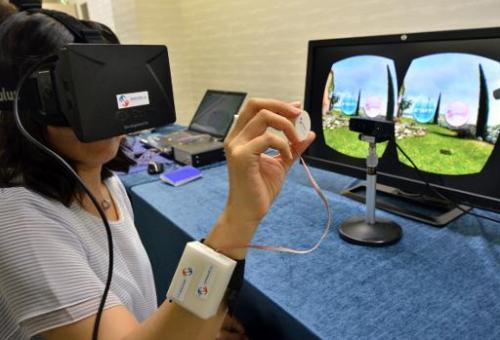
At the press conference in Tsukuba, a journalist was allowed to demonstrate a prototype head-mount display, which connects with a small hand-held, coin-shaped device that enables the user to feel resistance from virtual buttons he or she pushes. The company says the haptics system can be built into devices in the shape of pens, sticks, or coins, like the one demonstrated. In fact, as a company spokesperson suggested, one particularly invaluable use for the new technology a navigation assistance system in the form of a cane for visually impaired people.
Miraisens, which is a spin-off of the National Institute of Advanced Industrial Science and Technology, anticipates many uses for the technology, including opening remarkable new 3D horizons in video gaming: “It could be used to give a sense of resistance in response to certain actions within the game,” they speculated. Other likely uses will be medicine or a combination of medicine and robotics, particularly with remote surgery. In such scenarios, an expert surgeon might perform surgery on a patient from a thousand miles away. Nursing staff would set up the equipment, prep and monitor the patient. The surgeon would be a telepresence, receiving resistance and tactile feedback during the procedure.
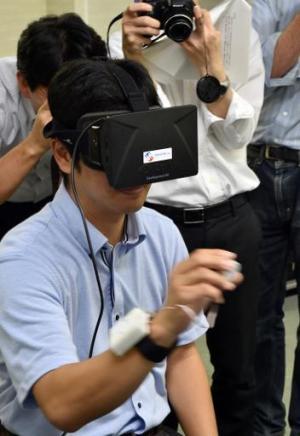
Miraisens CEO Natsuo Koda demonstrates “3D-Haptics technology.”
The company provided other examples where their haptics system could be applied and this is where 3D printing comes into play: “It could also be used,” they suggest, “to make up complicated data that could be fed into a 3D printer, allowing a child to make a virtual dinosaur model and then watch it come into existence.” And that’s evidently the next step for Miraisens, as the company aims to create commercial applications for this groundbreaking technology in the electronics and service industries.
What do you think would be the best uses for this technology within the 3D printing and modeling space? Discuss in the Touchable 3D Technology forum thread on 3DPB.com
Subscribe to Our Email Newsletter
Stay up-to-date on all the latest news from the 3D printing industry and receive information and offers from third party vendors.
Print Services
Upload your 3D Models and get them printed quickly and efficiently.











You May Also Like
3D Printing News Briefs, December 3, 2025: Vapor Smoothing, Microneedles, & More
Happy 3D Printing Day! In today’s 3D Printing News Briefs, we cover everything from a 3D printer order and vapor smoothing to microneedles, surgical training models, and more. Read on...
Indian Additive Construction Firm MiCoB Delivers Over 500 Bunkers to the Indian Army
Like many nations attempting to capture Industry 4.0 gains, India laid out an ambitious long-term plan in 2014 to transform its economy: the Make in India initiative. However, as is...
Boston’s Additive Edge at Autodesk: Harvard Researchers Turn Mining Waste into Masonry
When most people look at piles of mining waste, they see rubble. For Maddie Farrer and Chenming He, two researchers at Harvard’s Graduate School of Design (GSD), those rocks look...
3D Printing News Briefs, November 12, 2025: Standards, Printhead, UV Printing, & More
We’re starting with standards news from ASTM International in today’s 3D Printing News Briefs, and then moving on to business, as Precision Plastics Australia launched a new collaborative venture. ValCUN...