Indian Additive Construction Firm MiCoB Delivers Over 500 Bunkers to the Indian Army


Like many nations attempting to capture Industry 4.0 gains, India laid out an ambitious long-term plan in 2014 to transform its economy: the Make in India initiative. However, as is also the case for many of those same nations, the metrics for Make in India thus far look mixed at best. For instance, while the Indian government was targeting a boost to manufacturing’s share of the GDP from 16.7% to 25% between 2014 and 2025, that percentage had actually fallen slightly by 2024.
On the other hand — in yet another instance where India’s efforts echo the broader pattern — the numbers tell only part of the story. In the last few years in particular, India has demonstrated tangible progress at scaling technologies including additive manufacturing (AM), and India’s government continues to prioritize increased manufacturing activity as a national strategic objective.
Additive construction (AC) is another emerging technological area where India excels, and the Indian military has played a central role in that context. In the latest update to the story, MiCoB Private Limited, an original equipment manufacturer (OEM) of construction printers and end-to-end provider of AC services, announced that it has delivered over 500 3D printed bunkers to the Indian Army.
According to MiCoB, the bunkers are “impact and blast resistant,” based on tests that have been conducted since 2022, including blasts from the T90 tank, the main battle tank used by the Indian Army. Although it doesn’t appear to have been explicitly announced at the time, MiCoB is the company that was involved in a project which began in 2022 to deliver 3D printed shelters to the Indian Army, at the line of actual control (LAC) that separates India and China. (However, stories in outlets like Hindustan Times did mention, “The modules are being built by the army in partnership with the IITs at Gandhinagar and Madras. The technology startups that are part of the incubation cells of the two IITs have the printers required for this.”)
MiCoB claims that, since the early days of the project, the company has reduced the printing time needed for each bunker from 45 days to 7 days.
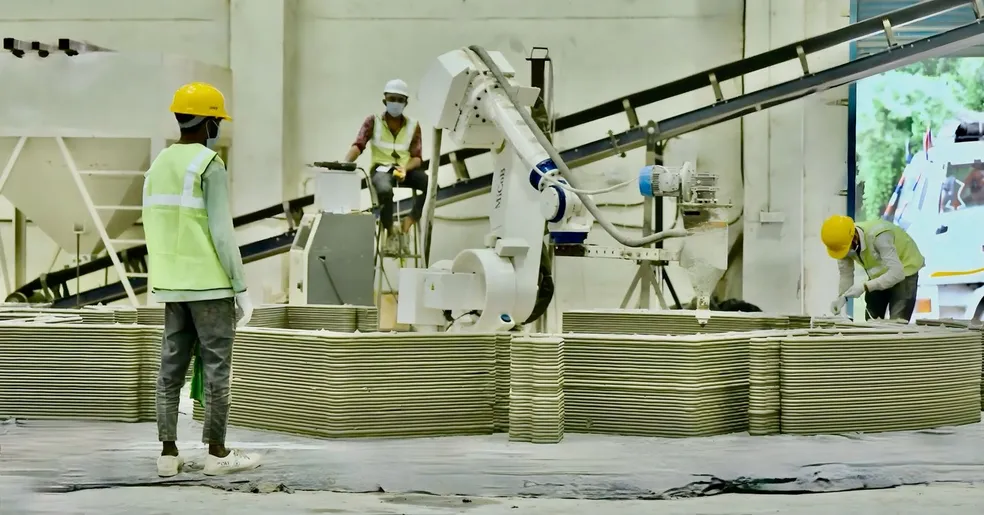
In a press release about MiCoB’s delivery of over 500 bunkers to the Indian Army, the company’s co-founder and CEO, Dr. Shashank Shekhar, said, “Delivering 500+ 3D Printed Bunkers to the Indian Army is more than an achievement, it’s a powerful demonstration of how innovation meets purpose to strengthen and protect our nation. Each structure has been thoughtfully designed with a deep understanding of the Army’s on-ground realities, ensuring every feature enhances safety, comfort, and operational readiness, even in the most challenging terrains.
“In the projects delivered by us, we saved over 20,000 tons of construction material compared to conventional methodology, aligning with our motto of building sustainably with speed. This is a proud moment for India as we are leading the innovation and adoption of 3D concrete printing technology, and the active support from various government and private stakeholders will position India as a leader in the sustainable construction practices.”
Just like in the rest of the world, India suffers from an increasingly severe lack of affordability in its housing market, with higher costs of inputs a major factor behind the crisis. The problem is obviously exacerbated by the fact that India contains almost 18% of the global population, and even more stratified disparities between rich and poor than prevail across the world at-large.
There are many conflicting claims about the benefits of 3D printed construction, but it seems beyond dispute that the technology is steadily improving all the time, and that it’s continuing to scale as it progresses. MiCoB, for one, has tested its technology for a number of different verticals beyond the military, including residential housing and resorts. And there are other startups in India achieving similar results.
AC stakeholders in India have an excellent opportunity to pitch themselves as a genuine Make in India success story. If India doubles down on AC, it would solve multiple problems simultaneously: above all, creating middle-class jobs as well as the infrastructure to house middle-class families (not to mention more impoverished demographics).
One problem with Make in India is likely that it has simply cast too wide a net to make as much of a dent in any one area as was initially hoped for. By narrowing the focus down to the handful of areas where Indian startups have been most productive, the endeavor may increase its chances for success.
Images courtesy of MiCoB
Subscribe to Our Email Newsletter
Stay up-to-date on all the latest news from the 3D printing industry and receive information and offers from third party vendors.
Print Services
Upload your 3D Models and get them printed quickly and efficiently.












You May Also Like
Inside Decibel’s Collaboration with SKYLRK at Coachella 2026
There’s a version of Coachella most people never see. Not the stage. Not the crowd. Not even the music. It’s everything built around it: the spaces where artists host, brands...
Caracol to Build Large-Format 3D Printing Hub in Milan With Designtech & LAMÁQUINA
In the 1990 classic in economic strategy, The Competitive Advantage of Nations, business theorist Michael Porter wrote, “Most commentators on the Italian economy have persistently underestimated Italy, because they have...
Why Kyle Bass Is Betting on Divergent, and What It Says About the Future of Manufacturing
Kyle Bass has spent much of his career looking at big economic trends before everyone else does. The founder of Hayman Capital Management became famous for betting against the U.S....
Beyond Thermoplastics: Why JuggerBot Is Betting on Hybrid AM
For years, thermoplastics have been the workhorse of additive manufacturing (AM). They are pretty easy to process, available, and compatible with many of today’s industrial 3D printers. From prototypes to...