
New Self-Healing Bio-Glass May Be Used as 3D Printed Cartilage Replacements

 A team of scientists at the Imperial College London and at the University of Milano-Bicocca have collaborated to develop a unique, flexible material that could potentially be used to help repair damaged cartilage, including the cartilage material between vertebrae. This bio-glass material can mimic the shock-absorbing properties of real cartilage enough to relieve patients’ pain, while also helping to encourage the regrowth of natural cartilage tissue. There are currently no traditional methods of successfully re-growing the cartilage tissue in knees, but early tests of the new bio-glass have been successful, and the material may eventually allow this hard to repair tissue to repair itself over time.
The new bio-material is made from a mixture of a polymer called polycaprolactone, a biodegradable polyester with a low melting point, and basic silica. The resulting mixture is a highly flexible material that is very similar to real cartilage and is both strong and flexible. It also has self-healing properties so a section of the material can be cut and then fully reattached just by pushing the two parts together. The researchers say that they can produce the bio-glass as a biodegradable ink that could then be 3D printed into small, implantable scaffolds to be inserted into damaged cartilage tissue. Once fully implanted, the scaffolds would encourage the cartilage to start to repair itself, while the implant is slowly broken down and absorbed by the patient’s body.
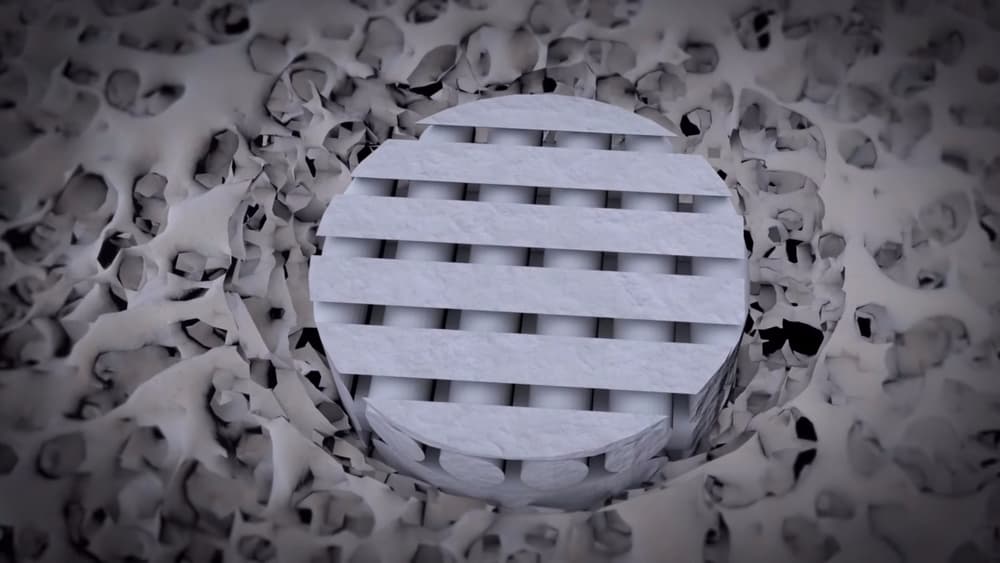
3D printable biodegradable bio-glass cartilage implants can help heal damaged cartilage.
Here a computer animation of how the 3D printed bio-glass scaffold would be implanted into damaged cartilage tissue and encourage successful tissue regrowth:
“Bio-glass has been around since the 1960’s, originally developed around the time of the Vietnam War to help heal bones of veterans, which were damaged in conflict. Our research shows that a new flexible version of this material could be used as cartilage-like material. Patients will readily attest to loss of mobility that is associated with degraded cartilage and the lengths they will go to try and alleviate often excruciating pain. We still have a long way to go before this technology reaches patients, but we’ve made some important steps in the right direction to move this technology towards the marketplace, which may ultimately provide relief to people around the world,” explained one of the developers of the bio-glass material, Professor Julian Jones from the Department of Materials at Imperial.
One of the several bio-glass formulations that the scientists have developed could be used to treat patients with damaged intervertebral discs. When the cartilage in the spine begins to degenerate it will result in severe pain for the patient. Currently the only way to treat these types of injuries involves completely fusing the vertebrae together to prevent the bones from scraping against each other. The scientists believe they are capable of engineering the bio-glass into an artificial cartilage disc implant that would have the same mechanical properties of the real cartilage.
“This novel formulation and method of manufacture will allow [Professor Jones] and his team to develop the next generation of biomaterials. Today, the best performing artificial joints are more than a thousand times stiffer than normal cartilage. While they work very well, the promise of a novel class of bearing material that is close to nature and can be 3D printed is really exciting. Using [Professor Jones]’s technology platform we may be able to restore flexibility and comfort to stiff joints and spines without using stiff metal and all its associated problems,” said Professor Justin Cobb, Chair in Orthopaedic Surgery at Imperial’s Department of Medicine and the co-leader of the next stage of research.
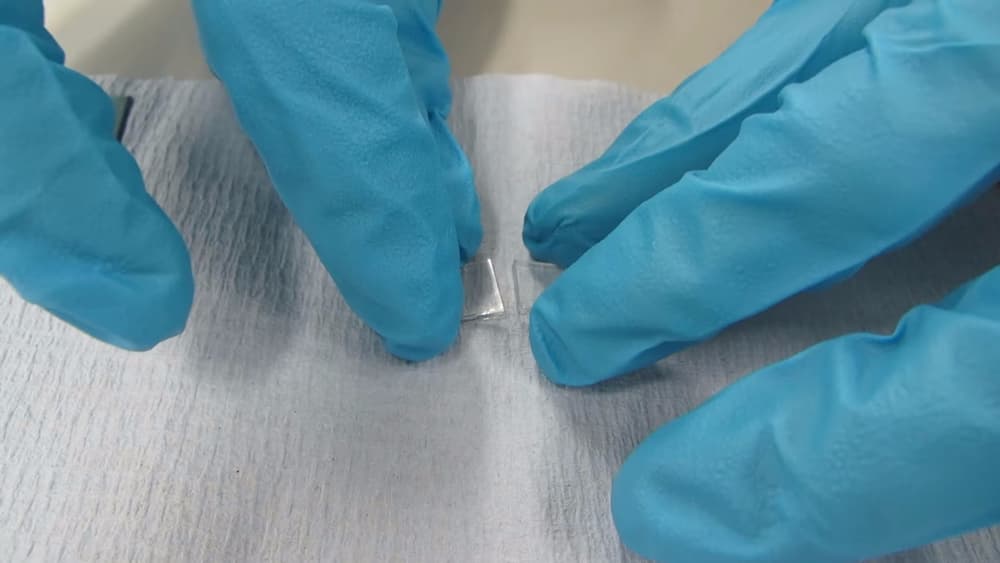
The bio-glass material is self-healing and will repair itself.
Some of the more unique properties of the bio-glass is its ability to self-heal, which is why the material is an ideal option as a cartilage replacement. When the material is damaged, it simply needs to make contact with the two severed pieces again and they will bond together and no longer be able to be pulled apart. These properties make the material easier to 3D print into custom shapes, and will result in more resilient and dependable implants.
You can see video of the bio-glass’ self-healing properties here:
The material has successfully been tested in test tube trials and it has shown itself capable of encouraging the growth of new cartilage cells. While the research team estimates that they still have about ten more years of testing and approvals before bio-glass cartilage implants are available to the general public, Professor Jones believes that they are moving in that direction. You can read more about this amazing new material over on Imperial College London. How do you see this new development impacting the medical field? Discuss in the 3D Printed Bio-Glass forum over at 3DPB.com.
[Source/Images: Imperial College London]Subscribe to Our Email Newsletter
Stay up-to-date on all the latest news from the 3D printing industry and receive information and offers from third party vendors.
Print Services
Upload your 3D Models and get them printed quickly and efficiently.













You May Also Like
Metal 3D Printers for the Desktop Are Finally Starting to Feel Like Desktop Products
FDM 3D printing is becoming increasingly accessible, yet metal 3D printers designed for everyday desktop use remain rare on an ordinary workbench. The real challenge is not making a metal...
3D Printing Financials: 6K Additive Sales Rise as Aerospace and Defense Demand Grows
6K Additive (ASX: 6KA) grew rapidly in the first half of 2026 as demand for its metal powders increased, particularly from aerospace and defense customers. The newly public company also...
When Data Becomes the Differentiator: Qualified Material Data is Changing the Future of Structural Additive Manufacturing
For years, additive manufacturing has promised engineers greater design freedom. The challenge wasn’t printing the part—it was proving the part belonged on an aircraft. Designing a lightweight bracket or consolidating...
Amaero Builds U.S. Metal Powder Capacity for Additive Manufacturing
For metal additive manufacturing (AM) to grow in the United States, companies need more than printers. They also need a reliable supply of the powders that go into those machines....























































