Researchers Create New Cushioning Material Using 3D Printing Technique


Cushioning or padding are utilized to dampen shock and vibrations, distribute and relieve stress, maintain relative positioning, or mitigate the effect of size variation. The materials that serve these purposes are part of our ever day lives in sporting and other consumer goods, as well as being utilized by the defense and aerospace industries and for packaging and transportation. Their ubiquitous nature has led to a thorough study of their uses, characteristics, strengths, and weaknesses.
This cushioning and padding can be provided through either gels or foams but either method has its disadvantages. Gels provide a high level of cushioning but are subject to lower performance depending on the temperature, and they are relatively heavy. In contrast, foams are lighter and have a high level of compressibility but their performance varies unpredictably as it is not possible to entirely control the shape, size, or placement of the air pockets they contain.
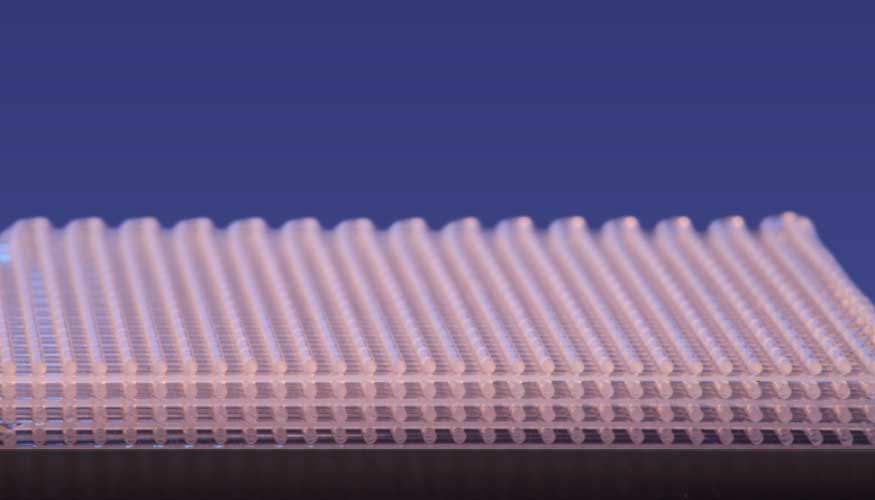 In an attempt to create a better product, engineers and scientists at Lawrence Livermore National Laboratory (LLNL) worked together to create an entirely new way of producing a cushioning material. Their approach was to work at the microscale and fabricate a material with a number of programmable properties that could be manipulated to create the desired characteristics.
These new materials are produced using an additive manufacturing techniques called direct ink writing with a silicone-based ink that cures into a material much like rubber. Using this technique, engineers at LLNL are able to create materials with controlled, complex architectures called cellular elastomers. These ordered, cellular materials enable improved control over the material’s mechanical and directional properties, enhanced uniformity, and increased predictive modeling capability.
The team has released their research in the Journal of Advanced Functional Materials. Lead author Eric Duoss described the nature of their contribution:
“The ability to dial in a predetermined set of behaviors across a material at this resolution is unique, and it offers industry a level of customization that has not been seen before.”
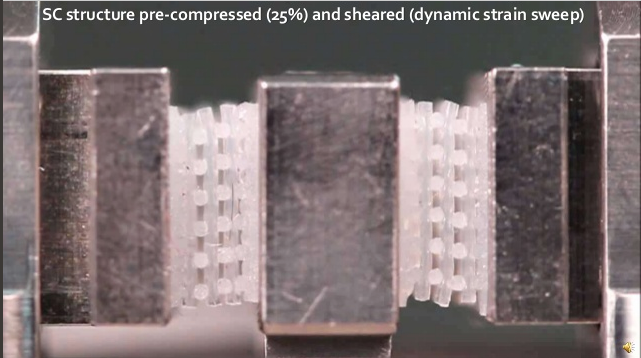
The cushion material that the LLNL researchers created can have one of two different forms, a stacked inline configuration or a staggered configuration. The component materials for either configuration are exactly the same and posess the same degree of porosity but they exhibit very different responses to shear and compression stresses. The stacked configuration undergoes a buckling instability under increased compression, but at normal compression exhibits a stiffer structure while the staggered material is softer under normal compression with a bending deformation under increased compression.
 Currently, LLNL has patents filed for the materials they have engineered and are working to scale up their infrastructure to allow for commercial production. In addition, they are hoping to continue refining and improving the product as well as seeking out additional performance characteristics that make it suitable for a wider variety of market applications.
Subscribe to Our Email Newsletter
Stay up-to-date on all the latest news from the 3D printing industry and receive information and offers from third party vendors.
Print Services
Upload your 3D Models and get them printed quickly and efficiently.













You May Also Like
Impossible Objects Closes $40M Series B
The Pentagon, along with deep-pocketed collaborators in the private sector, is urgently coordinating the buildup of all the elements necessary for a domestic US drone supply chain. Even so, those...
The 3D Printing Opportunity in UGVs
In 2024, IperionX partnered with fastener firm Vegas Fasteners to jointly make fasteners for the US Army Ground Vehicle Systems Center (GVSC). That DEVCOM component has been hit by funding...
$51 Million Revenue VMP Wants to Become a Leading Additive Manufacturing Metal Powder Producer
Chinese powder producers have traditionally had little impact on the additive manufacturing market. Typically, they offer low-cost powders without much in the way of settings or application support. But China’s...
IperionX Gets $11.5M Army Boost to Make Titanium Fasteners in the U.S.
IperionX is going to get another $11.5 million, potentially up to $25.4 million, of an existing SBIR Phase III with the Army (Task Order W911QX26FA097). The award covers low-cost titanium...