STEM Divas Gets Young Girls Interested in 3D Printing and Other Technology

 There’s been a lot of debate on how to get young girls more involved in the STEM (science, technology, engineering, and math) curriculum. There’s some controversy about the practice of “pinkifying” tech in order to allegedly make it more interesting to females; the implication is that to get girls and women interested in science and tech, we need to apply it to things they understand, e.g., clothes, jewelry, and other “girly” things. It’s a condescending attitude that infuriates many women who have made careers building rocket engines and developing cures for deadly diseases, but when it comes to kids, it’s not necessarily always harmful.
What makes STEM Divas different is that it doesn’t assume that all girls are interested only in pink and glitter, but recognizes that some girls, particularly very young ones, do respond better to new ideas when they’re dressed up in a pretty package. Pettee Guerrero, a STEM Outreach associate for Northern Illinois University, created the program to appeal to the “girly-girls” who have eschewed science as presented in their classrooms. Some girls, of course, eagerly jump right in to STEM coursework, but others consider it “uncool.”

STEM Divas makes that coursework “cool” by applying it to the interests of this particular segment of girls in the 7- to 10-year-old age range. The program meets once a month on Saturdays at the Northern Illinois University campus, and involves such activities as building jewelry boxes, tie-dyeing clothing, or making soap and lip gloss while learning about the tools and chemistry that go into the processes (and while wearing bright pink hard hats and goggles). The most recent class, which took place on February 6, introduced girls to 3D printing by teaching them how to design their own jewelry.
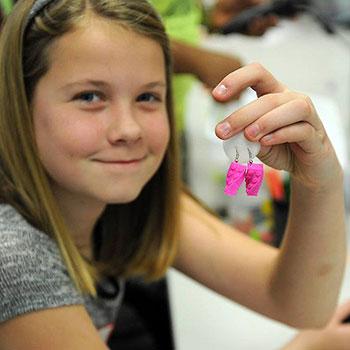
Image: NIU Today
The four-hour class began with a lesson in how to design 3D models in Autodesk Fusion 360. Since there were only two 3D printers available, it wasn’t feasible for every girl to print her design, so each child was given a 3Doodler to create jewelry and other shapes.
“We showed them our 3-D printers, how they work and what the process is,” said Mackenzie Thompson, a sophomore mechanical engineering major and STEM Outreach student worker. “These pens are basically 3-D printers, but instead of using a computer, they’re using their brain.”
The next class will be on March 12, and will focus on the science of musical instruments. Each workshop is $42 and takes place from 9:00 AM to 1:00 PM. The program has already shown itself to be working; girls who previously showed no interest in science, or even actively disliked it, have changed their minds after realizing how it can be applied to their own interests.
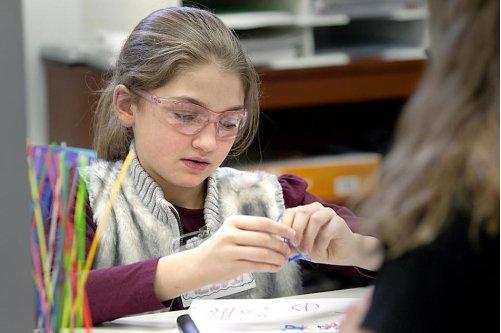
Image: Katie Smith, Shaw Media
“Our whole STEM Divas series, it’s just about getting girls interested in STEM and it’s about getting them more comfortable with it,” said Thompson. “A lot of studies have shown that one of the reasons girls don’t go into STEM is because it’s more focused toward boys, and so by having this class it’s kind of showing them that girls can do it and there’s a way to apply it in ways they’re interested in.”
In that respect, pinkifying can be a great starting point for young girls. Those same girls may grow up to be successful engineers or researchers who would laugh you out of the room if you suggested they try “hacking a hair dryer,” but at age 7, sometimes it takes a little glitter to spark their interest. Some STEM Divas participants have already announced that they have changed their career ambitions from ballerinas to engineers, so it looks as though Guerrero’s idea has hit the (pink) nail right on the head. What do you think of this angle for getting girls interested in STEM technology? Discuss in the STEM Divas 3D Print forum over at 3DPB.com.
Subscribe to Our Email Newsletter
Stay up-to-date on all the latest news from the 3D printing industry and receive information and offers from third party vendors.
You May Also Like
3D Printing News Briefs, April 13, 2024: Robotics, Orthotics, & Hypersonics
In 3D Printing News Briefs today, we’re focusing first on robotics, as Carnegie Mellon University’s new Robotics Innovation Center will house several community outreach programs, and Ugogo3D is now working...
Rail Giant Alstom Saves $15M with 3D Printing Automation Software 3D Spark
3D Spark has entered into a three-year deal with the rail giant Alstom. Alstom, a transport behemoth with annual revenues of $16 billion, specializes in the manufacture of trains, trams,...
Meltio Expands Global Reach with New Partnerships in the Americas and Europe
Spanish 3D printing manufacturer Meltio has expanded its sales network across the globe. With the addition of three new partners in the United States, Brazil, Argentina, and Italy, Meltio aims...
3D Printing Webinar and Event Roundup: April 7, 2024
Webinars and events in the 3D printing industry are picking back up this week! Sea-Air-Space is coming to Maryland, and SAE International is sponsoring a 3D Systems webinar about 3D...