3D Printed “Kinetic Ring With Ruby Spheres” Contains Jewels That Move With Their Wearer


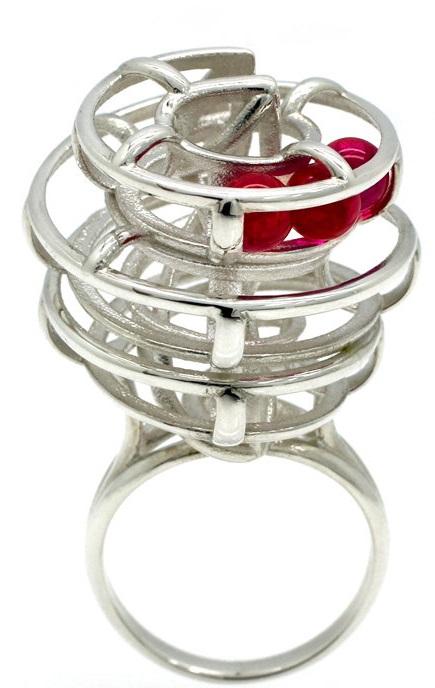 One of the appeals of 3D printed jewelry is that the technology lends itself to designing and creating completely unique, customized pieces. We’ve covered several stories about individuals who turned to 3D printing to create one-of-a-kind engagement rings; often, the desire to find a perfect, unique, personal gift for a loved one is what draws people to the technology. In Desmond Chan’s case, that desire led him to build an entire business.
 In 2013, Chan was struggling to find the perfect Christmas gift for his wife. Being already skilled with 3D modeling and printing, he decided to use the technology to make her gift himself. He came up with a beautiful, delicate silver starfish design that would become a necklace for his wife. Pleased with how successfully the design turned out, he began to work with more 3D printed jewelry, and thus Vulcan Jewelry was born. Chan’s eclectic collection is comprised of rings, necklaces and bracelets inspired by the ocean, animals, plants and more. Earlier this year we wrote about his “Tree in Cross” design, which was inspired by the work of Surrealist artist Salvador Dalí.
“I am…inspired by everything, from Modern Art to something I see on the streets,” Chan tells 3DPrint.com. “In my designing process, I try to find a balance between technology and art.”
His latest design may be his most fascinating one yet. Kinetic Ring With Ruby Spheres is designed as a small silver cage in which three small rubies are enclosed. The cage is designed as a series of concentric spirals; the innermost spiral acts as a “track” on which the rubies slowly roll as the wearer moves.
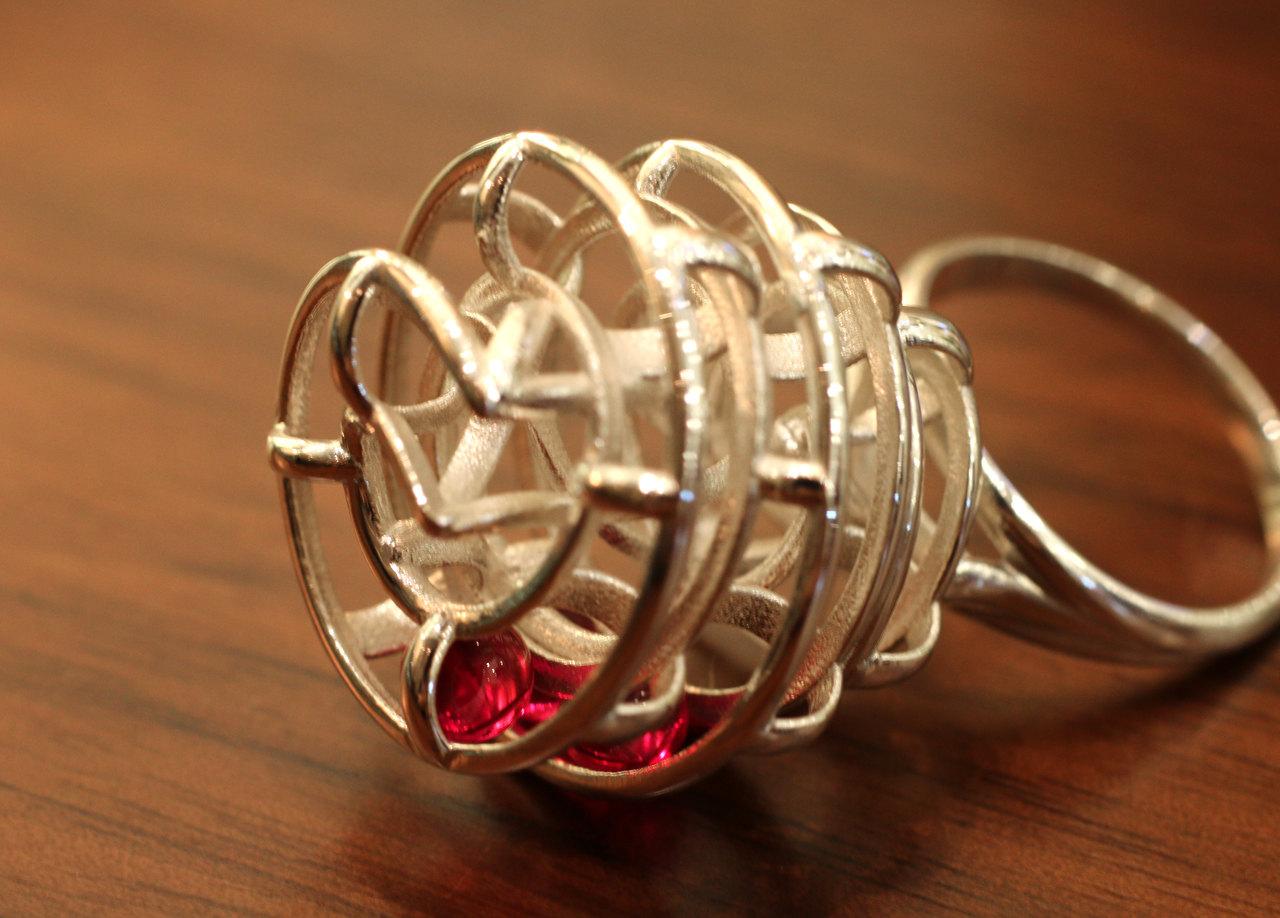
“It explores the delicate balance between freedom and captivity,” Chan explains.
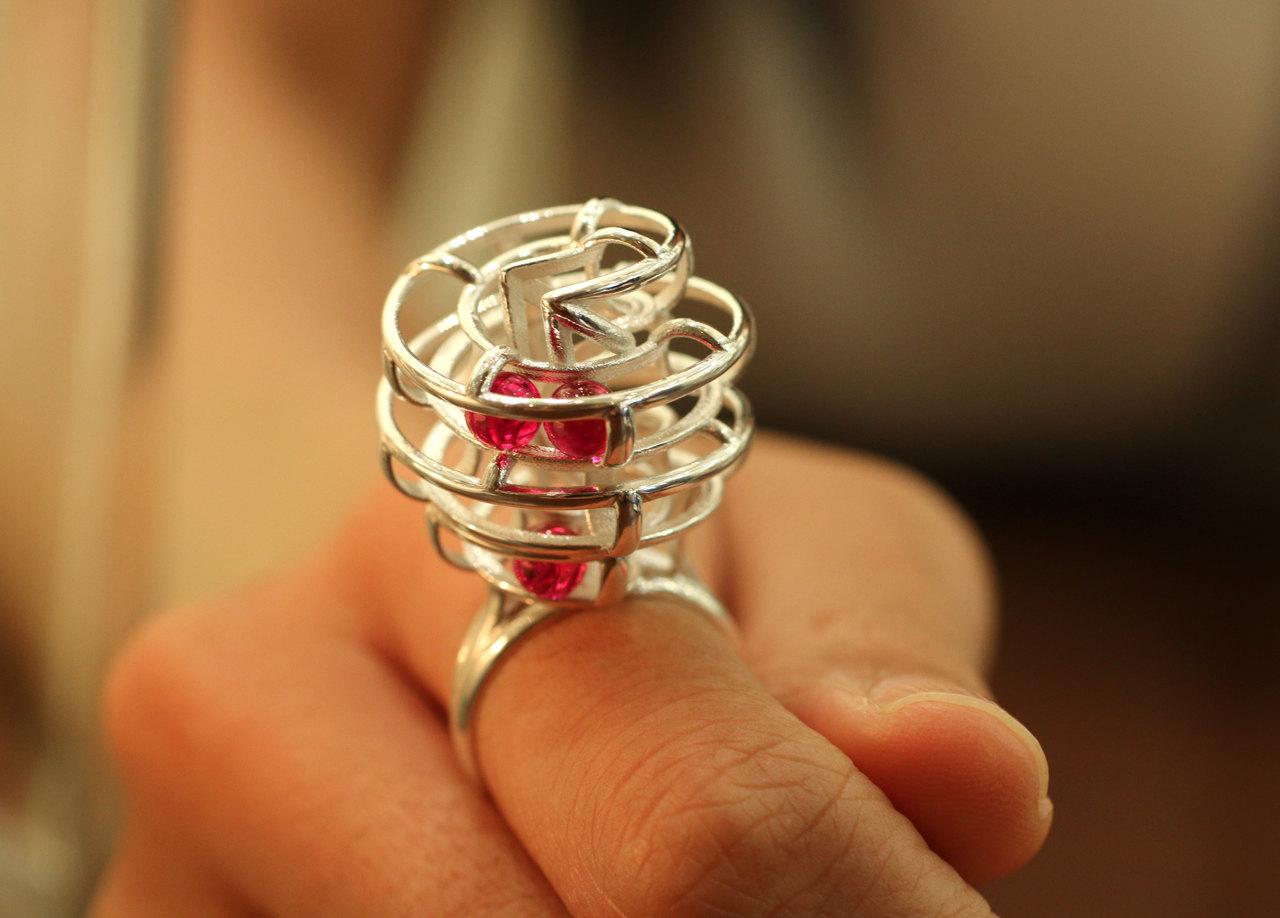 The ring illustrates that balance well. Watching the rubies float down their silver track again and again, one is reminded of colorful fish or birds, beautiful to look at and free in their graceful movement, but ultimately confined to circling around and around in their small, enclosed space.
Printed in sterling silver, the ring retails at $275. Chan also offers the options of 14k white gold, 14k yellow gold or 14k rose gold; contact him directly for pricing. His work is also available on several other sites including Etsy and i.materialise, though the number of items for sale on each site varies. Kinetic Ring With Ruby Spheres is Chan’s first actual kinetic jewelry piece, though much of his other work gives the impression of movement, from his series of pieces depicting rabbits in mid-sprint to his motifs of leaves and spiraling shells.
According to its website, “Vulcan Jewelry is aimed to design energetic, limited and specialized jewelry.” Energy is definitely present in Chan’s work, reflecting his own creative energy. Check out the video below to see Kinetic Ring With Ruby Spheres in motion, but be warned, you may want to watch it several times, because it’s pretty mesmerizing. Discuss this story in the 3D Printed Kinetic Jewelry forum thread on 3DPB.com.
Subscribe to Our Email Newsletter
Stay up-to-date on all the latest news from the 3D printing industry and receive information and offers from third party vendors.
Print Services
Upload your 3D Models and get them printed quickly and efficiently.













You May Also Like
Meltio Helps Grow Rubies Inside 3D Printed Platinum
At the University of the West of England (UWE Bristol), the Centre for Print Research (CFPR) is using metal 3D printing to help grow gemstones directly inside platinum structures. The...
3D Printing News Briefs, September 10, 2026: Tax Credits, Polymer Research, Microneedles, & More
We’re starting off this week’s 3D Printing News Briefs with a little business from Axtra3D and Beehive Industries, before moving on to a scientific collaboration agreement between Roboze and a...
3D Printing News Briefs, September 5, 2026: Electronic Skin, Cartilage, Cookies, & More
We’re starting with standards in this weekend’s 3D Printing News Briefs, as ASTM has re-launched its Advanced Manufacturing Division as the Critical and Emerging Technologies (CET) Division. Then we’ll move...
3D Printing News Briefs, August 29, 2026: Prosthetics, Pelvic Implants, Capillaries, & More
In this weekend’s 3D Printing News Briefs, America Makes announced the winner of its GOTHAAM Project Call. Then it’s all about healthcare 3D printing news, with Stratasys and Limbitless Solutions...