Changing the Face of Medical Schools with Anatomically Accurate 3D Printed Cadavers



A 3D printed hand [a] next to a plastinated hand [b].
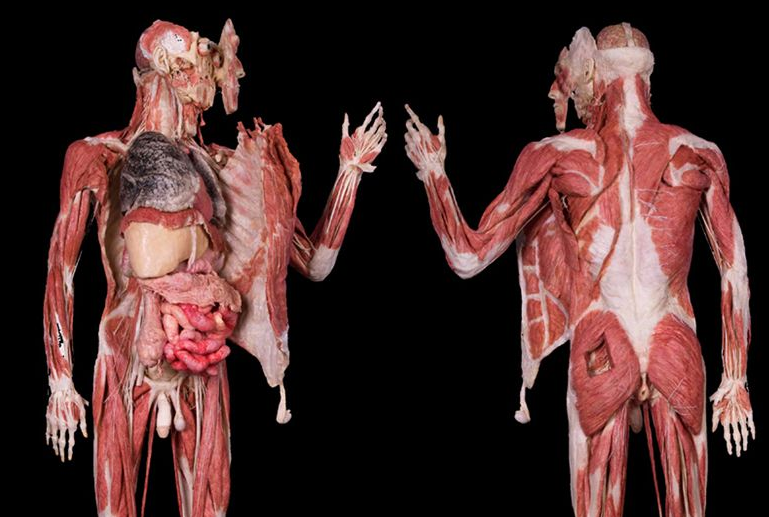
Plastinated human body.
But Australia’s Monash University thinks that they have stumbled onto a solution to all of these problems by creating the first commercially available kit of 3D printed cadaver replicas, in the works now for some time. The kits are all realistic and anatomically accurate, while also allowing for limited color-coding to help medical students better visualize the human body and how it works. The university recently published a paper examining the benefits of using 3D printed cadavers during medical education. The paper called “The Production of Anatomical Teaching Resources Using Three-Dimensional Printing Technology” details many of the advantages, including the durability, reusability, accuracy, ease of production, cost and the lack of need for the specialized storing requirements needed for fixed cadaver specimens or plastinated specimens.
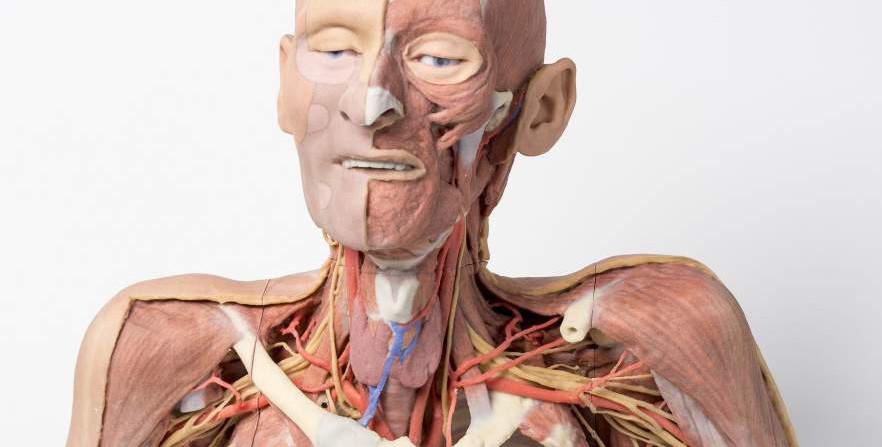
3D printed head, neck, shoulders and chest.
The 3D printed cadavers used by Monash are printed with the schools two full color 3D Systems industrial 3D printers. The university has a ProJet 660 and a ProJet 4500 which produce high-quality color reproductions that match the real human body almost exactly. The ProJet series of printers ability to produce such accurate colors is essential to the process, and the ability to add in color coded parts like veins, arteries and nerves is an essential teaching tool. The director of the Centre for Human Anatomy Education (CHAE) at Monash University Paul McMenamin believes that their 3D printed cadaver kits are a cost-effective alternative to real bodies for many of the required lessons, and could actually produce better outcomes for patients.
Director of the Centre for Human Anatomy Education (CHAE) Paul McMenamin.
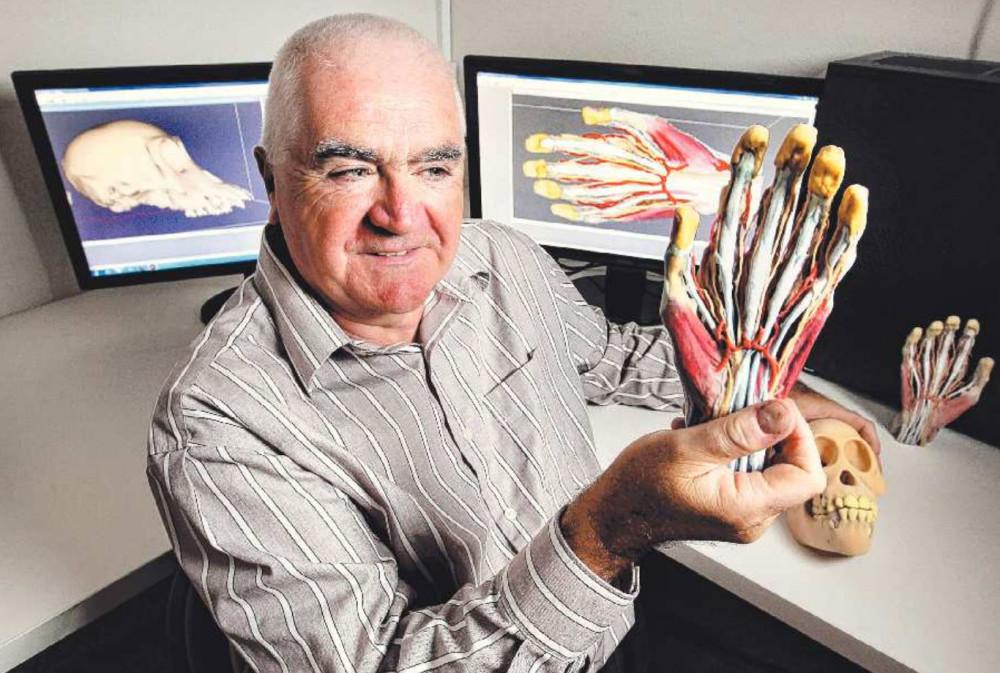
The idea to create the 3D printed cadaver replicas came to McMenamin as an ‘aha’ moment while he was looking for ways to produce a series of anatomy prosections. Initially he intended to plastinate them, a method of anatomical preservation that removes the body parts water and fats and replaces them with preservative plastic materials, however that would have been nearly impossible.
“I was looking for a way to produce more anatomy prosections and maybe plastinate them, but realized it would take decades and more than a half-million dollars to set up a plastination lab,” says McMenamin. “Each specimen would have to be dissected and prepared and then I would have one of that specimen. So we thought ‘why don’t we scan them (CT or laser), make color STL or VRML files, and print them so we can make lots of copies’. Seems obvious now, but it was sort of an ‘ah ha’ moment.”
Faced with the impracticality of his first idea, McMenamin realized that he could scan the specimens using a CT or laser scanner and convert them into full color STL or VRML files. Not only would that be a less expensive option, but it would be faster and give them the ability to create as many copies as they wanted.
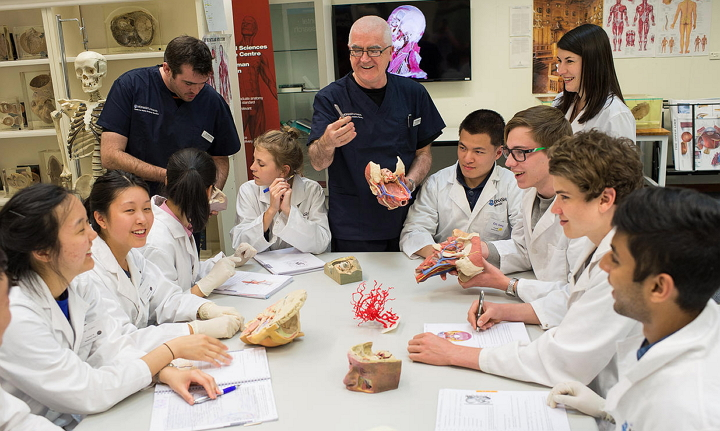
Paul McMenamin with his students.
Using their ProJet 3D printers, Monash University can produce realistic body part reproductions ranging from an entire human body, a head and neck, upper limbs, the pelvis and lower limbs, and the thoracic and abdominal region. They are also able to produce anatomically correct models that would be impossible for students to visualize using embalmed cadavers featuring the delicate vasculature structures of the head, including the fine veins and arteries embedded inside of the skull and brain.
The 3D printed cadavers are printed using the 3D Systems VisiJet C4 Spectrum line of 3D printing materials that are strong enough to produce small, thin or intricate body parts like blood vessels and nerve clusters. Monash University has formed a partnership with German anatomical model makers Erler-Zimmer to make their 3D printed cadaver kits available online for purchase. The kits can be 3D printed to order and delivered in only a matter of weeks, and will cost significantly less than embalmed or plastinated body parts. Discuss this story in the 3D Printed Cadaver forum on 3DPB.com.
Subscribe to Our Email Newsletter
Stay up-to-date on all the latest news from the 3D printing industry and receive information and offers from third party vendors.
Print Services
Upload your 3D Models and get them printed quickly and efficiently.












You May Also Like
3D Printing News Briefs, June 13, 2026: Management Changes, Project Calls, & Wheelchairs
We’ll kick this weekend’s 3D Printing News Briefs off with some advisory board and management changes, and then move on to project call news. We’ll end with some heartwarming stories...
Researchers Combine AI and Bioprinting to Create Tiny Blood Vessel Networks
If 2026 has a theme in bioprinting, it may be blood vessels. Researchers can already print incredibly sophisticated tissues. The harder part is keeping those tissues alive. Without a network...
University of Arkansas Researchers Test Metal 3D Printing in a Mars-Like Atmosphere
If humans eventually establish a long-term presence on Mars, they will face a major manufacturing challenge almost immediately. Tools will break. Parts will wear out. Equipment will need repairs. But...
UT Researchers Use 3D Printing to Develop “Tabletop EUV Lithography” Process
Photolithography, the semiconductor manufacturing process whereby lasers transfer patterns onto chemical layers coating a substrate, is one of the most amazing industrial processes humanity has ever created. It is also...