U.S. Army Researches 3D Printing For Use in Uniforms and Gear

It seems like every week we cover another story related to the United States Army’s current and future applications of 3D printing, both on and off the battlefield. From 3D printed warheads and food, to 3D bioprinting skin  in order to help heal wounded soldiers, the Army has shown major interest in this incredible technology. This month, an entire issue of Army Technology Magazine was devoted to the research that is being done within the field of 3D printing, and the applications of which the Army is already exploring.
A soldier’s uniform is extremely important to their well-being. In addition to providing a means to carry all sorts of equipment and housing armor for protection, it also is the camouflage used to make soldiers on the battlefield less noticeable. Currently, designers rely on 2D CAD software to create the correct schematics for each piece, however, in the near future 3D printing will likely be incorporated into that design process as well.
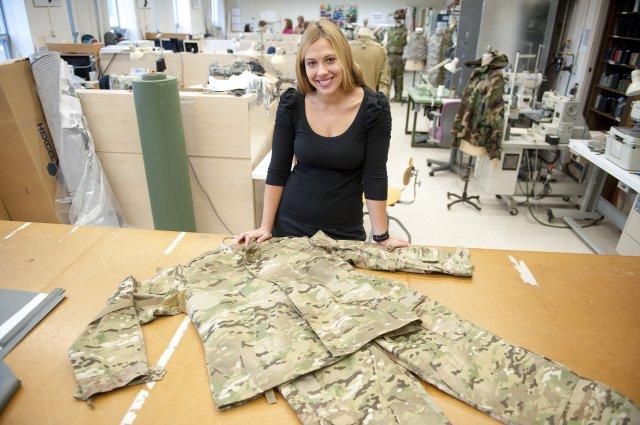
Annette LaFleur, team leader for NSRDEC’s Design, Pattern and Prototype Team
The U.S. Army Natick Soldier Research, Development, and Engineering Center (NSRDEC) is where products such as field clothing, hats, combat clothing, body armor, and helmets are designed. Annette LaFleur is a team leader at the NSRDEC, and oversees numerous projects related to the production of such garments and equipment.
“It could improve flexibility,” LaFleur said of 3D printing. “You could incorporate hard and soft materials together into one design. So, maybe you have some sort of clothing or protective item that has rigid areas that move into soft areas, where our body needs to flex. That could be really exciting because that is hard to accomplish with a regular textile.”
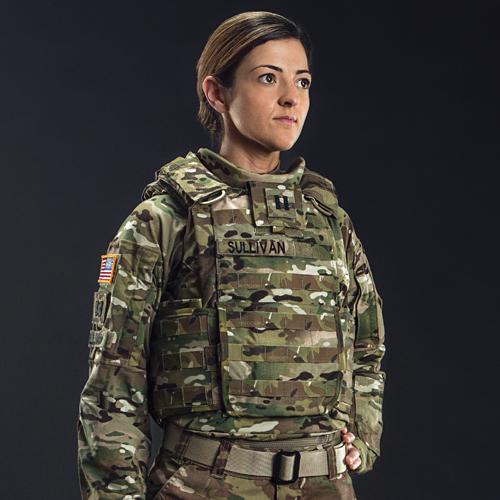 Like LaFleur touched on above, there are several ways in which 3D printing could play a major role in the production and advancement of the clothing and armor worn by soldiers, both on and off the battlefield. For one, there would be less stitching and seams required in garments. Clothing could be catered to the exact size of a particular solider, while design programs could determine how to print each piece with the least number of seams and stitches as possible. Such an accomplishment may seem rather insignificant, but the comfort of a soldier is incredibly important, especially during long, tough missions.
“We could create something that is a totally perfect fit and reduce weight, maybe reduce bulk. A lot of the neat textiles that are being 3-D printed, even out of these synthetics, have a 3D structure to them,” LaFleur said. “That makes you think about spacer-type materials where you have air flow, which is so important if our Soldiers are going to be somewhere hot again, whether it is jungle or desert.”
Other applications could include the printing of ballistic materials for armor, in precise shapes, making it less expensive and more efficient at protecting a soldier. The team at NSRDEC already heavily uses CAD software for their 2D designs, so once the technology is available, where they can incorporate 3D printing into the design process, the framework is already partially in place.
Do you think we will see 3D printed clothing or armor within combat any time soon? What about for civilian use? Let’s hear your thoughts in the 3D printed Army gear forum thread on 3DPB.com.
Subscribe to Our Email Newsletter
Stay up-to-date on all the latest news from the 3D printing industry and receive information and offers from third party vendors.
Print Services
Upload your 3D Models and get them printed quickly and efficiently.













You May Also Like
Solukon Goes Big with New SFM-AT850 Depowdering System
Solukon has released the SFM-AT850 depowdering system. The German depowdering specialist has updated its product line, and this machine replaces the SFM-AT800-S and SFM-AT1000-S. Rather than many small parts, this...
The Hidden Economics of Powder Bed 3D Printing: Closing the Loop in Powder Management
Automation is a very topical thing in additive manufacturing at the moment. With renewed scale, some clients are fervently looking to automate production. Other business cases only make sense with...
Oerlikon Adds ATLIX’s xBUILD 5000, Plans More for 2027
Oerlikon has installed a new ATLIX xBUILD 5000 metal 3D printer at its facility in Huntersville, North Carolina, marking the first production deployment of the system worldwide. The machine will...
The Science Lab You Can 3D Print
Researchers at Sweden’s Umeå University have shown how desktop 3D printers can be used to make lab equipment, giving scientists a cheaper way to build tools for their research. The...