Graphene Flex Foam: Graphene 3D Lab Introduces New Lightweight, Flexible Graphene Material


 Among the materials best poised to live up to their hype as a truly game-changing technology is graphene–and among the leaders in developing graphene as a viable material for use in additive manufacture is Graphene 3D Lab. We’ve been following the company’s progress as they’ve made huge strides recently toward large-scale commercialization of graphene materials, including a recent patent filing for a process to create high-grade graphene rapidly and in quantity, as well as the bold move of acquiring former parent company Graphene Laboratories, and the company shows no signs in slowing down in their R&D.
Today, Graphene 3D Lab has announced Graphene Flex Foam, a new commercial product that will be available through Graphene Laboratories’ e-commerce site, Graphene Supermarket.
“Graphene Flex Foam is an excellent substrate candidate in the manufacture of electrodes of lithium-ion batteries. Wearable electronics is an obvious application as the electronics, sensors and conductive properties will all need to be flexible with the wearable material. We also believe that this innovative product has a bright future for the next generation of flexible batteries and supercapacitors. Graphene Flex Foam offers energy storage as well as catalyst support in numerous organic synthesis reactions, gas sensors, flexible and ultrasonic acoustic device fabrication,” said Graphene 3D Lab co-CEO Daniel Stolyarov.
Described as a Multilayer Freestanding Flexible Graphene Foam, the all-new Graphene Flex Foam brings together a conductive elastomer composite with ultra-light graphene foam. The foam, a highly conductive three-dimensional chemical vapor disposition (CVD), together with the composite, brings together the best of several worlds of graphene usage. As a flexible foam, the material is both lightweight and reconfigurable, adding to ease of use and handling, with a porous structure.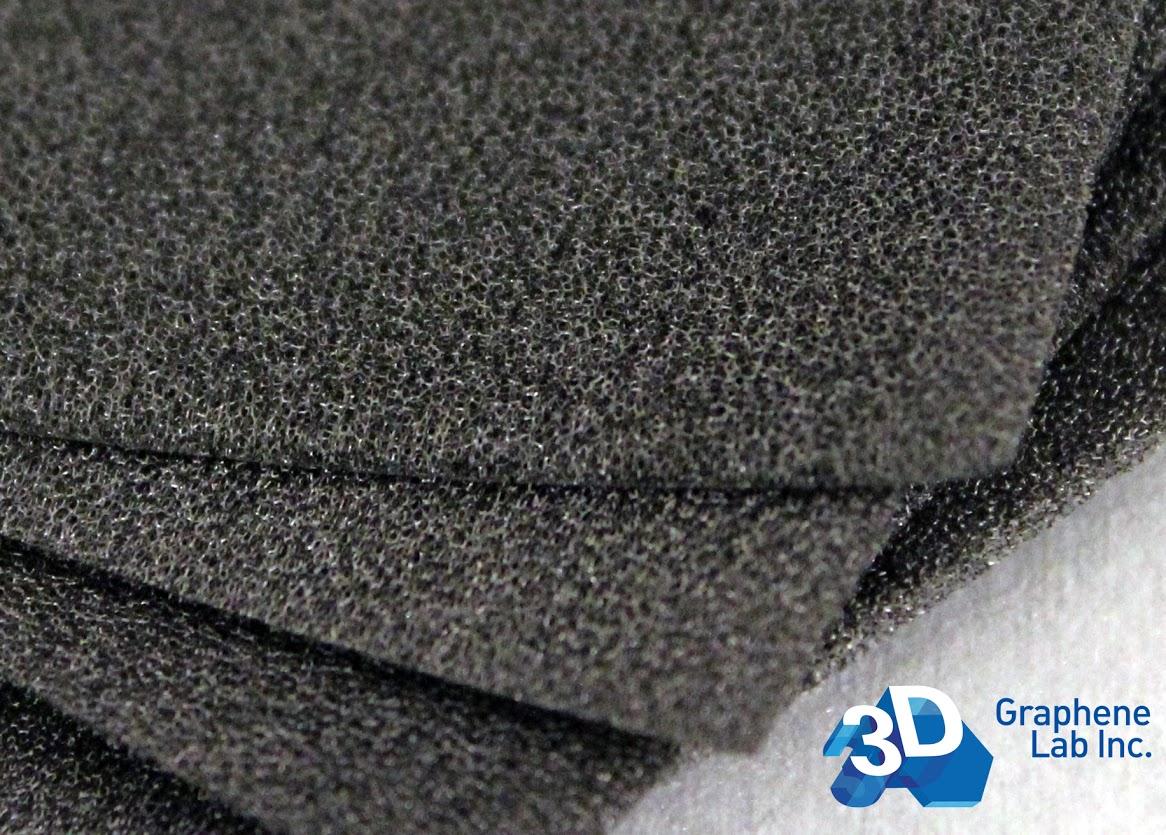
“We have the ability to manufacture Graphene Flex Foam in basically any shape or size,” explained Graphene 3D Lab co-CEO Elena Polyakova, “but it is the flexibility of the product which we believe will capture the attention of innovative manufacturers who will want to evaluate the potential of commercializing this material into their products. Any company interested in a freestanding, stable, ultralight, highly conductive material that can flex with their product and fit into any space, will be interested in this innovation.”
While the Graphene Flex Foam itself won’t exactly extrude through your desktop 3D printer, it could clearly be used in conjunction with other graphene-related materials–such as Graphene 3D Lab’s filament offerings–in the creation of electronics and other conductive products. The company doubled its production capacity for 3D printing filaments based on graphene materials earlier this year, and we’ve seen several significant steps toward the creation of electronics thanks to 3D printing technology (including this year’s winner of the James Dyson Award, the Voltera V-One).
As more materials emerge containing and properly utilizing graphene, the potential for creation of products such as wearable and/or flexible electronics, batteries, sensors, and more only continues to expand.
Subscribe to Our Email Newsletter
Stay up-to-date on all the latest news from the 3D printing industry and receive information and offers from third party vendors.
Print Services
Upload your 3D Models and get them printed quickly and efficiently.













You May Also Like
3D Printing News Briefs, June 18, 2026: Reseller, Relocation, Metal Space Powder, & More
We’ll start with business news in today’s 3D Printing News Briefs, as XJet appointed a value-added reseller in Germany, BIO INX is expanding its presence in the Italian market, and...
Scientists Use BMF to 3D Print Seal Whiskers That Track Prey Long After It’s Gone
Seals use their whiskers to hunt. Not Navy Seals, although they may in some way also, but this article is about lowercase seals. Not Seal the musician either; as far...
Researchers Combine AI and Bioprinting to Create Tiny Blood Vessel Networks
If 2026 has a theme in bioprinting, it may be blood vessels. Researchers can already print incredibly sophisticated tissues. The harder part is keeping those tissues alive. Without a network...
University of Arkansas Researchers Test Metal 3D Printing in a Mars-Like Atmosphere
If humans eventually establish a long-term presence on Mars, they will face a major manufacturing challenge almost immediately. Tools will break. Parts will wear out. Equipment will need repairs. But...