Scan Pyramids: International Research Team Attempts to See Inside the Pyramids with 3D Scanning and Other Technologies


One of Superman’s superpowers is his X-Ray vision, inspiring countless children with superhero aspirations to declare that they, too, can see through walls. Little did the children of my generation know, however, that once they reached adulthood, seeing through walls would become a reality. 3D scanning technology still blows my mind. It’s amazing that we have the ability to see what’s inside solid objects without ever cracking them open. Solid objects like, for example, the pyramids.
The Egyptian Ministry of Antiquities launched the Scan Pyramids Mission, coordinated by the Faculty of Engineering at Cairo University and the French HIP (Heritage, Innovation and Preservation) Institute, at the beginning of November. Researchers from Cairo University, Quebec’s Université Laval and Japan’s Nagoya University are using sophisticated technologies, including 3D scanning, to see inside the pyramids and potentially solve some millennia-old mysteries.
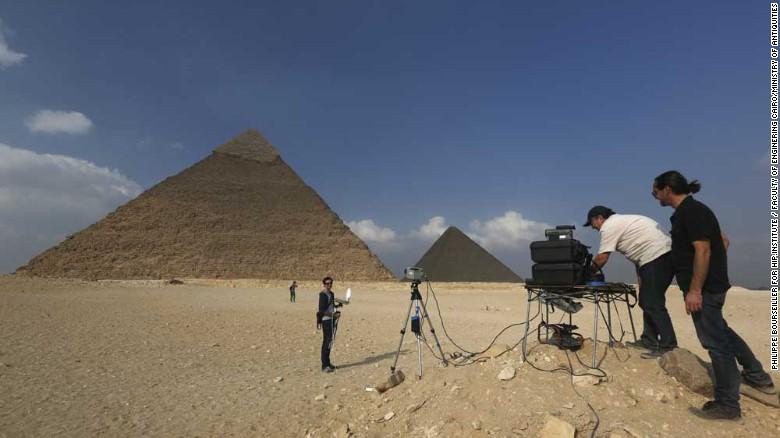
The study will focus on four pyramids in particular: the South, or Bent, and North, or Red, pyramids in Dashur, and the Khufu and Khafra pyramids on the Giza plateau. It won’t be a quick or simple endeavor; the study is expected to last until the end of 2016 and will utilize several scanning techniques. An initial scan, facilitated by Jean-Claude Barré of LedLiquid, will utilize infrared thermography to create a thermal map of the pyramids and reveal varying densities in their interior structures. A second and more in-depth scan, expected to take about a year to complete, will be carried out by Université Laval, to discern any voids or hollow spaces behind the pyramid walls.
 Nagoya University and Japanese research organization KEK will use muons detection to further distinguish between solid and hollow spaces within the pyramids. Speaking of mind-blowing – muons are particles that were formed from collisions between cosmic rays and the nuclei of atmospheric atoms. Likened to heavy electrons, the particles are constantly falling from the atmosphere at the speed of light, passing through solid objects like the pyramids. Detectors placed at strategic locations measure the accumulated muons inside the pyramids, allowing the researchers to observe where the particles were absorbed or deflected, indicating a solid area, vs. hollow areas where the particles fell without interruption.
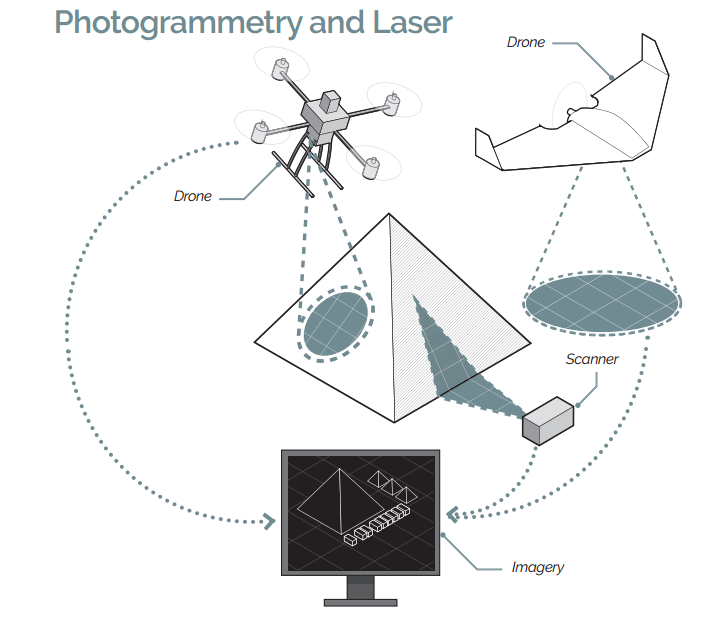
French company Iconem will use drones to take photogrammetry scans of the entire Giza and Dashur plateaus, along with all of their pyramids and monuments, and create meticulously detailed 3D models of the topography, down to the last centimeter. Using two different types of drones, the areas will be scanned at both large and small scales.
“First, drones with wings like airplanes,” said Yves Ubelmaan, Iconem founder and CEO. “Their autonomy will allow us to obtain the data of large areas and reconstruct the pyramids’ environments with details up to 5 centimeters. This will allow us to position all the monuments very precisely and to identify levels, slopes and possibly traces of ancient ramps of construction paths. The details of this micro-topography will also give us clues about the position or shape of unexcavated buildings that are visible only thanks to the shape of the ground.”
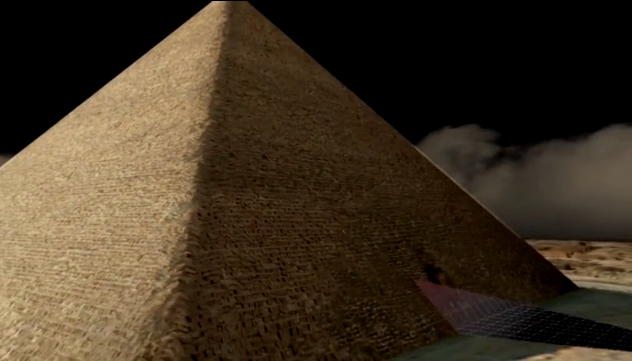
The second, less autonomous type of drone will take close-up images of the pyramid walls, gathering information on texture, alignment and even possible traces of tools or other signs of construction. Finally, laser scanners will be used to scan the insides of the pyramids. The 3D models produced from the results of the scans will be made available to the public by the HIP Institute.
In the two weeks since the project began, several “thermal anomalies” have already been discovered within the pyramids, indicating the possible presence of chambers or other hollow areas. Further study will determine more detail, but the research team will turn the analysis over to the Egyptologists.
“Many theories have been proposed, either explaining (the pyramids’) construction or their structural anomalies, but we are physicists and engineers, not archaeologists,” said Hany Helal, Engineering Professor at Cairo University and a coordinator of the project. “Our goal is to use techniques to get concrete results. Then the Egyptologists will interpret them.”
You can read more about Scan Pyramids and the techniques involved here. Discuss this story in the Pyramid 3D Scanning forum thread on 3DPB.com.
Subscribe to Our Email Newsletter
Stay up-to-date on all the latest news from the 3D printing industry and receive information and offers from third party vendors.
Print Services
Upload your 3D Models and get them printed quickly and efficiently.













You May Also Like
DREAMing in Dayton: DREAM Symposium Covers AM, AI, Supply Chain, & More
This month, I attended a manufacturing industry event, like I often do. But instead of getting on a plane to New York City, or driving four hours to Youngstown, I...
ORNL Origami Creates Large Foldable Structures
Oak Ridge National Laboratory (ORNL) is using a hybrid 3D printing method to make foldable panels. At the Department of Energy’s (DOE) Manufacturing Demonstration Facility (MDF) at ORNL, researchers turned...
Phase3D’s In-Situ Monitoring Lands $2.9M in Oversubscribed Round
The use of metal additive manufacturing (AM) for production at scale appears to be steadily increasing, as evidenced by recent announcements like EOS’s sale of 30 M4 ONYX systems to...
Excellent Desktop Injection Molding, Made in Italy by Robot Factory
I was captivated when I saw my first Robot Factory 3D printer. The robust, precise machine was built to last. And this was in an era of very flimsy, disposable,...