South Korea 3D Prints a Titanium Space Tank and Freezes It to Prove It Works


Building hardware for space is not easy. It needs to be light, strong, and capable of surviving extreme environments, like the bitter cold and vacuum of space. Now, a South Korean research team has 3D printed a large titanium tank, then put it through an extreme test. First, they froze it to -320.8°F or -196 °C (that’s more than twice as cold as the coldest temperature ever recorded in Antarctica). Then, they pressurized it to over 300 times normal atmospheric pressure. And it held up really well.
This marks what is likely the world’s first successful cryogenic pressure test of a 3D printed titanium tank, and it’s a major step that could impact how future spacecraft are built.
A First for AM in Space Hardware
The tank was made using laser-wire Directed Energy Deposition (DED) and Ti-6Al-4V, a strong and lightweight titanium alloy that is often used in aerospace and medical applications. The researchers printed two titanium hemispheres separately, treated and machined them for precision, then welded them together to create a single spherical pressure vessel.
Creating a part like this the traditional way would require expensive forging equipment and a lot of machining. Instead, DED 3D printing reduces time and material waste. That makes it not only faster and cheaper, but also easier to customize for specific missions.
Still, despite growing interest in AM, the use of 3D printed metal parts in space systems has raised concerns about their reliability, particularly under extreme conditions such as high pressure and cryogenic temperatures. That is why this successful test is so important. It helps show that 3D printing can produce components that meet, and even exceed, the tough standards of space applications.
Behind this breakthrough is a team of South Korean researchers working across industry, academia, and government. The project was a collaboration between the Korea Institute of Industrial Technology (KITECH), which led the additive manufacturing (AM) process, and the Korea Aerospace Research Institute (KARI), which handled the cryogenic testing, along with KP Aero Industries, AM Solutions, and Hanyang University.

Fabricated and tested a Ti-6Al-4V tank with researchers involved in the development project. Image courtesy of KITECH.
Putting the Tank to the Test
Once assembled, the tank underwent several rounds of quality checks. Real-time monitoring during the build helped ensure the geometry and structure were solid. Non-destructive evaluation (NDE) confirmed that there were no defects hiding beneath the surface.
Then came the real challenge: cryogenic testing. Under KARI’s supervision, the tank was cooled with liquid nitrogen to –196°C and pressurized to 330 bar, far above its normal operating limit of 220 bar. That’s a standard safety margin in aerospace, and the tank passed without issue.
Sensors recorded strain and temperature data during the test, and everything confirmed the team’s structural simulations. So basically, the tank performed exactly as expected.
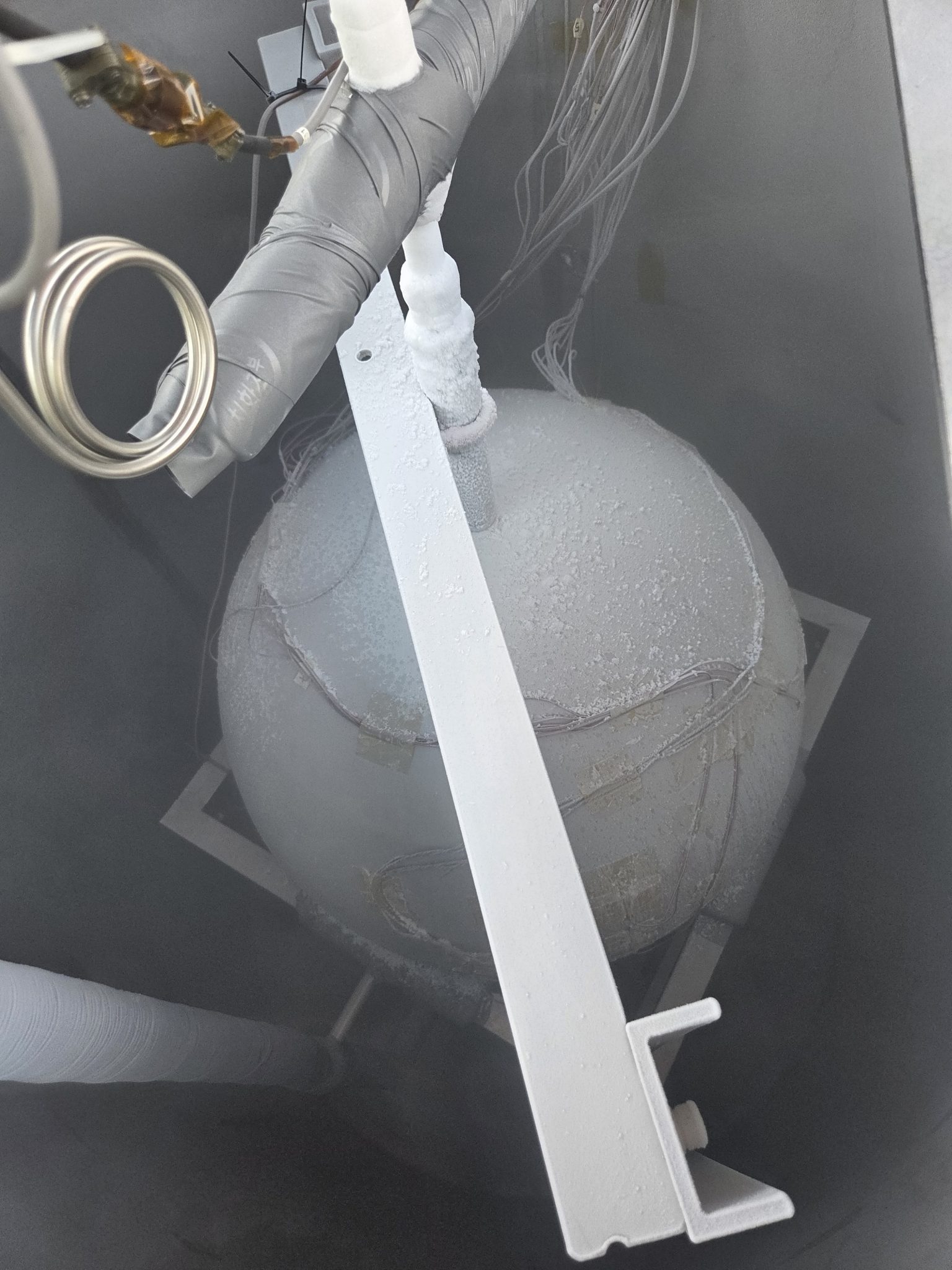
Cryogenic pressure testing of the high-pressure vessel in progress. Image courtesy of KITECH.
A Step Toward Commercial Space Use
Dr. Hyub Lee, the principal researcher at KITECH who oversaw the development, said, “This achievement proves that additive manufacturing technology is capable of meeting the extreme performance requirements demanded by space missions, opening new possibilities for aerospace component manufacturing.”
The team now plans to continue with more testing and work with commercial space companies to bring the technology to market. If successful, this method could be used to produce pressure tanks for satellites, launch vehicles, or even crewed spacecraft.
As space missions become more frequent, there will be a growing demand for faster, more cost-effective ways to build mission-critical hardware. In fact, the successful test of a 3D printed titanium tank under cryogenic and high-pressure conditions points to AM’s capability to produce the components needed by the space industry.
Subscribe to Our Email Newsletter
Stay up-to-date on all the latest news from the 3D printing industry and receive information and offers from third party vendors.
Print Services
Upload your 3D Models and get them printed quickly and efficiently.













You May Also Like
3DPOD 302: Digital Inventory for AM with Mikhail Gladkikh, Würth Additive Group
Mikhail Gladkikh has worked in oil and gas for many years. With this background, we obviously talk about energy market turbulence and the adoption of AM in oil and gas....
Spectrum Filaments Gets Investment: How They Could Win in Filament
Spectrum Filaments is a long-time high-quality filament supplier based in Poland. With good tolerances, roundness, and consistency coupled with affordable pricing, the firm has been a mainstay for makers, industrial...
NX Atomics and Sciaky Collaborating to 3D Print Nuclear Components
For decades, the nuclear industry has quietly experimented with and implemented additive. Bouyed by the likes of ORNL, companies such as Westinghouse have 3D printed components serially. We have an...
Incodema3D Buys 14 Metal EOS Systems, Now One of the World’s Largest Metal 3D Printer Operators
Recently, a majority stake of 3D printing service bureau Incodema3D was purchased by AFM Capital. Under new ownership, the Freeville, New York company is now using its cash-rich parent for...