3D Print in Coffee? Italian Designer Prints Using an Impressive Coffee/Clay Composite Material


Francesco Pacelli
With the influx of new 3D printers hitting the market at ever increasing rates, it won’t be long before more and more companies begin to focus not on the hardware itself, but rather on material engineering and development. Currently we are still limited by technology, preventing us form 3D printing in materials that we would prefer. For example, current consumer level 3D printers allow us several plastic options, and a very few nylon-like choices, but most 3D printers today pretty much stop there.
It’s only a matter of time before we will be able to create objects to our liking in metals, rubbers, ceramics, and woods, but that time has not come quite yet.
An Italian designer and engineer, named Francesco Pacelli, hopes to help with the advancement of 3D printable materials. After graduating from The Polytechnic University of Milan, a school that specializes in product design and material engineering, he set out with one of his professors (Marinella Levi) to open a lab within the university. In this lab, researchers can conduct academic research on 3D printing, by combining their design and engineering backgrounds.
Pacelli has had an interest in 3D printing, thus the idea of working on generating materials for the process was one in which he caught onto quite well.
“I think it’s a very interesting material to work on (3D printable materials), since low-cost 3D printers could become a very useful tool for craftman to realize complex shapes without molds,” Pacelli told 3DPrint.com. “During [these past] weeks I [discovered] a project for a contest called ‘Ceramic Futures’ in collaboration with 3 other European design schools, Confindustria Ceramica (an important Italian ceramics association) and Cersaie, a fair that will be held in Bologna on September 2014 where all the projects will be shown.”

Pacelli’s Coffee/Clay Composite
Pacelli decided to enter into the contest, creating a project for “Ceramic Futures”, which he calls, “To Eat”. The idea behind his work is to create 3D printed bricks and modules composed of complex structures, using clay based material, combined with recycled food wastes. “I [conducted] some experiments on the material itself, combining clay powder with food wastes such as coffee powder, dried fruit peels, dried vegetables, and paper food packaging, obtaining different composition and properties for each material,” Pacelli told us. “At the moment I am able to 3D print just the coffee powder/clay based material because coffee grains, in powder form, can pass through a syringe’s nozzle without blocking [it].”
His idea behind the project is to recycle food waste, and limit the post processing on the waste itself. This is a bit of a problem since any wastes that aren’t ground into a powder won’t fit through the syringe. In order to get the waste into printable form, it requires the post-processing (grinding) of the material. Pacelli went forward though, with the ground coffee bean / clay composite material.
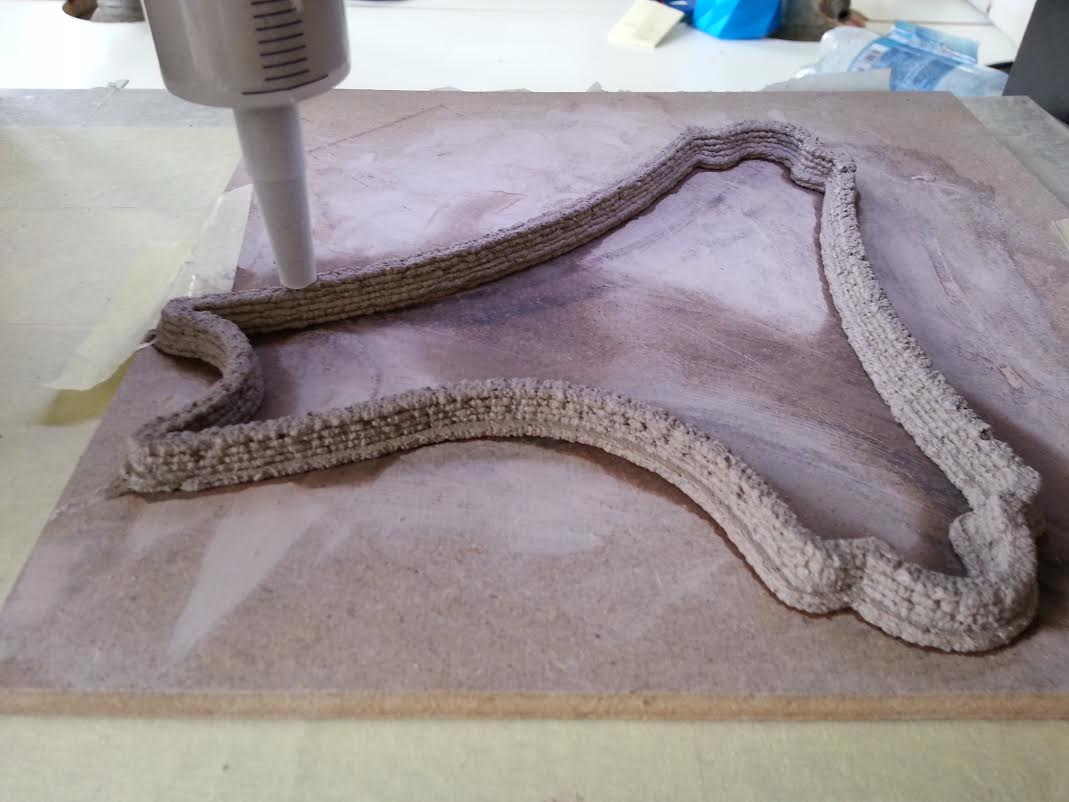
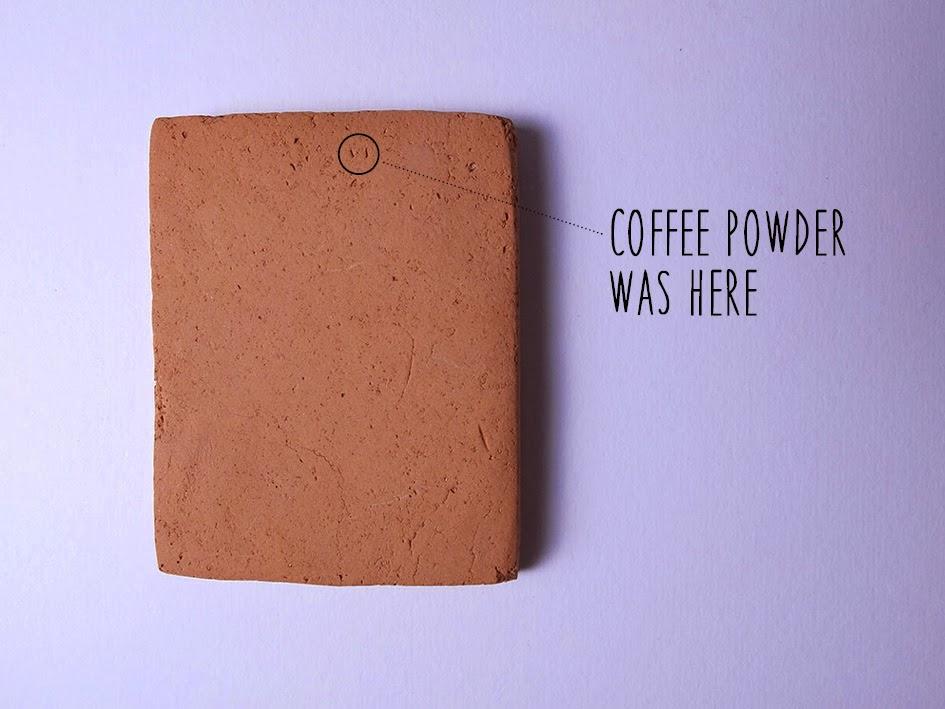
Pacelli’s coffee/clay composite
Surprisingly, by mixing the ground coffee beans with the clay, he got a material that could be printed with much more ease than just the clay by itself. “I obtained a more precise deposition with coffee/clay material than with simple clay, since coffee makes the material less gluey and sequential layers are less influenced by the nozzle’s passage,” Pacelli told us. “I think this is related to the atomic packing of coffee powder grains when passing through the 4mm nozzle, but I can’t say it for sure, I need to investigate on that a bit more.”
Pacelli has experimented and has been successful in printing using both a mixture including red clay, as well as white clay. Here is the printer in action, printing using Pacelli’s coffee/clay material.
Pacelli plans to continue working on his material engineering, to see what else he can come up with. It’s projects like these that will ultimately lead to 3D printing being adopted at greater rates. People want to have the ability to print objects out of materials that make them the most usable, so the more new 3D printable materials that come about, the better.
 Discuss Pacelli’s coffee/clay composite material in the Coffee/Clay 3D Printing forum thread on 3DPB.com.

Subscribe to Our Email Newsletter
Stay up-to-date on all the latest news from the 3D printing industry and receive information and offers from third party vendors.
Print Services
Upload your 3D Models and get them printed quickly and efficiently.











You May Also Like
Stratasys Partners With Defense Prime Heavyweights to Qualify SAF PA12 for Industrial 3D Printing
Perhaps the most valuable lesson that the additive manufacturing (AM) industry has learned in its technical maturation era over the last five years or so is that you can’t really...
Via EOS Partnership, Texas’s ACMI Is the First Customer for the AMCM M 8K 3D Printer
EOS’s two major announcements in the last few months have been the launch of the EOS M4 ONYX at Formnext 2025 and the news from a couple of weeks ago...
Reuniting ExOne and voxeljet: An Investor’s View on Building a Global Industrial Sand Printing Leader
Authored by Whitney Haring-Smith, Chair of the Board, ExOne Global Holdings & Managing Partner, Anzu Partners At Anzu Partners, we invest with conviction in industrial technologies that create categories—and then...
VulcanForms Raises $220M as Investors Back Scaled U.S. Metal 3D Printing
VulcanForms has closed a $220 million Series D funding round, a large vote of confidence at a time when investment in 3D printing has become more selective. Investors are backing...