LUXeXceL Releases Report Establishing Benchmarks for 3D Printing Transparent Materials

 We’ve had our eye on LUXeXceL for some time now here at 3DPrint.com, covering their innovative use of transparent 3d printing. The Dutch company, founded in 2009, focuses on the 3d printing of products that demand extremely high standards of transparency. They have made news in the 3D printing world previously through their introduction of Printoptical Technology, an additive manufacturing process used in the creation of components such as freeform lenses, arrays, prisms, and other complex and decoratively designed optical surfaces.
Recently, they have released to a limited audience the results of their efforts to quantify the differences among 3D printing materials in terms of the material’s optical properties and overall quality. The research project involved the manipulation of a variety of variables in order to create a precise score for each of the materials tested. The idea behind the research is that it is one thing to qualitatively understand that a series of products are transparent, but the R&D team wanted to be able to qualify and therefore rank different materials and processes.
“Transparent 3D printing is quite difficult, especially to print without the need for elaborate post-processing. Nowadays, a variety of materials and different 3D print technologies are available on the market. However, between these printing technologies there are a lot of difference in the definition of transparency. Most of the 3D printing technologies are not developed for optical applications where light transmission is highly important.”
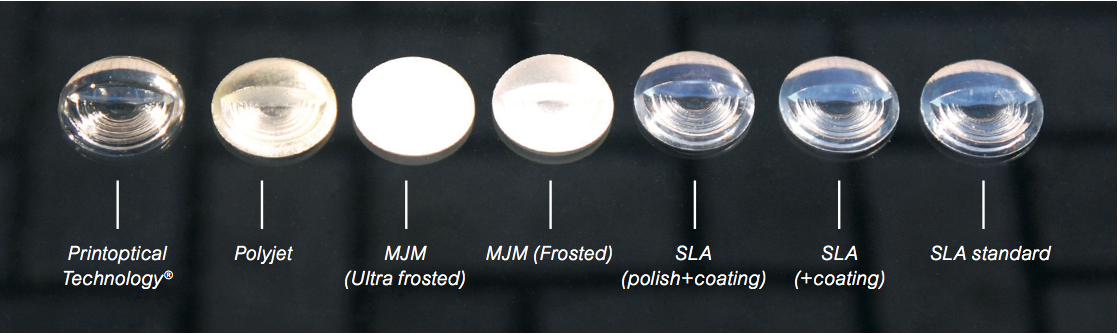 It was important then to create a series of benchmarks by which a common language of transparency could be developed across products and with a variety of stakeholders. This kind of language calibration is an important part of any developing technology as precise concepts require equally precise definitions in order to be generalized.
In the research performed for the report, they compared the most commonly utilized 3D printing technologies: Printoptical Technology, SLA, Multi Jet Modeling, and Polyjet printing. They created samples of 30mm x 30mm x 2mm using each printing method. A baseline was established by measuring the optical properties of each of the samples for the four primary methods of transparent 3D printing in terms of light transmission and diffusion as well for yellowness. One 0f the primary impediments in the use of 3d printing to create transparent materials is the inevitable scattering that occurs as a result of the method of layering that is utilized.
 When examining the various samples, the total light transmission was evaluated with the higher percentage of light being transmitted being equal to a higher optical quality of the printed product. According to their results, Printoptical Technology performs with a 90.9% light transmission in comparison with slightly over 60% transmission with Multi Jet Modeling technology, 83.6% with SLA printing, 87.3% with Polyjet printing, and so on (all results shown below). The measurements indicate the opposite when taken for the light diffusion test, with the lower percentage values indicating the highest optical quality. Once again, Printoptical Technology came in first place with the lowest numbers.
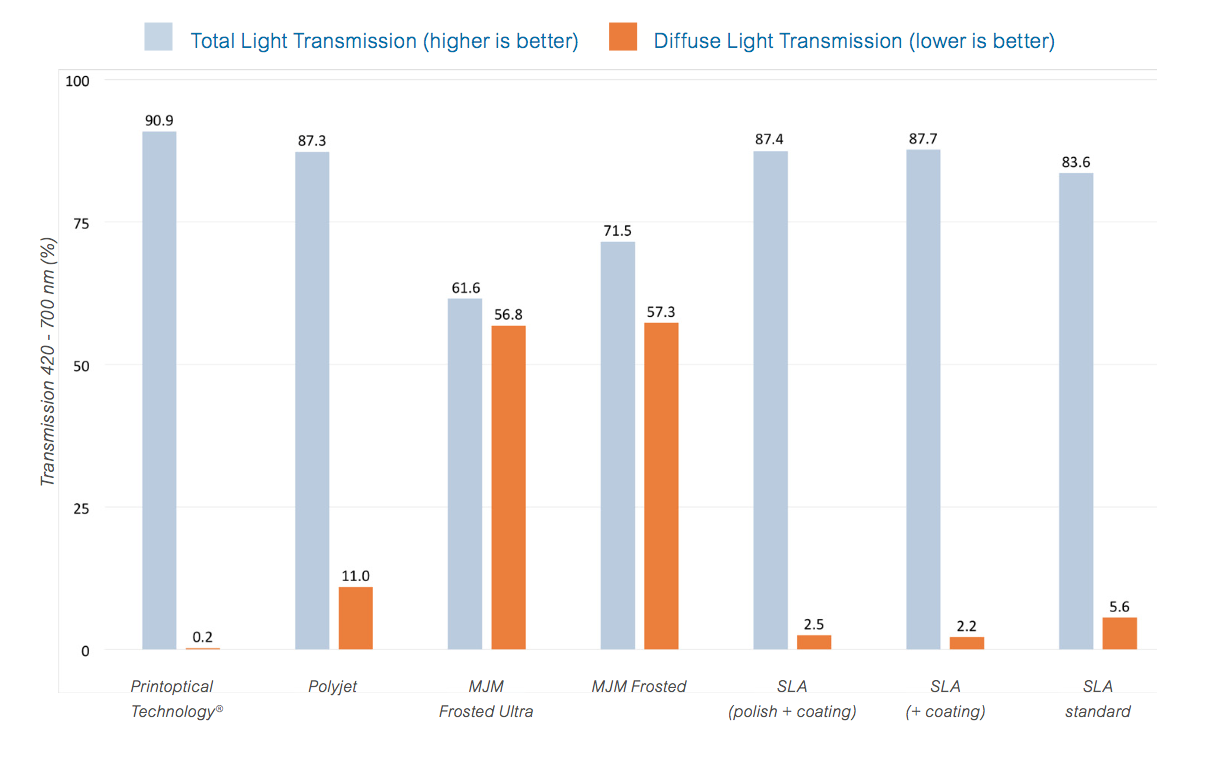 Finally, and hardly surprisingly, the yellowness index value assigned to Printoptical Technology indicated the least deviation from the transmission of clear, colorless light.
“To summarize, when it comes to 3D printing there is a broad definition. However, when you measure sample plates of each technology, you start to notice differences between the technologies. If you would like to obtain smooth, transparent products with optical function, Printoptical Technology suits your demands best.”
It should come as no surprise that the company’s evaluation of their own products lead to the conclusion that theirs are the best available. However, what this report really does is issue a challenge to any who wish to compete in the market for transparent 3D printing, and either there will be a bevy of similar research reports to appear and help to calibrate the standards of clarity or LUXeXceL will carry the day.
That much is definitely clear.
Let’s hear your thoughts on this new report. Discuss in the LUXeXcel Forum thread on 3DPB.com. The full report can be found here.
Subscribe to Our Email Newsletter
Stay up-to-date on all the latest news from the 3D printing industry and receive information and offers from third party vendors.
Print Services
Upload your 3D Models and get them printed quickly and efficiently.











You May Also Like
Stratasys Partners With Defense Prime Heavyweights to Qualify SAF PA12 for Industrial 3D Printing
Perhaps the most valuable lesson that the additive manufacturing (AM) industry has learned in its technical maturation era over the last five years or so is that you can’t really...
Via EOS Partnership, Texas’s ACMI Is the First Customer for the AMCM M 8K 3D Printer
EOS’s two major announcements in the last few months have been the launch of the EOS M4 ONYX at Formnext 2025 and the news from a couple of weeks ago...
Reuniting ExOne and voxeljet: An Investor’s View on Building a Global Industrial Sand Printing Leader
Authored by Whitney Haring-Smith, Chair of the Board, ExOne Global Holdings & Managing Partner, Anzu Partners At Anzu Partners, we invest with conviction in industrial technologies that create categories—and then...
VulcanForms Raises $220M as Investors Back Scaled U.S. Metal 3D Printing
VulcanForms has closed a $220 million Series D funding round, a large vote of confidence at a time when investment in 3D printing has become more selective. Investors are backing...