Utah 4-Year-Old Ready for Kindergarten with His New 3D Printed Prosthetic Ear

I admit I throw out about two-thirds of the mail that shows up in my physical mailbox, and I’m sure I’m not alone in that. Pre-approvals for credit cards I don’t want, promotions for stores where I don’t shop, updates fro m the dealership where I bought my car six years ago…it adds up, and it gets tossed out. But sometimes flyers that show up in the mail just might be the thing to change an entire life.
For the Medina family, of Clearfield, Utah, a flyer in the mail happened to lead them directly to the specialist who would help four-year-old Tai fit in as he gets ready for kindergarten.
Tai was born with the rare condition of Microtia and Atresia (“little ear”), and without an ear canal; he’s deaf on his right side, where his “little,” or microtic, ear is.
“All ten fingers, all ten toes, just no ear,” said Tai’s mother, Tarra Medina.
Tai’s parents, Tarra and Ismael, had already gotten him a bone-conduction hearing aid, when they had noticed that Tai was falling a bit behind his peers as he became more verbal. The device certainly helps Tai in his daily life, and improved his speech, but it wasn’t quite an all-encompassing solution.
With school coming up, Tarra and Ismael worried that Tai might face problems fitting in, and potentially even be bullied due to cosmetic differences from his peers. Tarra noted that she does “see people stare sometimes, and that’s kind of hard to deal with,” and worried that that might become even more difficult as Tai moved into school age. Tai, too, wanted “a big ear.”
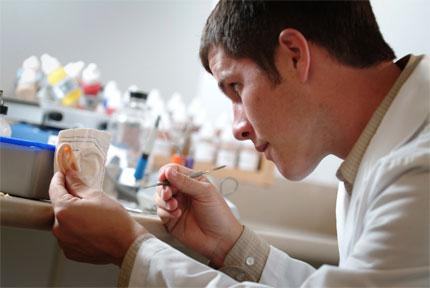
Paul Tanner at work on a prosthetic ear
One day in the mail, the Medinas received a flyer that led them to Paul Tanner, who works at the University of Utah’s Huntsman Cancer Institute in Salt Lake City. Tanner is an anaplastologist who works in the Institute’s Prosthetics Department.
“His presentation showed that he could fasten the prosthetic over the top of his microtic ear, which was huge for us,” said Tarra Medina.
Prior to their meeting with Tanner, the Medinas had been told by every specialist they had seen that for a “big ear” to work out for Tai, they would need to surgically remove his microtic ear — a procedure that seemed both unnecessary and risky. Tanner’s assurance that his prosthetic could be slipped on over Tai’s little ear ensured that this would be the best way to go for the Medina family.
Tanner worked with a CT scan of Tai’s full-sized left ear to create the fully customized, fit-to-stay prosthetic for Tai. By using his left ear as a model, Tanner was able to be certain the new prosthetic would fit Tai’s head and truly look like it fit there.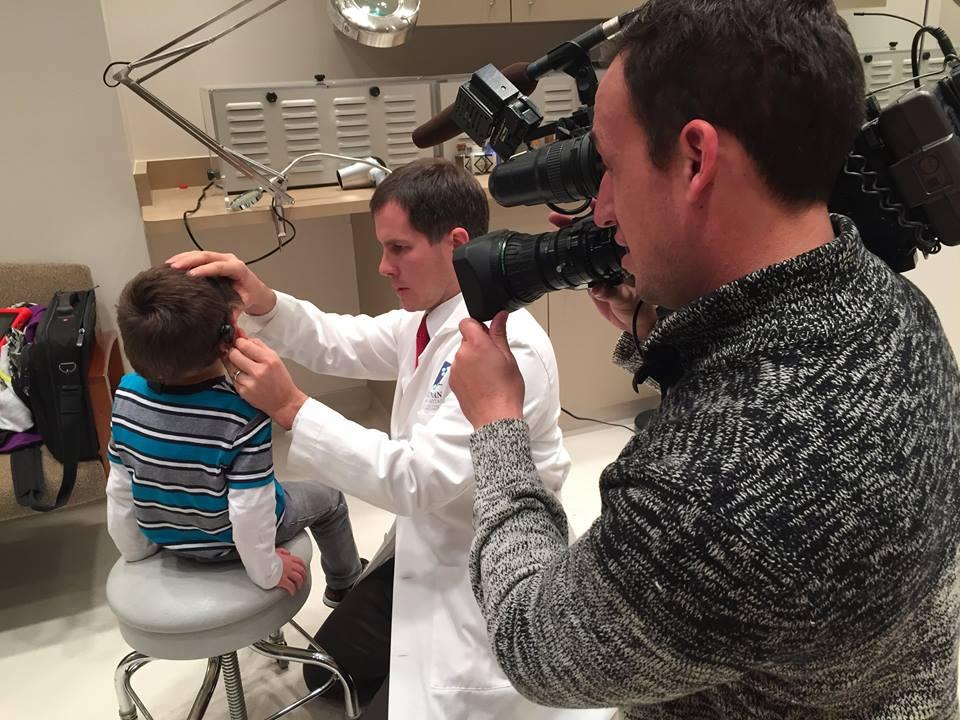
“Instead of sculpting the ear, I’m able to get a much more accurate model of the ear by doing a CT scan and then flipping it,” Tanner explained.
Once Tanner had the model from the flipped scan, he sent it off to the 3D printing service available at the University of Utah’s J. Willard Marriott Library. Tanner took the 3D printed piece from Marriott Library, created a silicone mold, and painted it to match Tai’s skin color — and it looks like he hit every mark in quality.
“It’s 3D printed, it’s a perfect replica of the other ear,” Ismael Medina said when he saw the ear fitted onto Tai.
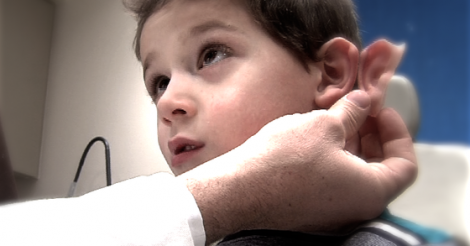 Tanner, who also founded Feeling Whole Again to create custom prosthetic nipples for breast cancer survivors, takes special pride in fitting his prosthetics directly to his patients and making sure they look and feel right, which includes painting it to match the skin color. His work with Tai, who is his youngest patient at Huntsman, shows the absolute quality he provides for his patients.
Tai will need a new ear created about every two years as he grows up, and fortunately with 3D printing technology, that will not be as difficult a task as it sounds. It should also continue to become more cost effective; for this first ear, the Medinas’ insurance covered most of the costs, but their share was still about $1400.
And Tai’s reaction after being fitted for the first time with his new ear? He couldn’t take his eyes (or hands) off his new “big ear” long enough to say, but his mother noted: “I do see a big old smile on his face right now, so I think he’s pretty excited and I think it will be good for him.”
Let us know what you think about this use for 3D printing technology in the ‘Four-Year-Old Gets 3D Printed Ear‘ forum thread over at 3DPB.com. Check out the video coverage below thanks to KUTV.
[Source: KUTV]
Subscribe to Our Email Newsletter
Stay up-to-date on all the latest news from the 3D printing industry and receive information and offers from third party vendors.
Print Services
Upload your 3D Models and get them printed quickly and efficiently.











You May Also Like
Reuniting ExOne and voxeljet: An Investor’s View on Building a Global Industrial Sand Printing Leader
Authored by Whitney Haring-Smith, Chair of the Board, ExOne Global Holdings & Managing Partner, Anzu Partners At Anzu Partners, we invest with conviction in industrial technologies that create categories—and then...
Adoption of Advanced Powder Metal Manufacturing in the Global Small Arms Space – SHOT Show 2026 Additive Manufacturing Analysis
Back in 2013, I remember being completely blown away when a company called Solid Concepts reportedly additively manufactured nearly a complete firearm as a proof of concept. Although desktop polymer...
AM-Europe, operated by CECIMO: Positioning Additive Manufacturing at the Core of Europe’s Industrial Competitiveness
As European industries face growing pressure to strengthen resilience, reduce supply chain risks, and meet sustainability objectives, additive manufacturing (AM) is emerging as a practical and strategic solution. Closely align...
Five Imperatives for CAD and PDM In The Additive Era
Additive manufacturing has reached an inflection point. Hardware capabilities continue to advance, materials portfolios are expanding rapidly, and automation is reshaping post‑processing and production workflows. Yet many additive programs still...