A Gore-Tex Patch and 3D Printing Used to Repair a Tiny Girl’s Failing Heart

Now two-years-old, Mina Khan was born with a hole in the wall between the chambers of her heart. The defect left her tired and held back the pace of her normal growth. Her prognosis was not promising. The tiny girl’s heart was deformed to the extent that her doctors were afraid it couldn’t be repaired.
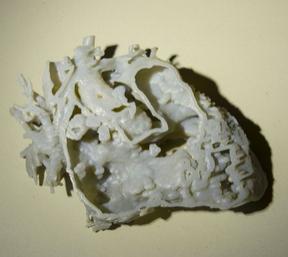
A hole between the ventricles, a pair of pumping muscles which help circulate blood through the heart and to the lungs, left surgeons but one option; patch the hole. But the minute size of a toddlers’ heart made the task a daunting one for even the most experienced pediatric heart specialists. So a team of pioneering doctors and medical professionals at St Thomas’ Hospital in London created a detailed, 3D printed model which included the defect to help them plan her operation.
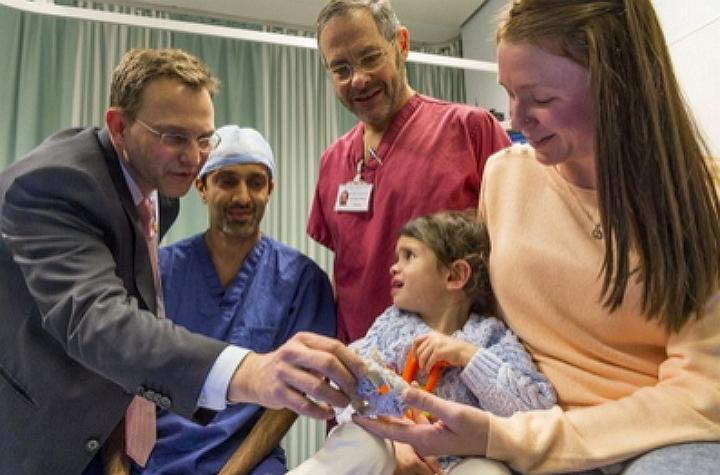 Dr. Gerald Greil, a specialist in 3D printing technique at St Thomas’, and Professor David Anderson who led the team, said the model aided them in creating a Gore-Tex ‘patch’ they stitched over the defect in Mina’s heart
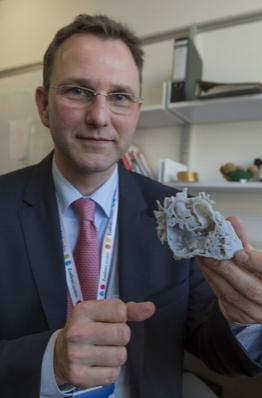
Dr. Gerald Greil
Anderson told the Sunday Times that the tiny child’s heart suffered from a “very complex” issue and he said the process of repairing the defect was a “huge intellectual challenge.”
The team took data collected of the patient’s heart from computerized tomography (CT) and magnetic resonance imaging (MRI) along with scans to design a model of her heart and a customized patch. The model was used to map out how the patch would be placed prior to the surgical procedure. Mina’s mother, Natasha Buckley, said the operation has made all the difference, and the doctors are pleased as well.
“The 3D printing meant we could create a model of her heart and then see the inside of it with a replica of the hole as it looked when the heart was pumping,” Anderson says. “We could go into the operation with a much better idea of what we would find.”
 Magnetic resonance imaging may soon be common to examine what’s called “extracardiac vasculature” in newborns with congenital heart disease.
The speed of circulation within their tiny hearts mean existing angiographic techniques lack the temporal resolution to assess complex cardiac anatomy, but recent work using four-dimensional, time-resolved angiography with 4D TRAK which can confirm diagnoses in newborns is changing that problem.
Doctors also say 3D echocardiography has the potential to be a valuable tool as well. They say the technology allows for the rendering of the depth of field and to allows visualization of the ventricular structures in any desired orientation. The technique allows doctors and surgeons to see adjacent structures and the “rims” of a particular defect, and that means they can be viewed from either the left or right ventricle.
Used in conjunction with 3D printed medical models, the technologies allow surgical teams to fully explore their options – in detail – before taking on complex procedures.
Have you read about any other instances of doctors saving a patient’s life with 3D printing? Let us know in the 3D Printing Used to Repair a Tiny Girl’s Failing Heart forum thread on 3DPB.com.
Subscribe to Our Email Newsletter
Stay up-to-date on all the latest news from the 3D printing industry and receive information and offers from third party vendors.
Print Services
Upload your 3D Models and get them printed quickly and efficiently.











You May Also Like
Via EOS Partnership, Texas’s ACMI Is the First Customer for the AMCM M 8K 3D Printer
EOS’s two major announcements in the last few months have been the launch of the EOS M4 ONYX at Formnext 2025 and the news from a couple of weeks ago...
Reuniting ExOne and voxeljet: An Investor’s View on Building a Global Industrial Sand Printing Leader
Authored by Whitney Haring-Smith, Chair of the Board, ExOne Global Holdings & Managing Partner, Anzu Partners At Anzu Partners, we invest with conviction in industrial technologies that create categories—and then...
VulcanForms Raises $220M as Investors Back Scaled U.S. Metal 3D Printing
VulcanForms has closed a $220 million Series D funding round, a large vote of confidence at a time when investment in 3D printing has become more selective. Investors are backing...
Inside TCT Asia 2026: Exploring a Full-Chain Additive Manufacturing Platform
As Asia’s largest additive manufacturing event, TCT Asia 2026 continues to position itself as a leading showcase of the entire additive manufacturing value chain — spanning equipment, materials, software, services,...