Kinetic Artist Benhaz Farahi’s 3D Printed Movable Helmet is Controlled by Wearer’s Brainwaves

 It seems likely that 3D printing will be increasingly used in the costume departments of Hollywood film sets because it allows for the kind of unique, futuristic creations that go so well with science fiction plot lines. But, oddly, sometimes the fashion and accessories are still not streamlined in the manner that we imagine the technology, fashion, and accessories of the future. In the last science fiction film I saw, Elysium starring Matt Damon, the film used headset devices that looked old and clunky. Slick, streamlined, and nano-chipped seem to be the wave of the real future. Due to new brain-focused technologies, the wave of the future will involve our brainwaves in radically new ways.
While we are on the subject of the brainwave of the future, designer/architect Benhaz Farahi’s latest project is a “kinetic art” inspired accessory just waiting for a science fiction screenplay. Her 3D printed Synapse is a helmet, resembling one “worn by an outer space sentry,” that moves according to brain activity. That’s right, your thoughts control the helmet’s motion.
How does it work? 3D printed in flexible material using an Object Connex500, the helmet has a modified  NeuroSky EEG chip inside it that is connected to a Mindflex headset. What is a NeuroSky EEG chip? According to the NeuroSky website, the EEG technology “digitizes analog brainwaves,” amplifying and processing “raw brain signals to deliver concise input” for application in games, education, research — and kinetic art pieces like Farahi’s Synapse helmet. This arrangement allows for different kinds of brainwaves — active and passive — to be analyzed and recorded. If you are attentive, the EEG chip’s “attention meter” indicates the intensity of a user’s level of mental “focus” or “attention.” Attention level increases when user focuses on a single thought or an external object, and conversely decreases when distracted. If you are
 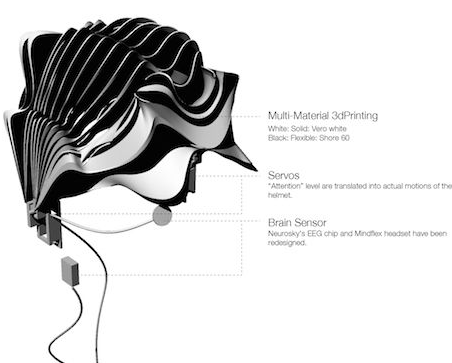 meditative, the EEG chip’s “meditation meter” indicates the level of a user’s mental “calmness” or “relaxation.” Meditation level increases when user relaxes his/her mind and decreases when he/she is uneasy or stressed. Both the attention and meditation meters’ values range from 0 to 100.
With the aid of the NeuroSky technology, your brainwaves move the Synapse helmet. Beyond exhibiting the incredible collaboration between 3D printing and other cutting edge technologies, Farahi describes Synapse‘s main intention is “to explore the possibilities of multi-material 3d printing in order to produce a shape-changing structure around the body as a second skin. It is an attempt to explore direct control of the movement with neural commands from the brain, so that we can effectively control the environment around us through our thoughts.”
Currently a PhD student in Media Arts and Practices at the University of Southern California’s School of Cinematic Arts, Farahi is a designer/architect and Annenberg Fellow at the University. All of Farahi’s work explores the relationship between interactive environments and the human body. Her work “aims to play 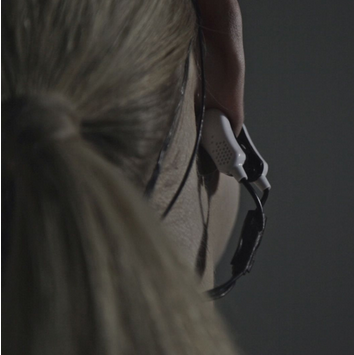 with the intimacy of our bodies and the environment to the point that the distinction between them becomes blurred, as both have ‘become’ a single entity.” She is especially interested in material behavior, and emerging technology applications in contemporary art/architecture practice.
Synapse is not the only 3D printing project under Farahi’s belt. She is also working on a NASA-funded project to develop a robot that can print structures on the moon. This project is in collaboration with Professor Behrokh Khoshnevis.
According to her website, Farahi’s work has been selected for many exhibitions, and in 2013 she was awarded first prize for the Kinetic Art Organization’s international competition, among other awards.
From an assessment of the artist’s own accomplishments, her Synapse helmet is just the beginning of her brain-kinetic artistic explorations and she has her hands in many incredible projects. To see he Synapse helmet in action, check out the video below.
What do you think about this application of 3D printing? Have you seen any other projects that incorporate brainwaves into devices? Let us know over at the 3D Printed, Brainwave-Reactive Helmet forum thread at 3DPB.com.
[Via: Vice.com]Subscribe to Our Email Newsletter
Stay up-to-date on all the latest news from the 3D printing industry and receive information and offers from third party vendors.
Print Services
Upload your 3D Models and get them printed quickly and efficiently.











You May Also Like
Metal Powder Works & Austal USA Form Partnership Surrounding US Navy 3D Printing
There are few companies that have been more integral than Austal USA to the U.S. Navy’s ongoing additive manufacturing (AM) buildup. Among other steps that the subsidiary of the Australian...
3D Printing News Briefs, December 17, 2025: Standards, Ballistics, Dental Aligners, & More
Today’s 3D Printing News Briefs is a bit of a mixed bag, including stories about standards, ballistics 3D printing, dental aligners, and more. Read on for all the details! DNV...
3D Printing News Briefs, December 11, 2025: Circular 3D Printing Farms, Depowdering, Composites, & More
In this week’s 3D Printing News Briefs, Dyndrite signed an Expression of Interest to partner with IAM3DHUB, while Batch.Works and E3D are partnering to scale circular 3D printing farms. Farsoon...
A U.S. AM Hub in the Indo-Pacific: ASTRO America’s Guam Ecosystem Is Officially Open
A multi-year effort by the Applied Science and Technology Organization (ASTRO) America to build an additive manufacturing (AM) hub in Guam that can serve the U.S. Navy’s demand for submarine...