UK AM Firm Says More Than 90 Percent of Britons Favor 3D Printing Education in Schools

When was the last time ninety-three percent of the populace – anywhere – agreed on something? They do when it comes to seeing students introduced and schooled in 3D printing technologies, at least in England.
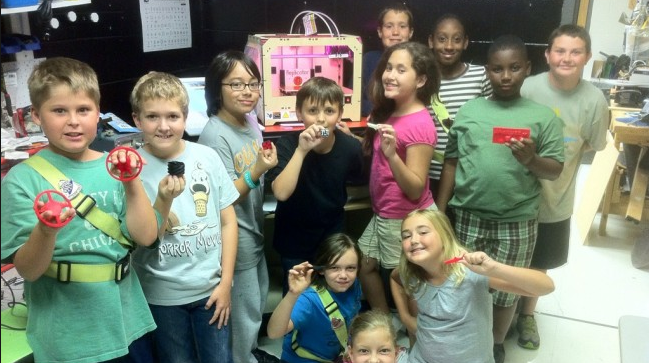
Croft Additive Manufacturing conducted research into the current perception of the technology, and after sifting through the responses of some 600 respondents, they found that a massive 93 percent of them said they wanted 3D printing introduced to school and college curriculum. It seems that the folks in the UK think that developing the next generation of engineers is a high priority.
“Current estimates suggest that 87,000 new engineers a year are required to replace those retiring, however it is vital that they are being trained to use the technology of the future as well as more traditional techniques,” said Neil Burns, a Director at CAM.
According to Burns, the research, which looked at the value of 3D printing to the economy, said support for STEM education will head off skills shortages in those areas going forward. The survey also found that 68 percent of those responding think the technology will have the biggest impact in the manufacturing and medical sectors.
“It’s not surprising that 3D printing is currently seen as a bit of a novelty, but it speaks volumes that every two out of three respondents think its true potential lies within STEM sectors,” Burns says. “Over the next few years, we can expect to see more people viewing 3D printing as a scientific manufacturing method and exploring how the technology can be used to its full potential.”
Croft Additive Manufacturing uses 3D printing to generate innovative filter designs, and the company was formed to utilize the capabilities and design freedom associated with additive manufacturing.
The Warrington-UK based company has become the first SME taken into a new business incubation unit set up to prove that the Large Hadron Collider at the European Organization for Nuclear Research (Cern), Switzerland can produce economic returns for its international donors. Croft and up to nine other companies are collaborating at the Swiss physics laboratory to replicate the idea in all 20 of its member countries in an effort to show austerity-hit European taxpayers that science spending and STEM education efforts make sense in the long run.
Do you think the United States is putting enough emphasis and clearing roadblocks to student involvement in STEM education? How could U.S. schools involve more students in 3D printing technology? How quickly do you think 3D printing will merge into the current curricula of schools, both in Europe and the U.S.? Let us know your thoughts in the 3D Printing Education forum thread on 3DPB.com.
Subscribe to Our Email Newsletter
Stay up-to-date on all the latest news from the 3D printing industry and receive information and offers from third party vendors.
Print Services
Upload your 3D Models and get them printed quickly and efficiently.











You May Also Like
Ceramitec 2026 3D Printing Wrap Up
I was surprised by just how many 3D printing companies and 3D printing projects there were at Ceramitec this year. I came away from the show convinced that the ceramics...
RusselSmith Brings Additive to Ghana’s Maritime Sector
Nigerian firm RusselSmith is in talks with Ghana’s Maritime Authority (GMA) to bring 3D printing to Ghana’s maritime sector. The Commonwealth Enterprise and Investment Council (CWEIC) helped make the discussion...
The Blueprint for Industrial Serial Production
Lithoz is kicking off the 2026 trade fair season with a powerful showcase of real-world applications of ceramic AM serial production capabilities alongside new material upgrades. The company is stepping...
Fraunhofer ILT Tests 3D Printed Titanium Reactors to Generate Hydrogen Onboard Heavy Vehicles
The Aachen-based Fraunhofer Institute for Laser Technology (Fraunhofer ILT) is to research titanium aluminide hydrogen reactors and heat exchangers. The hope is that lightweight, better-performing 3D printed components will make...