Art Professor Uses Ancient Beer Pong and 3D Printing to Teach Greek History

There are some college courses which just make sense to sign up for to fill in the gaps and raise the GPA to an acceptable level. Bowling. A Survey of the History of Television Cartoons. The Joy of Garbage. But until now, students interested in the intellectual underpinnings of Beer Pong had to do their investigations off school hours. Now a professor has remedied that oversight by teaching her students an ancient Greek drinking game, with 3D printing in place of the illustrations she once used.
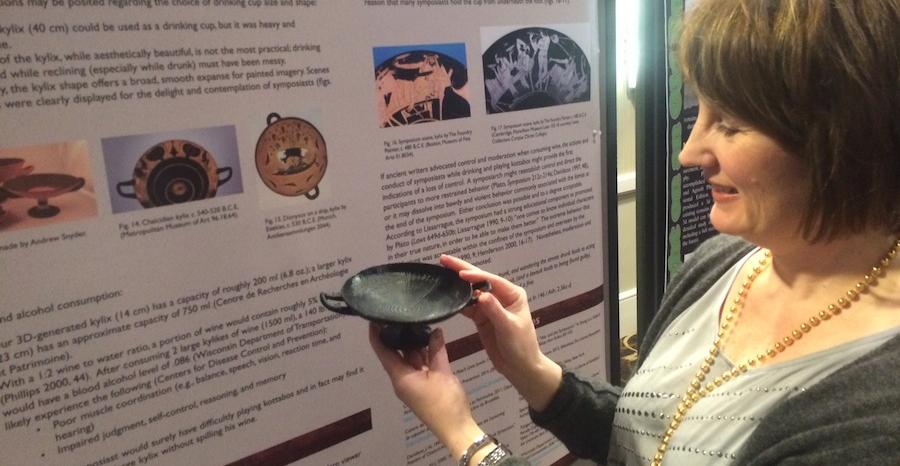
Professor Heather Sharpe with the 3D printed version of an ancient Greek version of a Solo Cup, a Kylix. Photo by Megan Gannon/Live Science
Heather Sharpe, an associate professor of art history at West Chester University of Pennsylvania, uses a 3D printed drinking cup to teach her students about a Beer Pong-like game the ancients played called kottabos.
“I thought it would be really great if we could actually try to do it ourselves,” Sharpe says.

Sharpe says historical texts and artworks show that the two ways to play kottabos — one an attempt to knock down a disc balanced on a metal stand, and one aimed at hitting small dishes floating in a large bowl of water — used leftover wine. Paintings on kylixes, the boozing cups of the day, included scenes of partygoers playing kottabos.
So Sharpe called on Andrew Snyder, a professor of ceramics at West Chester University, to lend her a hand in making the game pieces playable. Snyder built three replica kylixes out of clay, but he ultimately used a MakerBot Replicator 2 to print lighter, more durable versions of the cups.
And it seems the game was every bit as tough as the modern equivalent.
“It took a fair amount of control to actually direct the wine dregs, and interestingly enough, some of the women were the first to get it,” Sharpe told Megan Gannon of Live Science. “In some respects, they relied a little bit more on finesse, whereas some of the guys were trying to throw it too hard.”

An original Greek kylix
While Sharpe and her students used diluted grape juice, the professor says she’d ultimately like to play kottabos with real adult beverages, you know, to understand how the increasing levels of drunkenness would have affected the outcome of the game.
Science.
“It would be fun to actually experiment with wine drinking,” Sharpe says. “Of course, this was a university event, so we couldn’t exactly do it on campus. But really, to get the full experiment, it would be interesting to try it after having a kylix of wine — or after having two kylixes of wine.”
Do you know about any other instances where professors have used 3D printing to help their students understand history in a more ‘hands on’ way? If you do or you just want to comment, lets us know your thoughts on the Professor Uses Ancient Beer Pong and 3D Printing forum thread on 3DPB.com.
[Source: Live Science]Subscribe to Our Email Newsletter
Stay up-to-date on all the latest news from the 3D printing industry and receive information and offers from third party vendors.
Print Services
Upload your 3D Models and get them printed quickly and efficiently.











You May Also Like
Bambu Lab A1 Used to Directly 3D Print Copper Electroplated Parts
Maker Dzingof was doing tonnes of electroplating of desktop and other 3D prints years ago with his Metalizzr project. I’ve been playing, a lot less successfully, with electroplated 3D prints...
3D Printing Financials: Materialise Reports Strong Finish to 2025, Led by Medical Growth
Materialise (Nasdaq: MTLS) closed out 2025 with a solid fourth quarter, showing stronger profitability, steady revenue growth, and continued momentum in its medical business. While some parts of the company...
Takeaways From MILAM 2026: Defense’s Growing Role in Driving 3D Printing – Part II
At the recent Military Additive Manufacturing Summit & Technology Showcase (MILAM 2026), additive manufacturing wasn’t just being discussed as a production strategy; it was being packaged for deployment. A big...
From Vision to Volume: The Next Chapter for Additive Manufacturing
Additive manufacturing has spent years navigating skepticism, hype cycles, and industrial validation. Now, the industry finds itself at a decisive turning point. The conversation has shifted away from futuristic possibilities...