The World’s First 3D Printed Vacuum Cleaner Doubles as a Flower Pot

 A couple of weeks ago we broke a story about a man based in South Africa who 3D printed his own lawn mower. Hans Fouche had managed to print out the wheels, fan cover, motor cover, top cover, and frame of the mower within a 9 hour period on a custom made large-scale FFF 3D printer he had built in his garage.
What many people didn’t know was that Fouche had been working on this printer, which he has named “Cheetah” for months in an effort to take affordable, fast, large-scale 3D printing to the next level. The completion of this mower certainly provided a sense of accomplishment to the Gauteng, South African man, who clearly has a passion for 3D printing, but he is nowhere close to being finished.
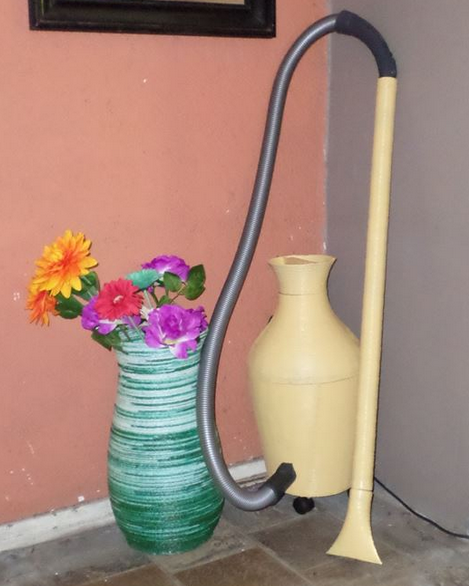
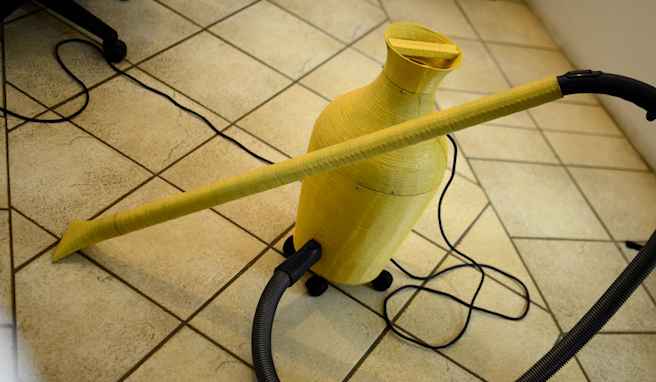
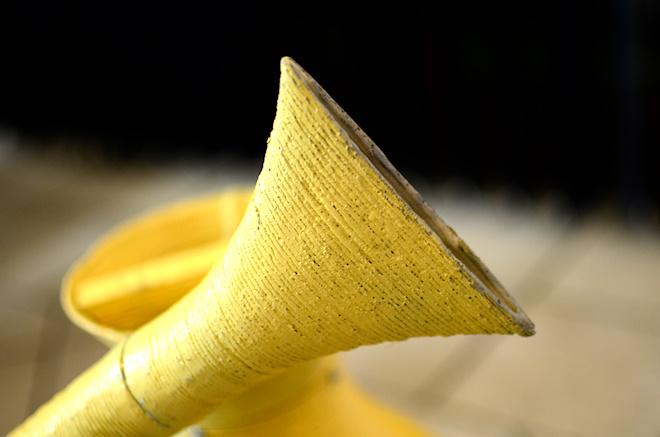
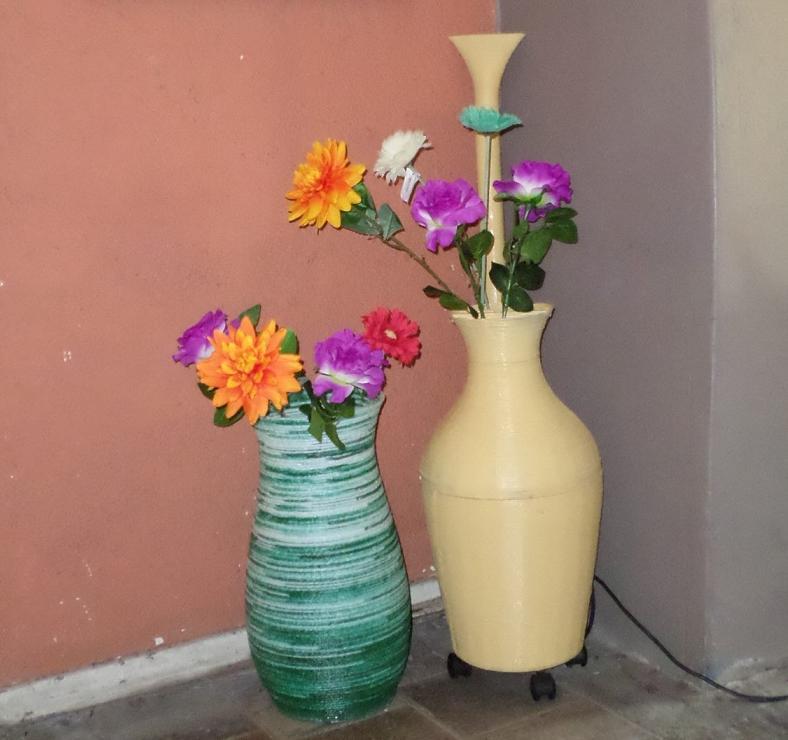
Last night, Fouche, along with his partners Kobus Van der Walt and Adam Oxford were on hand at House4Hack where they unveiled yet another one of their incredible 3D printed creations, a vase which also functions as a handy vacuum cleaner. The men, inspired by a competition which Hoover is sponsoring on Thingiverse, which seeks new designs for add-ons for their vacuums, decided that they wanted to take things a step further and 3D print the whole thing. They started by taking a broken Hoover vacuum and designed components as well as an outer shell for it.
“We wanted to show the lawnmower was not just a publicity stunt,” explained Fouche to 3DPrint.com. “We can actually make a lot of things with the Cheetah!”
Over a period of just four hours, the men used these designs to 3D print the shell of the vacuum, the nozzle, and even the main tube. On an average 3D printer you would likely have to break these 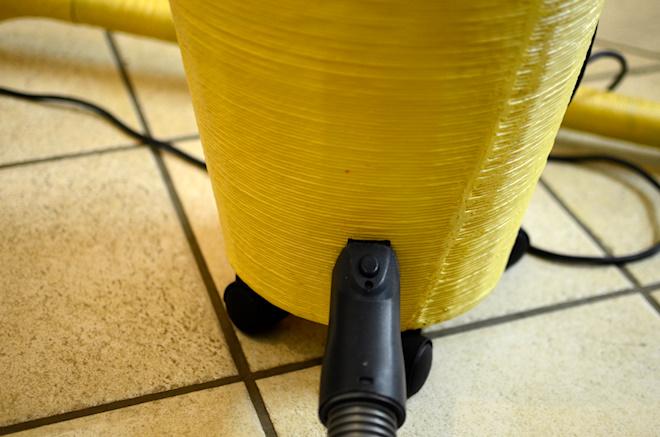 parts down into 12 or 15 individual pieces, and then fuse them together. It would likely take at least two full days to print. However with the Cheetah machine, which Fouche houses in his garage, the entire vacuum was able to be printed in just four hours flat.
Fouche told us that he used a total of 2 Kg of ABS thermoplastic granules at a price of 60 Rand (approximately $5.40) in South Africa, to print the entire thing. When the vacuum is not in use it can double as a rather decent looking flower pot.
“We have made a lot of vases. They are so easy to make! While working on the design of a normal industrial looking vacuum cleaner, this vase standing around caught my eye, and to my astonishment, the Hoover motor unit actually fit into it,” Fouche told us.
People like Fouche are the innovators within the industry who will drive it forward. It will be very interesting to see just what this South African man and his Cheetah 3D printer have in store for us all next. Fouche told us that right now he needs a bit of a break so that he can design a ‘beautiful chair’. I certainly can’t wait to see it when completed! How about you? Let us know your thoughts on yet another incredible 3D print in the Hans Fouche 3D Printed Vacuum forum thread on 3DPB.com. Below you will find a video of the vacuum in action:
Subscribe to Our Email Newsletter
Stay up-to-date on all the latest news from the 3D printing industry and receive information and offers from third party vendors.
Print Services
Upload your 3D Models and get them printed quickly and efficiently.











You May Also Like
Scaling AM Suppressor Production: Oerlikon AM & ATLIX Rise to the Challenge
End-of-barrel suppressors, oftentimes referred to as silencers, function by capturing and redirecting high-pressure propellant gases through carefully engineered internal structures and channels. By disrupting the gas flow before it exits...
Unlocking Big Part Manufacturing for the Energy Sector: How EPRI’s Convergent Approach Proves the Potential of Large-Area DED 3D Printing
The U.S. hydropower fleet, more than 2,200 plants averaging 65 years of age, relies on large, bespoke components that are increasingly difficult to source. Long lead times, disappearing suppliers, and...
In-Situ Automated Toolpath Generation and Auto-Alignment for Performance-Driven Directed Energy Deposition (DED)
The evolution of Directed Energy Deposition (DED) systems has increasingly focused on improving process adaptability, geometric fidelity, and integration into automated manufacturing environments. FormAlloy has advanced this progression through the...
From Material Maturity to Fleet Execution: What Comes Next for Additive Manufacturing in the U.S. Navy
Additive manufacturing is steadily moving from experimental use toward routine application in U.S. Navy shipbuilding, sustainment, and much more. In recent years, the Navy, working through its Maritime Industrial Base...