Materialise to Simplify 3D Printing Process, Bundles Leapfrog Builder With the Creatr HS

 I’ve said it before and I’ll say it again, in order for 3D printing to move into the mainstream, a simplified, intuitive software interface is necessary. There has been tremendous progress from the software side of the market over the last year, and improvements are certainly continuing.
Today at 2015 CES, Fried Vancraen, Founder and CEO of Materialise, and Leapfrog executives were on hand to announce a partnership which will pair one of the leaders within the software side of 3D printing, with Leapfrog, a company which has made a name for themselves with their high-end machines.
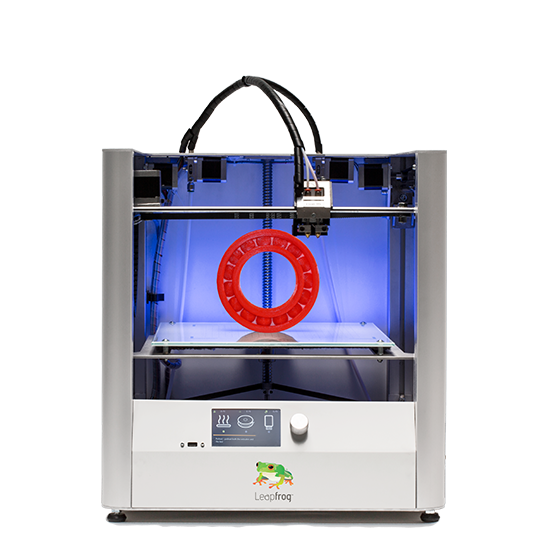
Leapfrog Creatr HS
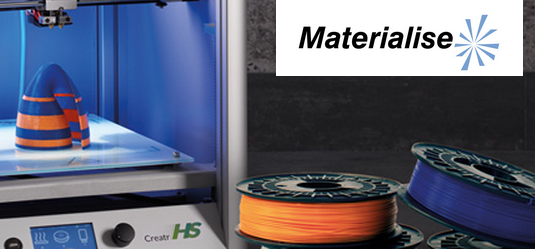
Back in June, we covered the launch of Leapfrog’s Creatr HS, a machine which features incredibly fast FFF printing at 300mm/sec speed with very fine resolutions. Through this announced partnership Materialise will now bundle their new Leapfrog Builder along with the new Creatr HS printer.
What is a ‘Builder’ you may ask? Think of it as the 3-dimensional version of a 2D printer driver. Just like printer drivers make inkjet printing easier, with a streamlined user interface, and the option for users to choose between various profiles and settings, Materialise’s Leapfrog Builder does the same for 3D printing on Leapfrog machines. Users will be able to build their own profile with parameters which they choose, allowing for a much more streamlined process from STL file to 3D print, effectively bridging the gap between the software and the actual 3D printer. Below you will find a list of key features within this builder:
- Part analysis – Automatically checks files for common errors, providing details for height and volume and helping the user avoid failed prints.
- Perfect platform calibration – Users can perform a 4-point check on the bed, choosing between several test prints for calibration.
- Basic fixing – Fixes problems like inverted triangles and small holes.
- Dual head calibration – Calibrates the distance between the two print heads.
- Wall thickness analysis – Uses a heat map to identify the thickness of walls.

For Materialise this isn’t their first Build Processors they have released. In fact, they have been working with EOS and SLM solutions for similar products, and they hope that such processors will “become the De Facto Standard for Simplifying the 3D Printing Process.”
Certainly this is good news for consumers, businesses, and educators who rely on simplicity when it comes to new technologies like this. Let’s hear your thoughts on this new partnership between Materialise and Leapfrog.
Subscribe to Our Email Newsletter
Stay up-to-date on all the latest news from the 3D printing industry and receive information and offers from third party vendors.
Print Services
Upload your 3D Models and get them printed quickly and efficiently.











You May Also Like
Ceramics 3D Printing at Ceramitec 2026
Ceramitec is a key event for the ceramics industry. Held in the lovely city of Munich, it is the leading global event for the ceramics community. With around 13,000 participants...
BMF Turns Up the Speed with microArch S150 Series
Boston Micro Fabrication (BMF) is releasing the microArch S150 Series. This series comprises two compact desktop systems. There’s a speedy microArch S150 Ultra and a more lab- or experiment-oriented microArch...
3D Printing Predictions 2026: Industrial Production & Polymer Additive Manufacturing
Polymer additive manufacturing is seeing less investment, attention, and disruption than metal additive manufacturing currently. Less crucial for defense needs, it has of late had far fewer new entrants. But,...
EPFL Is Growing Metal
Over the years, researchers in additive manufacturing have been working on different hydrogel systems for scaffolds, supports, and parts. Others have worked on different forms of growing 3D prints, while...