‘Dog Bone’ Shaped 3D Printed Polymers Used To Measure Force

Researchers have used 3D printing to create force sensors they say they couldn’t build with any other existing technology. The polymer structures change color when stretched, and the more they’re distorted, the more the color changes.
These tools, shaped like a dog bone, are made from commercially-available polycaprolactone and include an inner strip of spiropyran polymer. When the research team yanked on one end of the sensor, it was permanently deformed and the strip inside turned purple.

The “bones” were made to record the maximum amount of force applied to the material by embedding four squares of spiropyran polymer, and by taking into account the length of the devices – and the amount of force applied – researchers found they could match the applied force to an observed change in the color of the strips. As they experimented with various combinations of materials and applied force, they say they could quickly correlate the force by simply counting the number of purple squares which appeared.
Called photo and mechanochromic 3D printed structures, the team used a fused filament fabrication printer to print ‘single and multicomponent tensile strength testing pieces.’ They say it would be difficult “if not impossible” to make the sensors using traditional manufacturing techniques which might degrade the spiropyran units or polymer chains. Since such functional polymers can change their shape or chemical composition when subjected to outside factors like light, heat, and mechanical force, they might prove ideal as sensors or for use in drug delivery systems.
But the researchers say common manufacturing techniques which involve light or heat can trigger the functional aspects of the materials prematurely, posing a significant problem.

Andrew Boydston
In the past, researchers used molds to shape the functional polymers, but the process ultimately limits them in regard to the shape and complexity of structures they can create. So team lead Andrew J. Boydston of the University of Washington used 3D printing to create the necessary shapes.
To begin the work, the team developed a mechanosensitive polymer which could withstand being extruded by a commercial 3D printer – without changing color or being damaged – by the heat of the printing process. They then synthesized polycaprolactone polymers which contained 50% spiropyran, and when mechanical force is applied to spiropyran, it can isomerize to make a purple merocyanine.
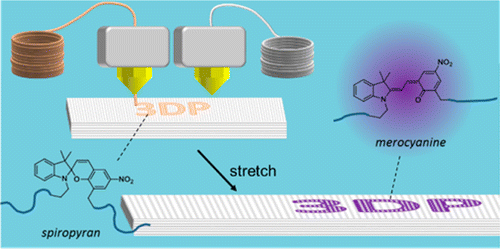
Boydston says that, while a 3D printer can make the devices quickly and accurately, such constructs – which include squares of one polymer embedded inside another material – would be next to impossible to create inside molds.
What methods do you see scientists using to create devices which would be impossible to make with common manufacturing techniques and what applications do you see for 3D printing in the sciences going forward. Weigh in with your take and comment in the Shaped 3D Printed Polymers forum thread on 3DPB.com.
Subscribe to Our Email Newsletter
Stay up-to-date on all the latest news from the 3D printing industry and receive information and offers from third party vendors.
Print Services
Upload your 3D Models and get them printed quickly and efficiently.











You May Also Like
Stratasys Partners With Defense Prime Heavyweights to Qualify SAF PA12 for Industrial 3D Printing
Perhaps the most valuable lesson that the additive manufacturing (AM) industry has learned in its technical maturation era over the last five years or so is that you can’t really...
Via EOS Partnership, Texas’s ACMI Is the First Customer for the AMCM M 8K 3D Printer
EOS’s two major announcements in the last few months have been the launch of the EOS M4 ONYX at Formnext 2025 and the news from a couple of weeks ago...
Reuniting ExOne and voxeljet: An Investor’s View on Building a Global Industrial Sand Printing Leader
Authored by Whitney Haring-Smith, Chair of the Board, ExOne Global Holdings & Managing Partner, Anzu Partners At Anzu Partners, we invest with conviction in industrial technologies that create categories—and then...
VulcanForms Raises $220M as Investors Back Scaled U.S. Metal 3D Printing
VulcanForms has closed a $220 million Series D funding round, a large vote of confidence at a time when investment in 3D printing has become more selective. Investors are backing...