‘PipeDream’ – Autodesk Working on Way to Integrate Tubes for Electronic Components Within 3D Prints

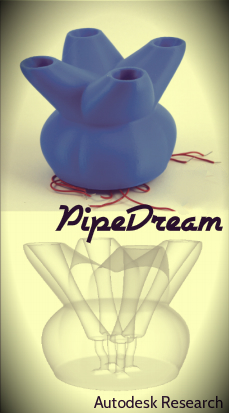
3-D-printed pen holder
If you 3D print sculptures or 3D print equipment that will need wires, sensors and lights, then you’ve probably been waiting for something like PipeDream to hit the market. PipeDream is a program that Autodesk researchers have been working on.
Autodesk researchers authored a white paper recently, “A Series of Tubes: Adding Interactivity to 3-D Prints Using Internal Pipes,” that lays out all the specifics. In the paper they explain how ‘pipes’ inside of objects can be open to the outside, fully enclosed or semi-enclosed. Once a 3d printed object which has pipes is printed, a variety of media can be inserted and used within those pipes. For example, an object with an open pipe configuration could be filled with conductive paint and used in tandem with a battery to light LED lights.
While it’s not commercially available yet, PipeDream will eventually lead to makers being able to put pipes or tubes into their creations. PipeDream works in one of two ways: Users can define the beginning and end points of the pipes or they can specify an internal shape, and then create a path along that shape.
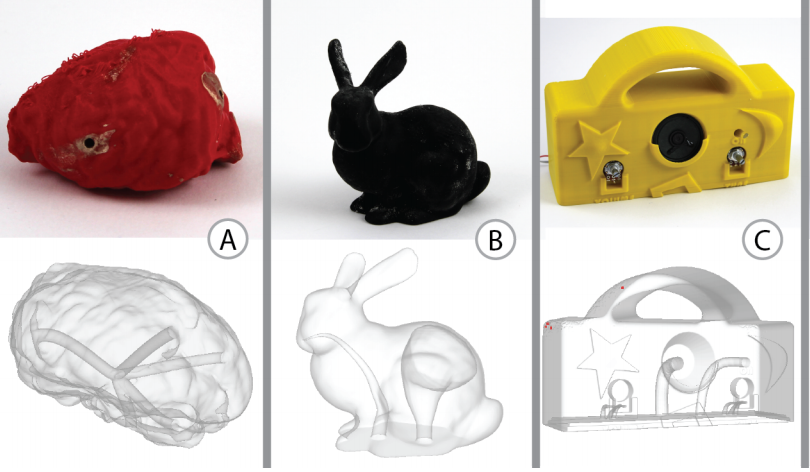
To prove that PipeDream is viable, the team who authored the paper created several prototype objects including touch-sensitive toys, a maze, an animated neon sign and a portable radio. The portable radio used pipe technology to allow for the addition of a speaker, volume, power and tuning controls. They also made a smart pen holder using traditional computer-aided-design software and then used PipeDream to add the pipe route. The pen holder can track whether or not a 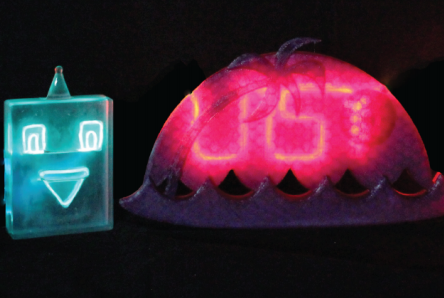 pen is missing thanks to sensors that would be added post-creation.
Another interesting item the Autodesk researchers made was a bunny. They envisioned the bunny as a life-like learning tool. It was made of soft material and, thanks to PipeDream, it had an internal cavity that acted as an air bladder. When connected to an air pump, the bunny seemed to be breathing. The cavity in a soft printed object could be fitted with other feedback devices like a noisemaker, buttons for lights, haptic buzzers, accelerometers and sensors to determine if an object has been touched.
The PipeDreams software could have staggering implications for the industry, allowing users with desktop 3D printers to easily create functioning electronic devices of all sorts from the comfort of their homes. Autodesk certainly seems to be stepping further and further into the 3D printing space from a software, platform, and even hardware perspective.
What would you make with ‘Pipes’? Let us know in the Autodesk PipeDream forum thread on 3DPB.com. To read the research paper, please visit AutodeskResearch.com. Check out the explanation video provided below:
Subscribe to Our Email Newsletter
Stay up-to-date on all the latest news from the 3D printing industry and receive information and offers from third party vendors.
Print Services
Upload your 3D Models and get them printed quickly and efficiently.











You May Also Like
Reuniting ExOne and voxeljet: An Investor’s View on Building a Global Industrial Sand Printing Leader
Authored by Whitney Haring-Smith, Chair of the Board, ExOne Global Holdings & Managing Partner, Anzu Partners At Anzu Partners, we invest with conviction in industrial technologies that create categories—and then...
Adoption of Advanced Powder Metal Manufacturing in the Global Small Arms Space – SHOT Show 2026 Additive Manufacturing Analysis
Back in 2013, I remember being completely blown away when a company called Solid Concepts reportedly additively manufactured nearly a complete firearm as a proof of concept. Although desktop polymer...
AM-Europe, operated by CECIMO: Positioning Additive Manufacturing at the Core of Europe’s Industrial Competitiveness
As European industries face growing pressure to strengthen resilience, reduce supply chain risks, and meet sustainability objectives, additive manufacturing (AM) is emerging as a practical and strategic solution. Closely align...
Five Imperatives for CAD and PDM In The Additive Era
Additive manufacturing has reached an inflection point. Hardware capabilities continue to advance, materials portfolios are expanding rapidly, and automation is reshaping post‑processing and production workflows. Yet many additive programs still...