DIY Telescope 3D Printed by UK Researchers Will Have You Seeing Stars

Galileo and Newton would have been impressed. And NASA should take note! Researchers in the UK have created the first highly efficient, 3D printed telescope out of cheap, basic parts that are available to anyone—as are the plans, for anyone who wants to make their own.
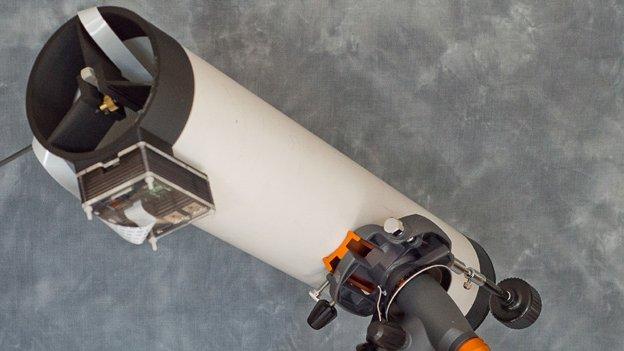
DIY telescope with 3D printed components.
The University of Sheffield researchers behind the project must have been pretty psyched when they were able to capture pictures of the moon on their first try. While telescopes are pretty simple tools, this is the first one to be created using 3D printed parts at a cost of £100, which translates to about $163.
Featuring magnification of times 160, and dubbed the Pikon, it is described as being comparable to telescopes that generally cost ten times as much. Physicist Mark Wrigley, one of the creators of the Pikon, says he hopes this new telescope will be a game changer, affording young scientists accessibility to the stars for a very low price, while encouraging interest in the new technology of 3D printing.
 Made with the simple, classic Newtonian design using a mirror to form an image, the DIY telescope is composed of basic components, with one interesting twist—a camera module, the Pi Infrared camera, taken from a Raspberry Pi computer—a credit card-sized computer developed in the UK by the Raspberry Pi Foundation—an organization that was involved with getting computers into schools.
The camera is able to be mounted right in front of the mirror on the end of the telescope’s components, which are 3D printed. Taking Newton’s idea one step further, the mirror focuses an image directly onto the Pi camera sensor, offering pictures of what the user is able to view. The lens and mirror are cheap parts that can be obtained easily.
“We hope that one day this will be seen on a par with the famous Dobsonian ‘pavement’ telescopes, which allowed hobbyists to see into the night skies for the first time,” said physicist Mark Wrigley, who will be demonstrating the the PiKon at University of Sheffield’s Festival of the Mind today. “This is all about democratizing technology, making it cheap and readily available to the general public.”

Images of the moon taken with 3D printed telescope.
While Isaac Newton was not the first to consider making tools to see out into space, he was the first to build a ‘reflective’ telescope with the use of mirrors in 1668 while working on his theory of color.
For everyone inspired by science, space, and out-of-this-world new technology, plans for making and 3D printing your own telescope will be available online soon on Thingiverse for everyone to download, make, and 3D print. Is this something you are interesting in pursuing? Join the conversation in the 3D printed telescope forum thread at 3DPB.
Subscribe to Our Email Newsletter
Stay up-to-date on all the latest news from the 3D printing industry and receive information and offers from third party vendors.
Print Services
Upload your 3D Models and get them printed quickly and efficiently.











You May Also Like
Stratasys Partners With Defense Prime Heavyweights to Qualify SAF PA12 for Industrial 3D Printing
Perhaps the most valuable lesson that the additive manufacturing (AM) industry has learned in its technical maturation era over the last five years or so is that you can’t really...
Via EOS Partnership, Texas’s ACMI Is the First Customer for the AMCM M 8K 3D Printer
EOS’s two major announcements in the last few months have been the launch of the EOS M4 ONYX at Formnext 2025 and the news from a couple of weeks ago...
Reuniting ExOne and voxeljet: An Investor’s View on Building a Global Industrial Sand Printing Leader
Authored by Whitney Haring-Smith, Chair of the Board, ExOne Global Holdings & Managing Partner, Anzu Partners At Anzu Partners, we invest with conviction in industrial technologies that create categories—and then...
VulcanForms Raises $220M as Investors Back Scaled U.S. Metal 3D Printing
VulcanForms has closed a $220 million Series D funding round, a large vote of confidence at a time when investment in 3D printing has become more selective. Investors are backing...