Reinventing the Printing Press: Man 3D Prints a Working Business Card-Sized Printing Press

 When I was in the 3rd grade, I recall doing a report on a man named Johannes Gutenberg. Gutenberg, for those of you who are unaware, was the inventor of the first moveable-type printing press in early 15th century. While to some, this may not seem like all that big of a deal, Gutenberg’s invention ended up igniting what is sometimes referred to as the “Printing Revolution” in Europe.
Fast forward almost 600 years, and printing is a lot different today. In fact, we are experiencing a Gutenberg-like renaissance of our own, only this time it’s in 3D. 3D printing has become one of the most talked about futuristic/modern technologies of the past few years, with scientists, architects, designers and surgeons from all over the globe looking toward the technology with tremendous hope for the future. For one man named Costantino Montanari, 3D printing has allowed him to turn back the clock some 550+ years to create a miniature printing press of his own.
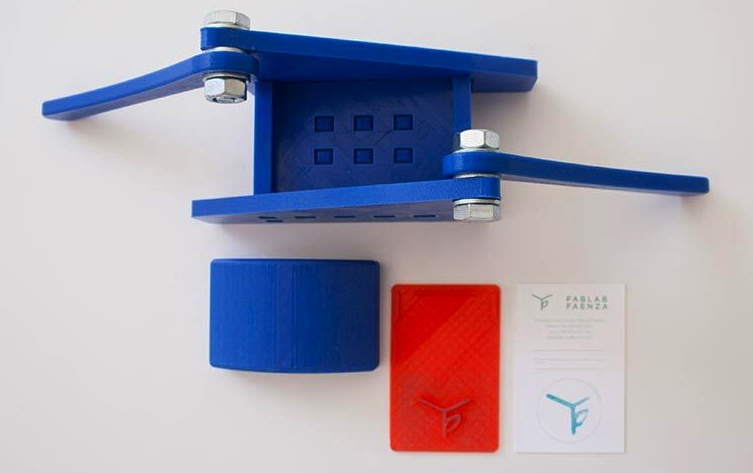
 While the design for his printing press is not entirely original, the 3D printable version certainly is. His printing press is capable of printing onto business card-sized pieces of paper, allowing for custom business card printing if desired. The maximum print size is 85 x 55 mm.
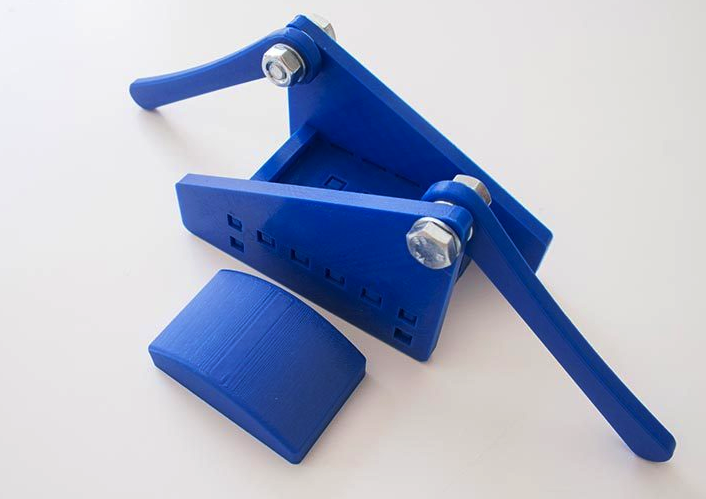
“I was interested in making a free version of what once was called the printing press,” Montanari, who lives in Italy, tells 3DPrint.com. “Operation is simple, as it merely requires a roller passing the ink on the printing plate. The printing plate is placed inside the press with the ink side at the top. Then you put the card into contact with the printing plate, insert the “soap piece” and press on the two levers which in turn will press press everything together like a sandwich, allowing the passage to get ink from the plate to the business card”
In all, the printing press required six 3D printed pieces, and two bolts which were not 3D printed. Montanari tells us that he designed his device in such a way that it could be printed on any 3D printer with a build area of at least 200mm x 200mm. The individual parts were designed using Rhino 5, which is a professional design software wthat he frequently uses.
While Montanari’s printing press was printed entirely out of PLA plastic, he does suggest that using a more flexible filament such as NinjaFlex would help the device perform better. It only takes a few hours to print out the device, and assembly is quite easy.
While this 3D printed printing press doesn’t come close to topping the Gutenberg press of the 15th century, it certainly goes a long way in proving some of the interesting things that can now be fabricated on a 3D printer.
Subscribe to Our Email Newsletter
Stay up-to-date on all the latest news from the 3D printing industry and receive information and offers from third party vendors.
Print Services
Upload your 3D Models and get them printed quickly and efficiently.













You May Also Like
3D Printing News Briefs, October 10, 2026: Drones, WAAM, Ceramics, & More
We have a packed 3D Printing News Briefs for you this weekend! First, America Makes celebrated the recent National Manufacturing Day with 3D printed drones, and then it’s on to...
10 Years of Multi Jet Fusion: Onsite at HP’s Vancouver, Washington Facility
At this year’s RAPID event in Boston, HP Additive Manufacturing Solutions celebrated ten years in the additive manufacturing (AM) market. The company ushered in the milestone with several innovations, including...
PharmaTher Plans U.S. Network to 3D Print Medicines on Demand
3D printing medicines has often been tied to the idea of personalization, basically making a pill in the right dose, shape, or drug combination for a patient. PharmaTher is now...
3D Printing News Briefs, September 17, 2026: 3D Printed Boat, UAS Development, & More
We’ll start with maritime manufacturing in this week’s 3D Printing News Briefs, and continue on to defense 3D printing. We’ll end with funding for Tripo AI. Read on for all...