These 3D Printed Porcelain Coffee Mugs & Donuts are Clever Topology-Related Joke


Henry Segerman’s jokes aren’t meant to be obscure but can be hopelessly perplexing if you don’t know anything about topology. His latest 3D-printed, topology-related project–a coffee mug transforming into a donut, which in turn transforms into a coffee mug, and so on–won’t make much sense to you unless you’re a topology insider and, doubtless, that’s probably a pretty small segment of the population. Here’s the joke: Topologists can’t tell the difference between a coffee mug and a doughnut.
Fortunately, mercifully, Henry explains this in a video that’s provided in a Shapeways article about Segerman’s most recent topology-inspired effort. Segerman, who is a mathematical artist and Shapeways community member, is collaborating with postdoctoral fellow at Columbia University, Keenan Crane, who is most certainly a member of that elite group of topology insiders. Crane explains that his research “draws on insights from differential geometry and computer science to develop fundamental algorithms for working with real-world geometric data. In short, he and Segerman speak the same arcane language of coffee mugs and donuts that are indistinguishable from one another.
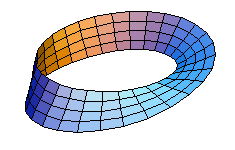
But, wait a minute! What’s topology anyway? In mathematics, topology is the study of the properties of space that are preserved under continuous deformations like bending and stretching. As a field of study, topology developed out of geometry and set theory. Topologists analyze concepts of space, dimension, and transformation and two important properties in topology are compactness and connectedness. Think of the mobius strip, for instance. It’s what happens when you connect the ends of a rectangle to one another but, rather than doing so directly and creating a cylinder, you twist the center of the rectangle and connect the ends that way (see the image if this makes no sense). You aren’t lengthening the rectangle but you are changing the way its edges are identified. The mobius strip ends up with one edge whereas the cylinder (and its precursor, the rectangle) has two. Imagine! People make a living thinking about concepts and constructions like this!
One such person is Henry Segerman, whose 3D-printed and utterly captivating sculptures are based on his study of topology and can be seen on his Shapeways shop. In addition to collaborating with Crane, Segerman also works with mathematician, Saul Schleimer, of the University of Warwick in the UK, another topology and geometry insider, and kinetic sculptor, Marco Mahler, with whom he shares a second Shapeways shop.
Segerman’s work is egghead heart, reminding one of the two-dimensional work of MC Escher, whose imagery seems to confound spatial logic. The coffee mugs and donuts are 3D printed in porcelain material as part of Shapeways’ porcelain pilot program, which is still in an experimental phase. The objects are life size, as you can see when watching the video, and are 3D printed in a pretty, robin’s egg blue porcelain.
For the most part, Segerman’s topological sculptures are white, with the exception of a few, including his fascinating “Twisted Earth.” While many of the objects are visually compelling, inviting one to pick them up and turn them around and around, some are puzzles, which should satisfy even the most confirmed brainiacs on your gift-shopping list. The pieces are also generally quite modestly priced. Our personal favorites are the stereographic projections, the knots (we define you to look upon one without becoming frustrated), and the lattices. While you don’t have to understand them to appreciate them, Segerman’s sculptures certainly invite further study.
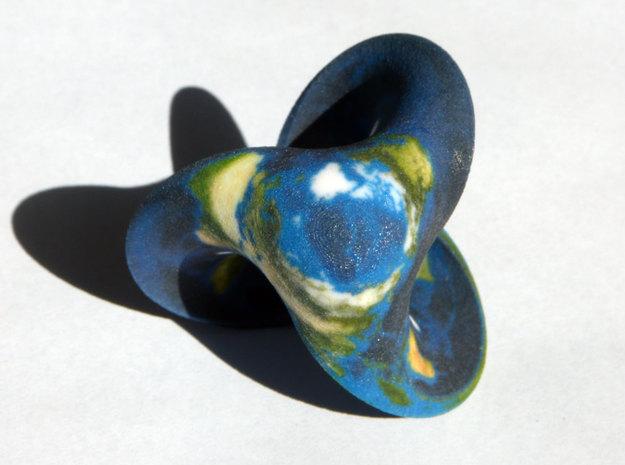
“Twisted Earth” is 3D printed in full color sandstone and costs $14.00 through Segerman’s Shapeways store.
Subscribe to Our Email Newsletter
Stay up-to-date on all the latest news from the 3D printing industry and receive information and offers from third party vendors.
Print Services
Upload your 3D Models and get them printed quickly and efficiently.












You May Also Like
3D Printing News Briefs, June 6, 2026: Expansions, New 3D Printers, & More
We’re starting with business in this weekend’s 3D Printing News Briefs. Axtra3D just opened its expanded facility in Italy, and Austal USA expanded its leadership team. Then we’ll move on...
3Dnatives to Present ADDITIV Metals 2026: Resolving Key Barriers to Scaling Metal Additive Manufacturing
As the metal additive manufacturing sector prepares for a massive leap—with market valuations expected to climb from $6.02 billion to $7.02 billion this year—the industry is shifting its focus from...
3D Printing News Briefs, May 28, 2026: Continuous Fiber Reinforcement, Bioprinted Trachea, & More
In today’s 3D Printing News Briefs, America Makes announced the winners of its JAQS-SQ Project Call. Axtra3D is partnering with Keystone Industries to expand its dental material ecosystem, while BigRep...
DoW Accelerates Drone Readiness with AMTrain Phase 2 Launch at Camp Lejeune
Equipping today’s warfighter with the most advanced technology is paramount, driving increased prioritization and investment in drone development and advanced manufacturing training within the Department of War (DoW). In this...