A Beehive That Glows! 3D Printed Solar Hive Wins Thingiverse Challenge

 MakerBot sure knows how to entice designers to come up with some of the most creative 3D printable designs possible. They simply dangle a MakerBot Replicator 3D printer as a prize, and the design ideas come flowing in. At least this has been the case with their recent Thingiversity Summer S.T.E.A.M. Challenges. One recent competition, which was called the “LightItUp” challenge, saw many unique 3D printable lighting designs being fabricated. The winner of that competition was a German man, named Christoph Queck, with his creation of what he calls the Solar Hive.
Basically Queck’s creation is a unique beehive looking solar powered parametric LED lamp, which costs about $25 to create, and could easily turn your yard into the talk of the town. All of the beehive’s body parts are 3D printed, and the parameters may be changed using either OpenSCAD or the Thingiverse Customizer in order to completely customize one’s own version.
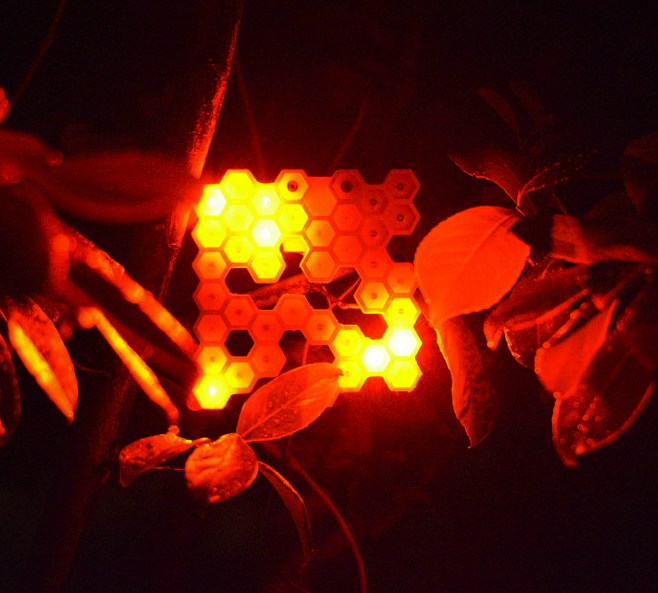
“The idea was to create a lamp dedicated to the beauty of randomness, so the shape and the glowing pattern are randomized,” Queck explains.
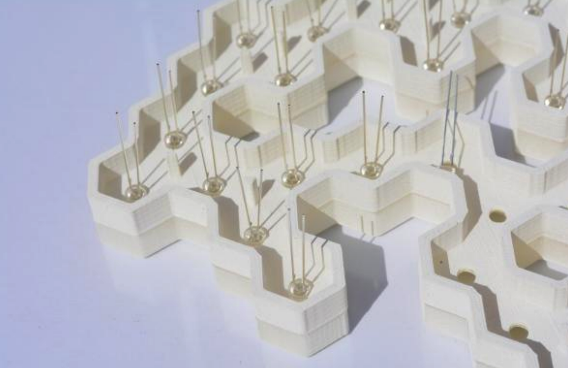
Other than the 3D printable body, the Solar Hive requires a laundry list of electronics and other parts which can not be 3D printed. This list includes things like the solar cell (if you wish to make your’s solar powered), 4 rechargeable NiMh cell batteries, an Arduino Mini, 20-40 LEDs, a diode, 2 resistors and a ton of wires, screws, and nuts. The parts are held together by solder and water resistant glue/silicone.
The backside of the hive is where all of the LEDs and wires are housed, and the LEDs illuminate the front plate when powered on. Where the fun really begins, however, is when it comes to customizing your own Solar Hive.
“You can adjust all the parameters to your likings,” says Queck. “Adjust the ‘Varamount’ Variable, [as] it determines how many of the
cells are rendered. ‘Cell Diameter’ determines the diameter of each cell, [and] ‘Wall Strength’ changes the thickness of the walls around the cells.”
In addition to this, other variables can be changed as well, including the “Seed” parameter which allows you to generate a new random pattern; the “LED Hole Diameter” which changes the size of the hole in the middle of each cell; and many more options, all of which are explained in better detail, here.

The assembly of the Solar Hive will be a bit tricky and certainly a little time consuming, but if it is all done correctly you will be left with the astonishing LED light source you see depicted here on this page. Queck recommends directing the solar panel on the light in the southern direction in order to collect the most energy. If it is powered off during the day, the batteries will charge.
“If you turn it on during daytime it will continue to collect energy until the solar cell can’t provide any more energy. Then a countdown starts, if it stays mostly dark during the next 25 minutes the lights will start their randomized play.”
All of the 3D printable files and instructions for this unique beehive-like lighting system can be downloaded for free from Thingiverse. What do you think about this unique creation? Will you be attempting to create your own Solar Hive? Discuss in the Solar Hive forum thread on 3DPB.com. Check out the video below.
Subscribe to Our Email Newsletter
Stay up-to-date on all the latest news from the 3D printing industry and receive information and offers from third party vendors.
Print Services
Upload your 3D Models and get them printed quickly and efficiently.












You May Also Like
Solukon Goes Big with New SFM-AT850 Depowdering System
Solukon has released the SFM-AT850 depowdering system. The German depowdering specialist has updated its product line, and this machine replaces the SFM-AT800-S and SFM-AT1000-S. Rather than many small parts, this...
The Hidden Economics of Powder Bed 3D Printing: Closing the Loop in Powder Management
Automation is a very topical thing in additive manufacturing at the moment. With renewed scale, some clients are fervently looking to automate production. Other business cases only make sense with...
Oerlikon Adds ATLIX’s xBUILD 5000, Plans More for 2027
Oerlikon has installed a new ATLIX xBUILD 5000 metal 3D printer at its facility in Huntersville, North Carolina, marking the first production deployment of the system worldwide. The machine will...
The Science Lab You Can 3D Print
Researchers at Sweden’s Umeå University have shown how desktop 3D printers can be used to make lab equipment, giving scientists a cheaper way to build tools for their research. The...