3D Printing a Fully Functional Miniature Submarine

 Issue a call to makers and they will answer it, and answer it, and answer it again. We’ve already covered some of the other amazing inventions and creative responses to the Thingiverse Make It Float challenge such as a spring powered tri-boat and an ultrasonic bug repellent waterlily.
Today, we bring you a 3D printed catfish; well, actually, a 3D printed submarine known as “The Catfish.”
This contribution to the population of Thingiverse is from Mike Blakemore, who in addition to holding a serious day job, wanted to create something fun to play with. Quick to give credit to his original source of inspiration, an RC Motor Boat by Wersey, his design is anything but derivative. And he makes it sound so easy to create.
“With the exception of electronics, motors, wire, rubber tubing, a metal valve, and some fishing line, the entire submarine is 3D printed. You’ll need to print out Hull-A through Hull-Z and any accessories, glue it together, add your electronics, calibrate your sub, and you [are] ready to go,” Blakemore says.
However, as history tells us, creating a working submarine is not as easy as sinking a boat that can still move forward. In the 17th century, the first reliable reports of a submarine 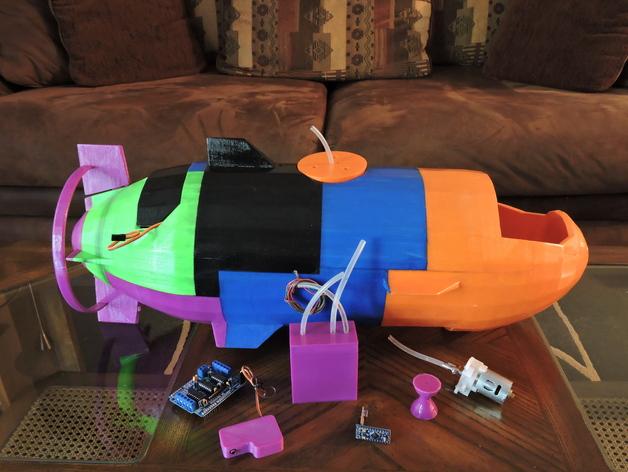 involved a creation made from wood and powered by the use of oars. It wasn’t until the 19th century that a submarine not relying on human-power was introduced. This latest contribution to the venerable history of submersibles utilizes a small DC motor. It isn’t just a matter of taking a full size submarine and shrinking it down to a smaller size.
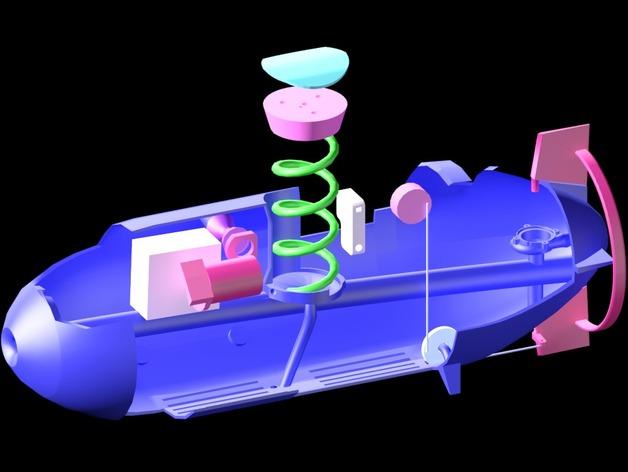
“I chose to use an air pump instead of compressed air tanks, which is what big submarines use to evacuate water. In order for an air pump to get air in, a coil of plastic or rubber tubing runs from the middle/top of the sub to a float/bogger that stays at the surface of the water. This also makes for good chances of recovery should the batteries run out,” Blakemore explains. “There is a small DC motor inside the sub that can reel in the float using fishing line. Even an inch of water can kill wireless signals, so the float can also be used to hold an antenna up out of the water and a bell crank is used at the bottom of the sub to convert vertical motion from a servo to a horizontal motion which drives the rudder.”
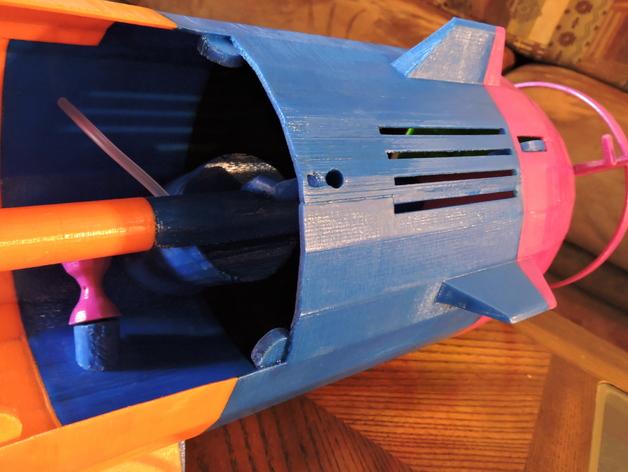 Blakemore has made the design for the colorful aquatic machine and the files necessary to create your own version available through Thingiverse as well as providing links to the pump and valves necessary for its functionality. It’s not just pretty to look at, but is also fully ready to carry miniature cargo for short distances.
“This is a fully working submarine capable of carrying electronics and other cargo,” Blakemore notes. “The entire inside of the sub (up to a max fill line) is used as an internal ballast tank. Submarines have holes on the bottom that are always open, allowing water to move freely in and out of the ballast tanks. Air is then pumped in or released, changing the amount of water stored in the tanks. The submarine floats when filled with air and sinks when filled with water.”
When not creating RC submersibles, Blakemore is the CEO of Hyperplane Interactive and one of the creators of Touch Control System, a 3D development platform/game engine for creating futuristic touch screen project interfaces.
Now, to fit one of those on a miniature submarine…
Let us know what you think of this Make It Float entry in the 3D Printed Miniature Submarine forum thread over at 3DPB.com.
Subscribe to Our Email Newsletter
Stay up-to-date on all the latest news from the 3D printing industry and receive information and offers from third party vendors.
Print Services
Upload your 3D Models and get them printed quickly and efficiently.











You May Also Like
nScrypt’s Ken Church on Why Additive Electronics Is Finally Finding Its Fit
For years, additive manufacturing (AM) has promised to reshape electronics. The idea has always been to print circuits directly where they are needed, add them into parts, and move beyond...
Harvard’s Jennifer Lewis Lab Is 3D Printing Artificial Muscles That Twist and Bend on Demand
Researchers at Harvard John A. Paulson School of Engineering and Applied Sciences (SEAS) have developed a new way to 3D print materials that can move on their own, bending, twisting,...
3D Printing News Briefs, May 2, 2026: Soft Robots, Agricultural Waste, & More
In this weekend’s 3D Printing News Briefs, we’ll start off with a multi-laser metal powder bed fusion 3D printer and post-processing news. We’ll end with research into soft robotics and...
Harvard SEAS Engineers Develop 3D Printing Method for Soft Robotic Components with Programmable Shapes
The world of soft robotics is still largely in its pure research phase, but the R&D landscape has started to produce examples of early-stage commercialization. Researchers have started to refine...