Jaws –- The 3D Printer Extruder Drive Bolt with Bite

No, there’s no ominous John Williams score to accompany this article, just smooth and consistent extrusion of 3D print filament. Matthew Fiedler and the Houston-based team at re:3D have developed a novel extruder bolt, which they’ve affectionately named Jaws. They intend to use Jaws to create a more consistent 3D printing experience.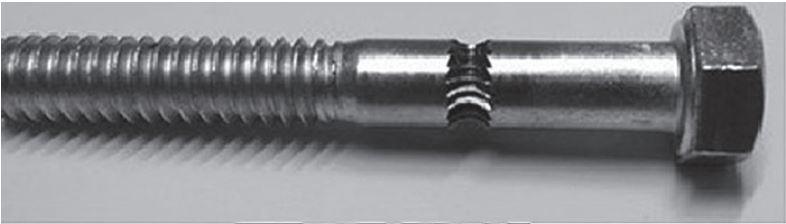
One of the most common causes of print failure is the filament feeding mechanism. With 3D printers continuing to grow in popularity, and the cost of use consistently dropping, the market for the industry is rapidly growing beyond the tinkerers, engineers, and early adopters. For this reason, in order to offer a consistent and reliable experience to small businesses or personal households for example, the 3D printing process needs to continue to improve towards 100% reliability; this is the aim of re:3D’s work.
“By surveying the literature and leveraging our current experience in hardware development, we have identified a gap in the knowledge base for understanding the mechanics and operations surrounding the extruder drive gear commonly used on fused filament fabrication (FFF) – type 3D printers,” they say.
The Jaws filament drive gear is a toothed bolt machined by a four-axis CNC milling process. Once the team manufactured Jaws, they then went to work testing tension and tooth geometry to optimize its grip.
According to the team, reliability of a 3D printer’s feed gear is dependent upon four factors:
- Size of the contact surface between the drive gear and the filament
- Depth of the gears tooth engagement into the filament
- Number of teeth engaged in the filament at any one time
- The direction of the force vector imparted by the drive gear into the filament
The re:3D team maximized the amount of contact between the drive gear and filament by using a cutting tool with the same diameter of the filament they’re intending to use. In this case it was a 3.0 mm diameter PLA filament driven through a Greg’s Wade-type extruder.
Developing the gear’s tooth engagement required them to strike a balance between the amount of engagement and the number of teeth on the filament at one time. If engagement is too shallow, too little force would be put on the filament. Too much engagement could cause the filament to deform out of spec and jam the hot end.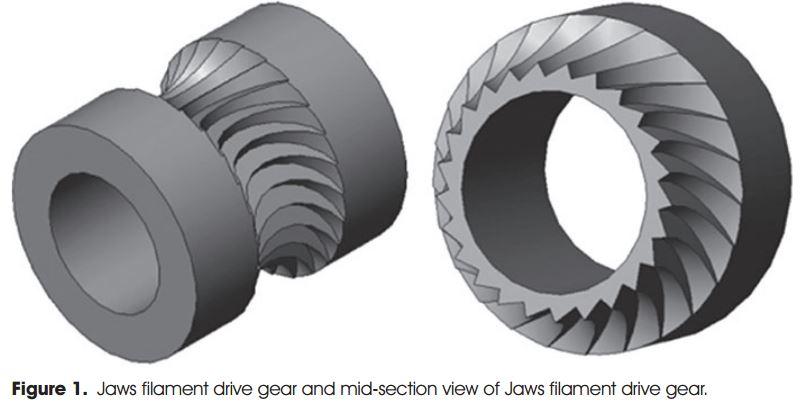
The number of teeth engaged with the filament at any given time is key to maintaining a consistent filament feed. If too few teeth are engaged, the linear feed of the filament will turn into more of a sine wave pattern than a consistent straight line over time.
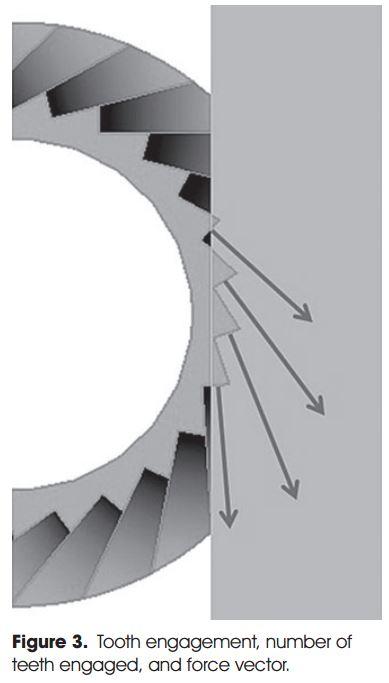 Directing the force of the vectors downward as much as possible is also critical to a consistent printing process. There will always be a certain amount of lateral force, but it should be limited in order to increase the conservation of energy in the printing process. Not to mention, too much lateral force could also lead to filament deformation.
Working to optimize the factors above, the re:3D team preformed multiple trials at varying levels of tensioner adjustments. The force was then measured by a custom-designed process they built specifically for the trials. They specifically wanted to measure the ability of the extruder to push the filament through the hot end in order to obtain better real-world operating conditions.
They repeatedly tested a gradual increase of force on the filament until it was stripped and the Jaws drive gear was no longer able to impart force upon it. The final result was that the team was able to impart over 50lbs of force on the filament.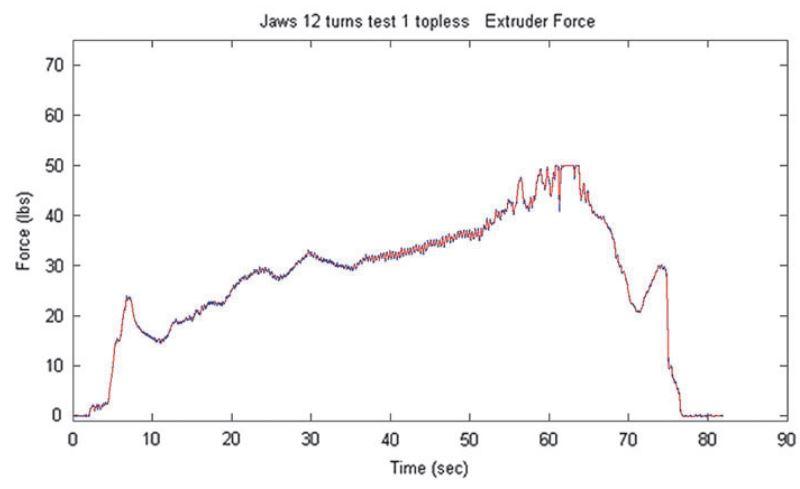
The promising results of their initial research established a baseline for the new Jaws extruder bolt. Perhaps more importantly, this work continues to lay the foundation for more consistent fused filament fabrication printers in the future, which will ultimately lead to wider adoption and growth of the 3D printing industry.
Subscribe to Our Email Newsletter
Stay up-to-date on all the latest news from the 3D printing industry and receive information and offers from third party vendors.
Print Services
Upload your 3D Models and get them printed quickly and efficiently.











You May Also Like
Reuniting ExOne and voxeljet: An Investor’s View on Building a Global Industrial Sand Printing Leader
Authored by Whitney Haring-Smith, Chair of the Board, ExOne Global Holdings & Managing Partner, Anzu Partners At Anzu Partners, we invest with conviction in industrial technologies that create categories—and then...
Adoption of Advanced Powder Metal Manufacturing in the Global Small Arms Space – SHOT Show 2026 Additive Manufacturing Analysis
Back in 2013, I remember being completely blown away when a company called Solid Concepts reportedly additively manufactured nearly a complete firearm as a proof of concept. Although desktop polymer...
AM-Europe, operated by CECIMO: Positioning Additive Manufacturing at the Core of Europe’s Industrial Competitiveness
As European industries face growing pressure to strengthen resilience, reduce supply chain risks, and meet sustainability objectives, additive manufacturing (AM) is emerging as a practical and strategic solution. Closely align...
Five Imperatives for CAD and PDM In The Additive Era
Additive manufacturing has reached an inflection point. Hardware capabilities continue to advance, materials portfolios are expanding rapidly, and automation is reshaping post‑processing and production workflows. Yet many additive programs still...