University of Oslo Master’s Student Creates Amazing Open Source 5-Axis 3D Printer

 When we think of desktop FDM/FFF 3D printers, we typically picture a gantry style Cartesian-based machine, or a Delta robot style printer. These machines are capable of 3D printing objects based on three axes: X, Y, and Z. The X and Y axes make up the two-dimensional plane, while the Z axis is the third dimension, allowing for objects to be built up one layer at a time. For one University of Oslo Master’s student, named Øyvind Kallevik Grutle, this just wasn’t enough.
Grutle, who needed to select a project for his Master’s thesis at the Norway-based university, decided to attempt to create a 3D printer that was capable of printing using 5 axes instead of the more conventional 3. The idea was actually that of his professor who wanted a student to build a 5-axis machine with some sort of tool attached to it. Grutle thought it would be interesting to create a 5-axis 3D printer, so that is exactly what he did.
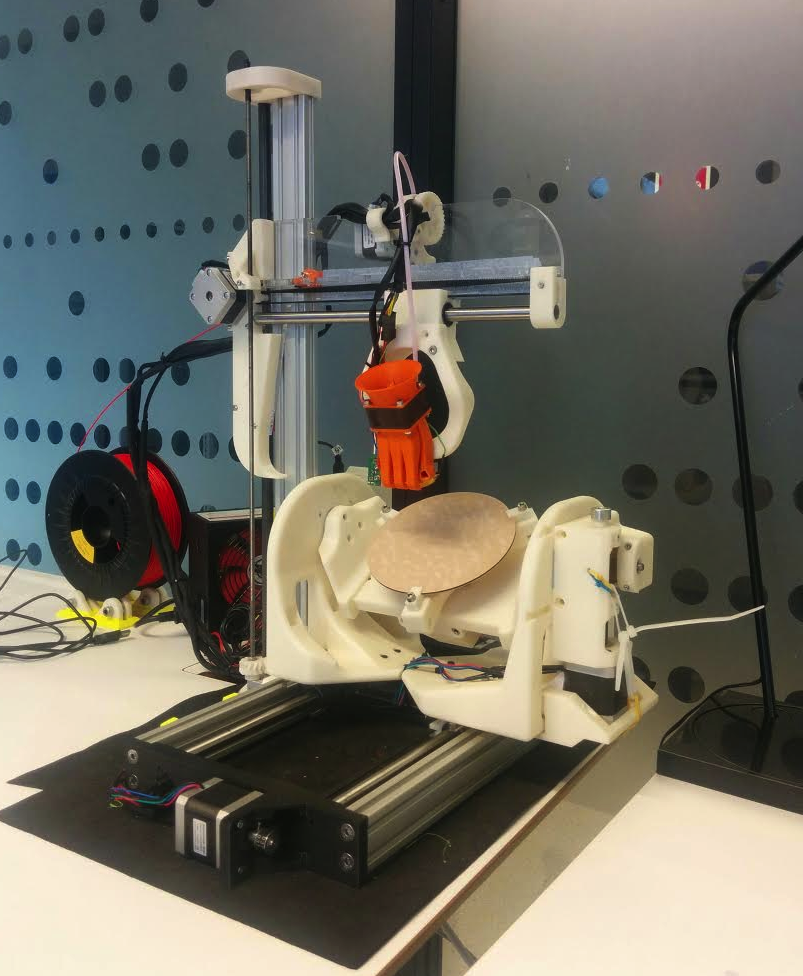
The 5-axis 3D printer
“The system is a modified RepRap Ormerod, where I have used the Duex4 controller for added motor drivers,” Grutle tells 3DPrint.com. “Then I have modified DC42’s Ormerod firmware version 1.04d to use the extra drivers on the Duex4 as motor drivers. Also the system utilizes a gcode which is based on FANUC Type I and Type II where the gcode has an untransformed x, y and z coordinates and an A and C angle or I, J, K vector which is the direction of the nozzle onto the part which is being printed. This gcode is transformed in the firmware and so the printer goes where it should.”
The proof of concept, which Grutle created, worked very well, so he decided to test out the two most obvious benefits that a 5-axis 3D printer should provide: the printing of smooth surfaces on planes other than the XY plane, and the printing of overhang structures without the need for support material.
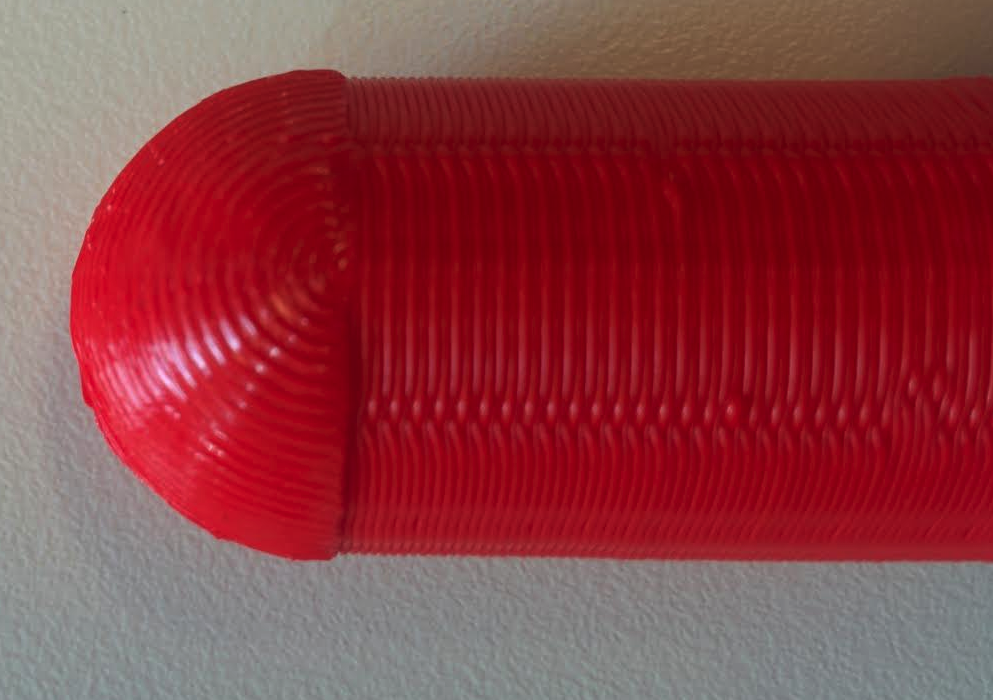
“Normal 3D printers can already do this to some extent with a low layer height and support, but my system removes costs in support material and time with the help of the 2 extra axes,” Grutle tells us. “Another benefit of this system is that it can build parts where the layers are in different directions. This can create parts that can bend in different directions, and can create parts which are stronger than in a normal system.”
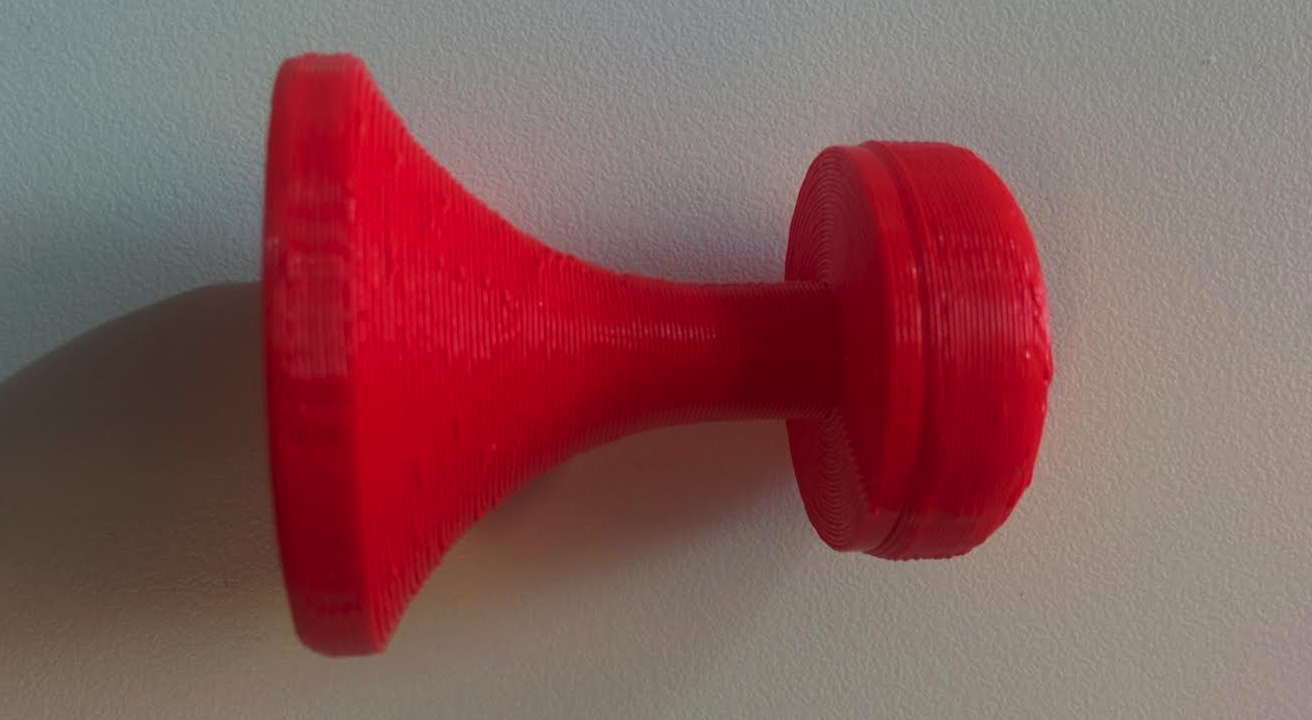
a 3D printed part
Grutle has so far created two different versions of his 5-axis 3D printer. The first version took him about 2-3 months to create, but he found that it had problems with the worm gear he chose to drive the A and C axes with. This convinced him that he needed to create a second version, called the “Pentarod,” which took him about a month to design and fabricate. It uses a FANUC Type I and Type II system, which seems to work much better.
“The reason I chose to make it work with the FANUC system is because there is a lack of gcode generators for 5 axis 3D printing, and with the FANUC system I could create 5-axis milling paths for surfaces with HSMWork, and then modify it to work as gcode for the 3D printer,” Grutle tells us.
Gruel, who is a 28-year-old student currently working for his Master’s degree in Robotics, plans to release the design files and instructions for this 5-axis 3D printer as an open source project, since it is based on a system from the RepRap community. He still hasn’t decided if he will develop it further or just release what he has created thus far.
As you can see in the videos below, there are many great benefits to a 5-axis 3D printer like the one that Grutle has created. With this project going open source it will certainly be interesting to see just how quickly 5-axis 3D printing catches on. What do you think about Grutle’s 3D printer? Do you think this is the future of desktop 3D printing? Discuss in the 5-Axis 3D Printer forum thread on 3DPB.com.
Subscribe to Our Email Newsletter
Stay up-to-date on all the latest news from the 3D printing industry and receive information and offers from third party vendors.
Print Services
Upload your 3D Models and get them printed quickly and efficiently.











You May Also Like
Campbell’s Exec Fired After “3D Printed Chicken” Claim — But What’s Really Going On?
Campbell’s is dealing with an unusual crisis this week, and somehow 3D printing ended up in the middle of it. It all began when a former employee, Robert Garza, released...
3D Printed Food for Those with Chewing Difficulties Now Available for Home Delivery
One interesting but overlooked use of 3D printing is in special food for hospitals and care facilities. This is a big potential market, as through additive, foods can be enriched...
UMAMI Bioworks to 3D Print Cultivated Fish Pet Food
UMAMI Bioworks is partnering with Friends & Family Pet Food Co. to produce 3D printed pet food. They will start with cat treats, which will be introduced to the markets...
3D Printing News Unpeeled: Tails, Wasteful 3D Prints & Salmonella
A photo on Reddit of a user making a color 3D printed model and getting 15 times the amount of waste has sparked a mini debate. But, with a 1000...