UK’s LPW Technology & Metalysis Partner to Offer Greener Metal Powders for 3D Printing


As the additive manufacturing market grows, one of the most significant areas of growth remains the development of technology to lower costs and to offer environmentally friendly products and processes that maintain industry standards in high-quality metal powder production. A recent partnership between two UK-based companies — LPW Technology and Metalysis — may change the future of powders used  in critical applications within the additive manufacturing (AM) market. The focus of the partnership is on developing an alternative supply chain for clean, environmentally friendly, and spherical tantalum and tungsten powders. While Metalysis offers unique metal production technology, LPW offers spherodisation and post-processing capabilities that will surely benefit the additive manufacturing industry.
Founded in 2007, UK-based LPW Technology leads the market in metal powder development and related services for the AM industry. From creating new alloys to providing expert application support and offering AM machine maintenance, LPW Technology has developed a range of optimized powders for Laser Metal Deposition (LMD), Electron Beam Melting (EBM), and Selective Laser Melting (SLM) with both stocked standard powders and customized powders available.
LPW is headquartered in Runcorn, Cheshire, UK with a Pittsburgh, Pennsylvania subsidiary that provides US-based support. The company serves the aerospace, biomedical, and automotive industries with high-quality powders all over the world: China, Israel, Italy, Japan, Singapore, South Korea, and Turkey have all forged relationships with the company.

Dr. Phil Carroll, LPW’s Managing Director, remarks about the potential benefits of this new partnership for the AM industry:
“Metalysis offers a greener and more cost-effective process, add our specialist industry knowledge and we can then supply a range of high quality, specially developed powders for the additive manufacturing industry.”
 Metalysis, also a UK-based company, owns the global rights to a cost-effective and environmentally friendly technology that produces metal powders and innovative alloys. As Metalysis’ website explains, the company’s process keeps the metal “in a solid state and no melting takes place as powder is produced directly from its oxide… It uses calcium chloride, which has the toxicity of table salt, and can then be recycled for repeated use.”
 A breakthrough process, Metalysis’ solid-state technology forms metal powders by introducing metal oxide into a molten salt bath where it is electrolyzed. Metalysis has built a prototype metal producing facility, and it is currently focused on tantalum powder production to be used in aerospace, biomedical, electronics, petrochemical, and automotive industries.
“The strategic collaboration between LPW and Metalysis will seek to develop and build the additive manufacturing market for tantalum and its alloys by pooling resources,” said Dion Vaughan, Metalysis’ Chief Executive. “We believe that LPW’s market expertise will complement Metalysis’s experience in metal powder production to further the development of AM.”
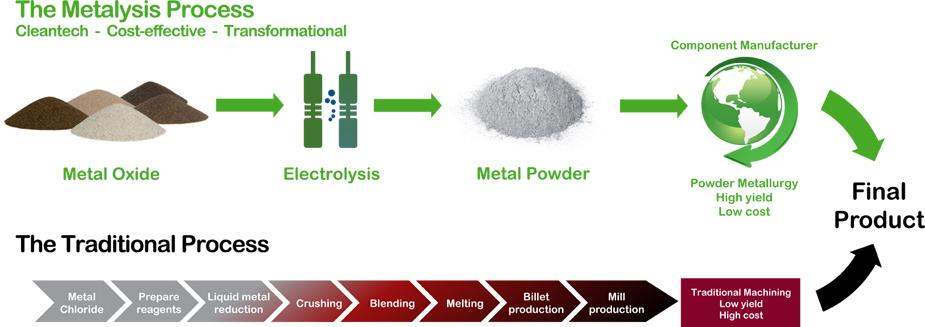
The future already looks brighter for lower-cost and greener metal powder production with these two companies leading the way through global industry connections and greener and cleaner technology solutions.
Let us know your thoughts on this new partnership in the Metalysis and LPW Technology forum thread over at 3DPB.com.
Subscribe to Our Email Newsletter
Stay up-to-date on all the latest news from the 3D printing industry and receive information and offers from third party vendors.
Print Services
Upload your 3D Models and get them printed quickly and efficiently.












You May Also Like
AM Asia Watch: Chinese Company Claims Advances in Titanium Powder Beyond 700C
They’re a familiar sight at trade shows: Chinese powder companies with barren stands lacking parts. There’s maybe some glass vessel with powder in it and a semi-complete data sheet, but...
Aires Tide Designed with AI, Supercomputers, and 3D Printing
The Department of Energy‘s National Nuclear Security Administration (DOE/NNSA) is part of the US government that manages the US nuclear stockpile, helping to upgrade, improve, and maintain nuclear weapons, and...
Largest Publicly Announced, Single Order in EOS History: Beehive Industries Spends $50M on M4 ONYX 3D Printers
Earlier this year, Beehive Industries received a $29.7 million contract to produce its Frenzy 6 and Frenzy 8 engines for the US Air Force. The metal additive manufacturing (AM) user...
Blue Origin’s New Glenn Explosion Comes During Major Manufacturing Push
Blue Origin‘s orbital New Glenn rocket exploded during a hot-fire test at Launch Complex 36 in Cape Canaveral on May 29, setting back the company’s launch ambitions at a time...