Taiwan’s ITRI Rolls Out Handheld and Wireless Mobile 3D Scanner


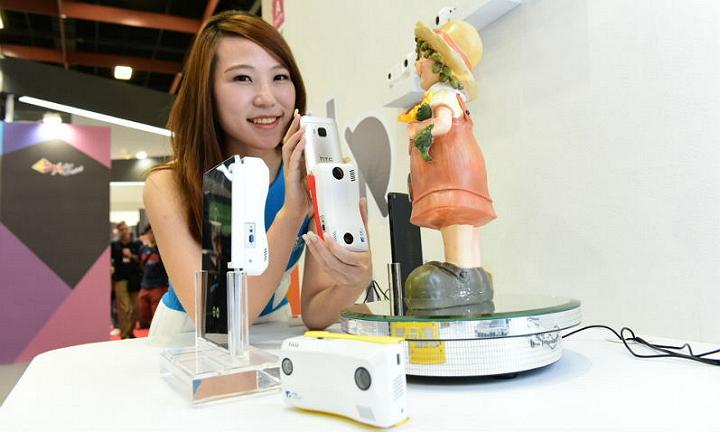 The Industrial Technology Research Institute, or ITRI, is the major government-funded institute for Taiwanese technology, and the group just debuted a state-of-the-art, handheld 3D scanner and wireless mobile 3D scanner, mScan, at COMPUTEX TAIPEI 2015.
 ITRI is a nonprofit R&D organization which undertakes applied research and technical services, and it was founded in 1973. Since that time, ITRI has overseen the development of more than 260 companies, among them global semiconductor companies such as TSMC and UMC. The group boasts strategic collaborative partners such as Corning Glass, Underwriters Laboratories, Applied Materials, Asahi Kasei, Nidec, Fraunhofer, VTT of Finland and Ericsson among their contacts.
ITRI also operated offices in Silicon Valley, Tokyo, Berlin, Moscow, and Eindhoven.
According to Jenny Lin, the Manager at the Electronics and Optoelectronics Research Laboratories within ITRI, this handheld 3D scanner uses depth camera technology to compare a captured image from an IR camera and then introduces a specific pattern of random speckles onto the target object.
“This is a light-weight handheld device – only 1kg in weight,” Lin says. “The scanning frame rate is 10 fps, and accuracy of 3D modeling can be reached to 0.1mm through the real time registration and fusion of 3D image processing.”
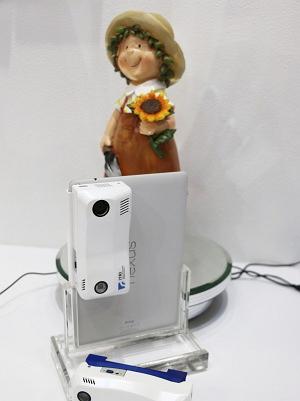
The scanner is also capable of acquiring 3D camera data of the target object based on a single-shot by superimposing the 3D data with a “volumetric registration method” to reconstruct the object and create a precision, 3D color model. The mScan is a wireless mobile 3D scanner designed to piggyback on the functionality of smartphones and devices.
“It integrates infrared depth and color image sensing into a single compact module,” Lin said. “Once the user installs the app to their Android device or Windows computer, 3D scanning can be activated through wireless communication.”
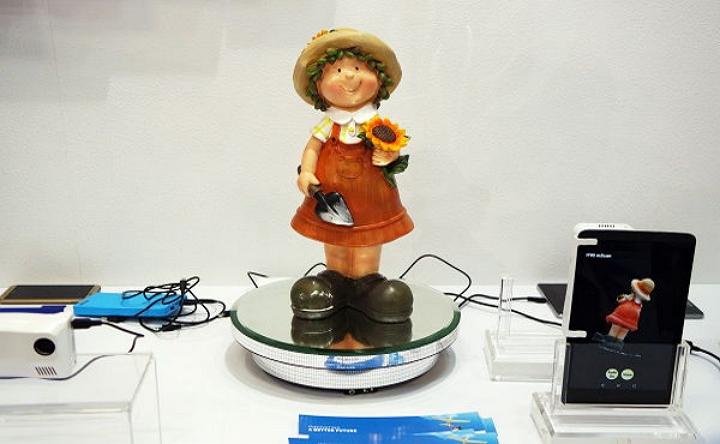
Lin says a user can view the creation of a full color 3D model instantly as the scanning process is underway, and that allows users to easily adjust the scanning angle and position of the device quickly to produce optimum images.
The mScan also functions with Android smart devices, Windows computers, RGB+IR single sensor camera designs and includes a wireless connection function. According to ITRI, the scanner is ideal for personal 3D modeling and printing, AR gaming development, 3D previewing, medical and healthcare applications, 3D image inspection and review, heritage preservation and digital archiving.
Have you ever had business dealings with ITRI or used any of the products they’ve nurtured over the years? What do you think of these latest 3D scanners? Let us know in the ITRI Mobile Scanner forum thread on 3DPB.com.
Subscribe to Our Email Newsletter
Stay up-to-date on all the latest news from the 3D printing industry and receive information and offers from third party vendors.
Print Services
Upload your 3D Models and get them printed quickly and efficiently.













You May Also Like
Metal 3D Printers for the Desktop Are Finally Starting to Feel Like Desktop Products
FDM 3D printing is becoming increasingly accessible, yet metal 3D printers designed for everyday desktop use remain rare on an ordinary workbench. The real challenge is not making a metal...
What 3D2GO Says About 3D Printing’s Growth in Southeast Asia
The Philippines offers an interesting case study in how 3D printing can develop in Southeast Asia, and Manila-based 3D2GO helps illustrate it. 3D printing in Southeast Asia doesn’t have to...
The Frankenservice Part 2: Have Your Cake and Eat it Too
This series of articles delves into a thought experiment. What if we let go of using a few machines very optimally, but instead use lots of different machines to meet...
Silencer Market Set to Test Metal Additive’s Readiness for Production Prime Time With Enormous Market Expansion
Throughout the history of additive manufacturing (AM) technologies, there are only a couple of really interesting case studies in which we see a market significantly disrupted and revolutionized by AM....