Build Useable Furniture With 3D Printable Modular Construction System

3D printed furniture has generally been a rather tough sell for most 3D printer owners. The main problem is size obviously, most desktop 3D printers have rather small build envelops, so in order 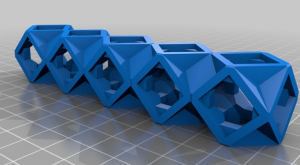 for the users to make use of it the parts would have to be printed is smaller pieces and then joined. For many geometries, that is where the real problems begin. Parts would need to be connected with super glue or a bonding agent, which can often weaken or deform the end product. Any finished furniture would need to be heavily post processed and most likely would not be especially sturdy.
There are very large volume 3D printers that are capable of printing smaller pieces of furniture in one piece, but those are prohibitively expensive and still limited to the available materials. Sure there are 3D printing filaments made of wood materials, however, durability is still going to be a concern. In order to make sure the furniture is strong enough to hold any weight the parts would need to be printed mostly solid which would equate to hundreds of dollars in material costs depending on the size object that is being fabricated. Not to mention the fact that it would take several days to print anything large enough to be called furniture.
 But a few designers have turned to modular construction in order to build larger objects which are easier to print and customize. 3D designer and Thingiverse user Stewart Allen has been developing a construction system using simple blocks that can be connected into a large variety of shapes and configurations, and he’s designed and tested over a hundred versions. His Construction System, Version 108 is his latest iteration and according to him his most successful attempt. The modular block system has 19 different components that can all be 3D printed on any desktop printer and assembled into furniture that is durable enough to be used every day without needing to worry about breaks or cracks.
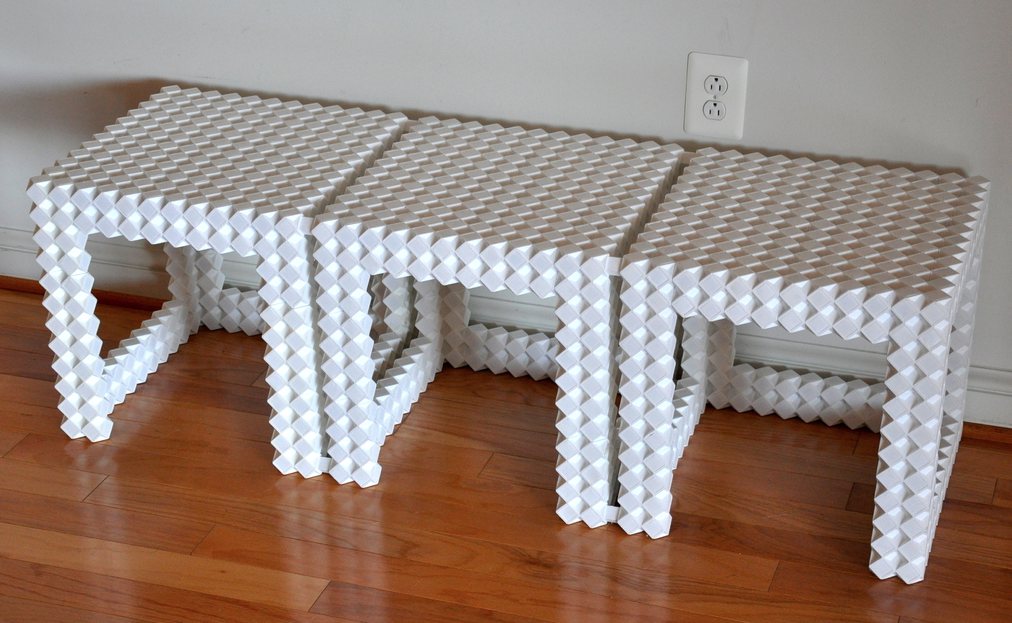
“Of the systems I’ve created, version 108 has so far been used to create the largest usable objects. The bench pictured is actually in my foyer. It’s incredibly sturdy and load bearing. Three people can sit on it. You can stand and dance on it. It does not bend or crack. My kids throw their backpacks and shoes on it daily. It consists of roughly 1068 blocks (mostly 2×6 “ell” shapes and 2×6 bars) and had a print time of a little under 400 hours (spread across 5 printers),” Allen explains.
Allen’s Construction System was modeled in Solidworks and then he sliced the parts using Simplify3D or Makerbot desktop. He sends the parts to a 3D printer farm of six connected Makerbot Replicator 2’s using wireless SD cards. Over the course of developing his modular constructions systems he has logged thousands of 3D printing hours and has run afoul of just about every limitation that desktop  3D printing has. In order to print large volumes of modular parts Allen had decided to develop his own 3D printer for scaled parallelized printing. He is also developing a webgl/javascript based slicer that he intends to make available later in the year.
“Other than the practical matter of printing a large number of parts, there is no reason this could not be used to create desks, shelves, cubicles, tables or cat palaces. The shape of the components in this bench were actually chosen for a combination of the fastest print time with the greatest strength,” Allen assured me.
Allen initially intended to apply for copyrights and trademarks for his Construction System but has decided to release the files as an open source design for anyone to use and modify. And despite this being his 108th version, he is going to continue to improve and optimize the 3D printable parts to maximize strength and lessen the required printing time. He is also in the process of building several more pieces of furniture, including a side table that will feature a tempered glass top. Let us know what you think of Allen’s latest design on our 3D Printable Modular Construction System forum at 3DPB.com.
Subscribe to Our Email Newsletter
Stay up-to-date on all the latest news from the 3D printing industry and receive information and offers from third party vendors.
Print Services
Upload your 3D Models and get them printed quickly and efficiently.











You May Also Like
Reuniting ExOne and voxeljet: An Investor’s View on Building a Global Industrial Sand Printing Leader
Authored by Whitney Haring-Smith, Chair of the Board, ExOne Global Holdings & Managing Partner, Anzu Partners At Anzu Partners, we invest with conviction in industrial technologies that create categories—and then...
Adoption of Advanced Powder Metal Manufacturing in the Global Small Arms Space – SHOT Show 2026 Additive Manufacturing Analysis
Back in 2013, I remember being completely blown away when a company called Solid Concepts reportedly additively manufactured nearly a complete firearm as a proof of concept. Although desktop polymer...
AM-Europe, operated by CECIMO: Positioning Additive Manufacturing at the Core of Europe’s Industrial Competitiveness
As European industries face growing pressure to strengthen resilience, reduce supply chain risks, and meet sustainability objectives, additive manufacturing (AM) is emerging as a practical and strategic solution. Closely align...
Five Imperatives for CAD and PDM In The Additive Era
Additive manufacturing has reached an inflection point. Hardware capabilities continue to advance, materials portfolios are expanding rapidly, and automation is reshaping post‑processing and production workflows. Yet many additive programs still...