This 3D Printed RC Tank Doubles as a Fully Functional PC

 When the first Quakecon event was held way back in 1996 it was an informal gathering of a small but dedicated group of fans of Id Software games Quake and Doom. It had only 30 attendees, however that quickly grew to over 100 by the end of the weekend. The event is now known for it’s massive tournaments and contests, but the first was just an impromptu LAN party set up by the small group of fans playing for t-shirts. Since that first gathering, the amount of people attending Quakecon has grown to well over 9,000, and the single tournament has grown into several contests, including one for computer case mods.
Over the years the case mod contest has produced some amazing entries, ranging from the artistic, to the high tech to the just plain weird. There has been multiple LEGO cases, a life sized R2D2 computer case, a case that looks like a BBQ and even a retro boom box case. As Quakecon grew into one of the most popular gaming events of the year, the case mods only got bigger and more elaborate.
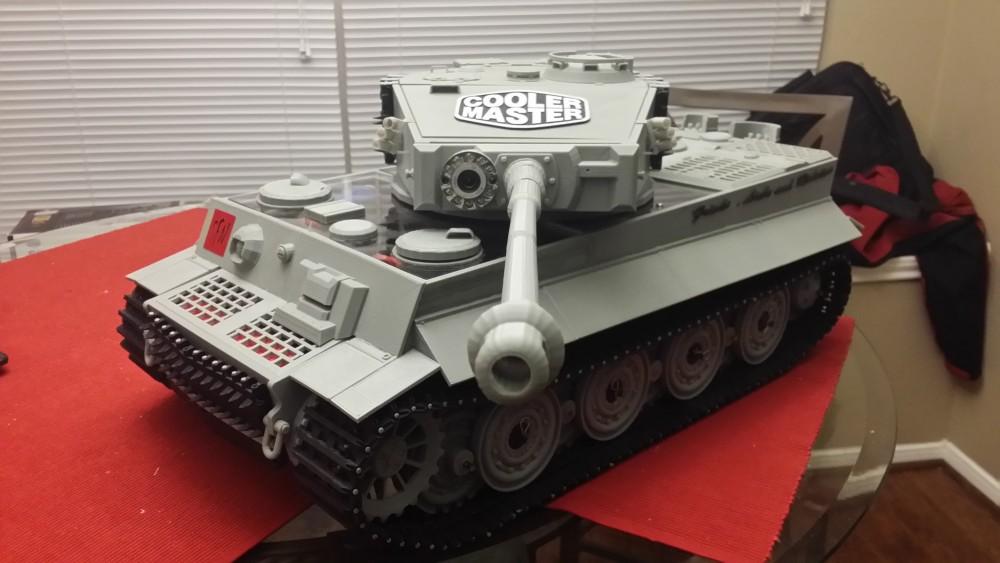 Regular Quakecon attendee Adam Owen had already won several contests in the fabrication category with previous entries, including a wooden table built to look like a classic Super Nintendo controller. He wanted to do something big for the latest Quakecon and initially intended to build a PC case that was also a functional mech unit from the game Wolfenstein: The New Order. But as anyone familiar with 3D printing can tell you, the learning curve can be steep and time was at a premium so he settled on a RC Tiger I tank. Owen purchased his first 3D printer kit on eBay and built his Eventorbot kit as a bit of a learning experience. When it came time to build his tank, he upgraded his 3D printer to a MakerBot Replicator X2.
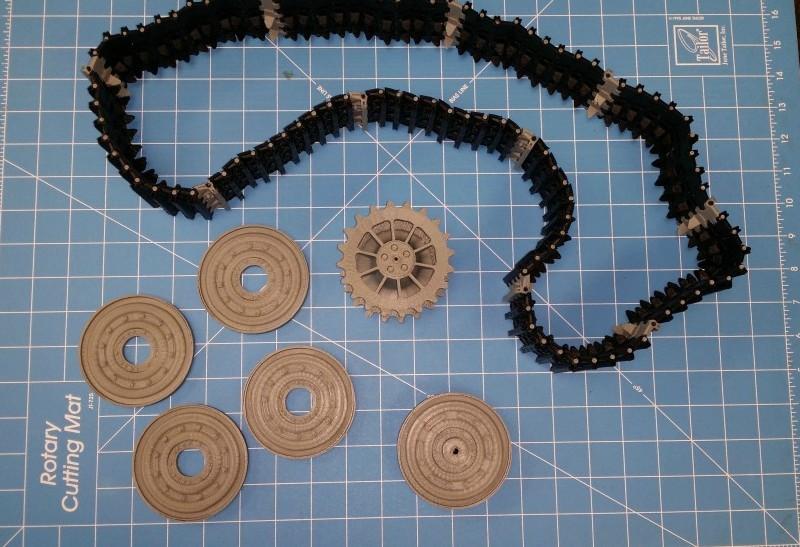
Each tank tread is made up of over 200 individual pieces.
Owen designed his tank case in Sketchup entirely on his own from reference photos that he found online, and many of the parts would need to be designed and printed several times. Just the tracks alone required several months of designing, testing and redesigning until they worked correctly. Each of the tank’s treads have over 200 individual parts, including 200 handmade pins to hold them together. Owen printed all of the case parts out in ABS, and he estimates that it took him well over 300 hours of printing time to complete his build. Although he believes that he could cut that down now that he has worked all of the design kinks out, and he’s even uploaded all of the 3D files to Thingiverse so anyone can try to build their own.
Here is a brief video of the tank case in action:
The tank tracks are driven by two electric rock crawler motors connected to a fully 3D printed transmission. The motors are powered by two lithium batteries and produce enough torque to easily move over twenty pounds without any issues. The turret is also fully functional and can rotate almost a full 360 degrees and tilt up and down. And there is still a powerful CPU inside of the RC tank, including a working cooling system and a camera.
“Using the software on my phone, I can access the camera from anywhere with internet access and control the turret functions remotely. Going back to the point of this build, the Tiger I houses a complete computer system with an Asus mini-ITX motherboard, Intel i7 4770K CPU, 550 watt Cooler Master power supply, and an EVGA 750ti video card. The PC is fully functional and can play any game I’ve thrown at it, including World of Tanks,” Owen explained via email.
Here is a video of Owen explaining the computer specs and case build process:
 All of the hundreds of individual parts were sliced using the native MakerBot Replicator software, and because Own wanted to print his tank in ABS for the added durability he needed to include a lot of rafts and support structures. That meant all of the parts required a lot of post processing work. In order to hold all of the parts together and maintain a solid structure, he created a concoction of acetone and ABS filament that he used to bond all of the components.
His first tank case mod won first place in the recent Quakecon fabrication category, but he still wasn’t content so Owen stripped the parts down and started to built it again. He decided to use higher quality Cooler Master parts and intends to enter the finished case into the Cooler Master Case Mod World Series event. His finished tank looks even better than the original, and will most certainly attract a lot of attention. You can read his detailed build log, including dozens of pictures over on the Cooler Master forums. And you can let us know what you think of Owens tank case mod in our 3D Printed RC Tank PC forum at 3DPB.com.
Subscribe to Our Email Newsletter
Stay up-to-date on all the latest news from the 3D printing industry and receive information and offers from third party vendors.
Print Services
Upload your 3D Models and get them printed quickly and efficiently.











You May Also Like
Boston’s Additive Edge: Harvard’s MEDscience Takes High Schoolers Into the Future of Medicine
Forget chalkboards and worksheets. At Harvard Medical School’s MEDscienceTECH Program, students learn medicine by building, coding, and experimenting – whether it’s navigating a LEGO robot through a 3D printed spine,...
3D Printing News Briefs, November 22, 2025: Rebranding, Integration, Electronic Eyes, & More
We’ll start with a new software tool from AON3D in today’s 3D Printing News Briefs, and then we’ve got a lot of business, from Conflux Technology and Prima Additive to...
Formnext 2025: New Metal PBF 3D Printer, Serial Production Applications, & More
It’s Day 2 of Formnext 2025, where over 800 exhibitors from around the world have converged in Frankfurt for Europe’s premier additive manufacturing (AM) trade show. From exciting new printers...
EOS Launches M4 ONYX 3D Printer at Formnext 2025
EOS is steadily establishing itself as an expert in developing dual-use technologies. Now, as I mentioned in a recent interview with Greg Hayes, the Senior VP Global Additive Minds at...