3D Systems Reveals Details of 3D Printing Assembly Line, 50X Faster Than Other Printers


One of the only factors holding back 3D printing within the mass manufacturing space, is speed. Even though only recently, has 3D printing become a useful means of manufacturing, 3D systems is already introducing a  new paradigm shift within the space, and it could lead to seismic changes for the manufacturing industry.
In an attempt to absorb a larger market share within the $10 trillion+ manufacturing industry, and to cater to the mass manufacturing needs of Google’s Project Ara, 3D Systems has invented a new high speed 3D printer which works similar to that of a sophisticated assembly line.
“The paradigm shifting, continuous, high speed, fab-grade printer will make true automated, low touch additive manufacturing a reality. To ramp up the speed for production level volume, we have broken away from the methods of contemporary 3D printers,” stated the company.
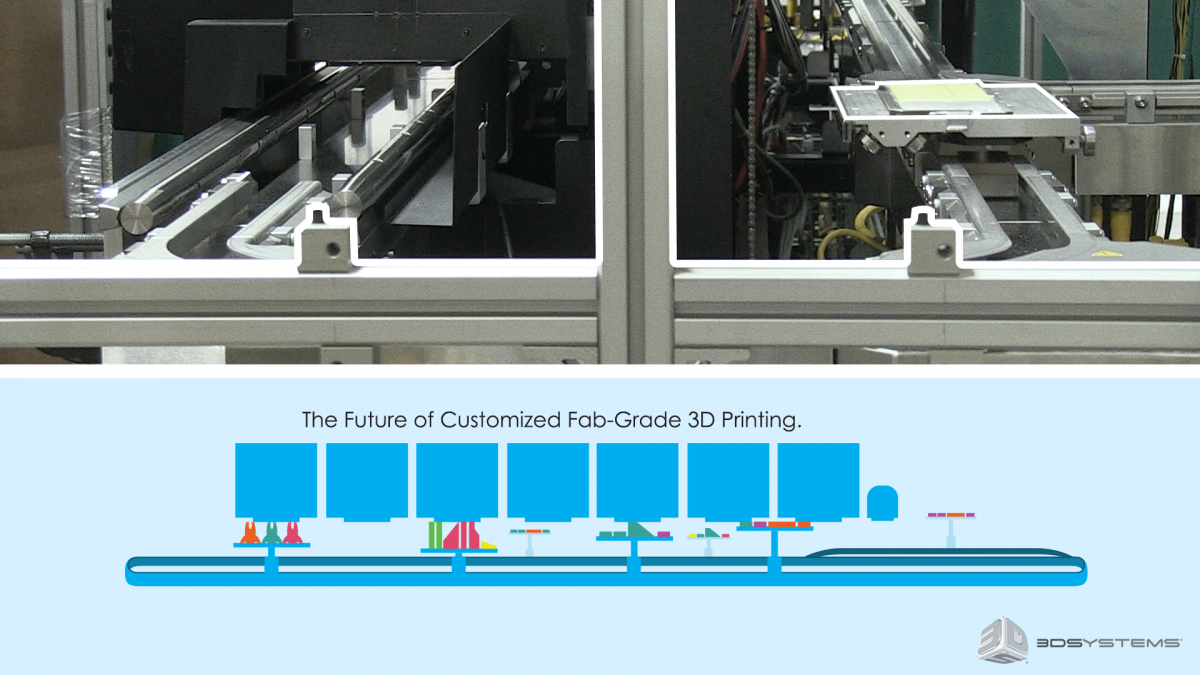
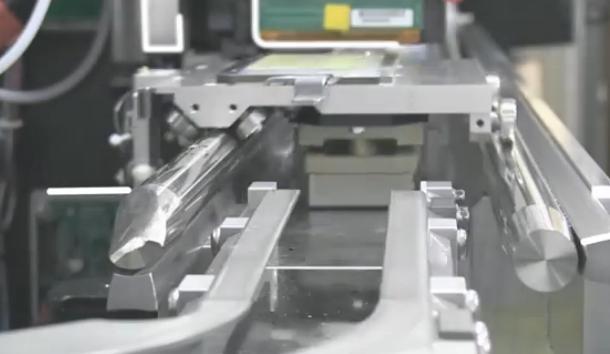
A typical 3D printer works by moving a print head over a print bed repeatedly, as it deposits material, layer upon layer, slowly building an object. This latest technology, which 3D Systems will officially unveil at Euromold 2014 this November, works in an entirely different manner. The new printer will be set up similar to that of an assembly line. Instead of the print head moving over a print bed, several print beds will speed along a racetrack-like architecture, passing through numerous stationary print heads, which deposit material on each of them. Like an assembly line, when one object is completely printed, its print bed will be diverted from the main track, and a new print bed will enter onto the track to begin its assembly. Each printed object is able to consist of multiple materials, as well as multiple colors.
3D Systems’ New Assembly Line Architecture
Such printers, according to 3D Systems, are capable of printing millions or even billions of Google Project Ara phone modules each year, and can print at speeds 50 times that of traditional 3D printers. One printer is capable of printing 4 billion drops of material via a jetting technology, each and every minute, with micron accuracy, and spits out two liters of plastic resin every three minutes.
“It really is the holy grail of 3D printing,” said Jeff Blank, VP engineering, new business development, for 3D Systems
It’s nearly impossible to imagine what such a printer could do for the manufacturing industry. The ability to mass produce objects, all with different shapes and of varying sizes, as fast as that of traditional mass manufacturing, would certainly be a valuable technology for thousands of companies around the globe.
Check out the video below, showing this new high speed 3D printing system in action. What do you think? Will this new paradigm shift within 3D printing technology lead to the industrial revolution that many have been talking about? Let us know in the 3D Systems assembly line printer forum thread on 3DPB.com.
Subscribe to Our Email Newsletter
Stay up-to-date on all the latest news from the 3D printing industry and receive information and offers from third party vendors.
Print Services
Upload your 3D Models and get them printed quickly and efficiently.













You May Also Like
AM Investment Strategies 2026 Sets the Stage for AMS 2027
AM Investment Strategies 2026 Nov. 5 · 12 p.m. ET · Free online event RESERVE YOUR SPOT ↗ A one-hour online discussion featuring some of the biggest names in 3D...
With Its Latest $200M Round, ICON May Be Running Away With the 3D Printed Construction Market
I used to view ICON, the Austin-based additive construction (AC) firm, as one of a handful of companies that could realistically consider itself the leader of the 3D printed construction...
How Should Businesses Build New Business? Dirk Simon Weighs In — Part 1
Dirk Simon had deep experience in materials and chemistry before joining the 3D printing industry. Instrumental in BASF and Farsoon’s market introduction, Dirk has spent a lot of time thinking...
3D Printing Services Near $2.5B as AM Market Shifts Beyond Hardware
The additive manufacturing market may be growing again, but one of the more interesting numbers behind that recovery has little to do with selling 3D printers. AM services generated nearly...