
California Deputies Raid Identity Theft Ring and Find “3D Printer” Making an AR-15 Lower

The San Bernardino County Sheriff’s Department in California says it all began with a report of a credit card being stolen from the front porch of a residence, and the ensuing investigation led to the arrest of two women who were allegedly operating a wide-ranging identity theft ring and attempting to 3D print a lower receiver for an AR-15 rifle.
The deputies say Josephine Chai, 30, and Jessica Duong, 25, were part of a larger identity theft ring.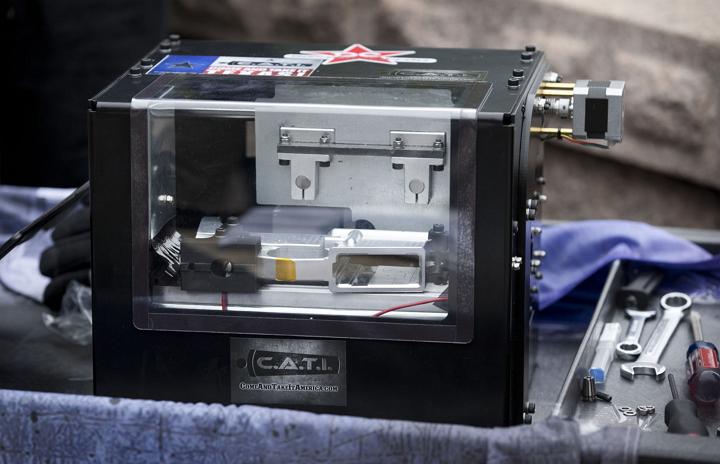
An arrest warrant issued in the investigation allegedly turned up a running 3D printer.
“The printer was on and in the process of making a lower receiver when we got to the home,” Deputy Brian Arias of the Chino Hills Police Department told the Chino Champion Newspaper.
In addition to the currently printing lower receiver for an AR-15 assault rifle, the investigators say they also found a manufactured lower receiver loaded with live ammunition and a manufactured gun, also loaded, but this one with AirSoft ammunition.
Chai and Duong were booked into the West Valley Detention Center on charges which included possession of a controlled substance for sale, manufacturing a firearm using a 3D printer, and a list of identity theft charges.
A pair of men the sheriffs say were part of the ring, Steven Phong, 32, and Wesley Isaacs, 50, were arrested last month.
The search warrant was served at Chai’s house on the morning of April 28, 2015, and the deputies say they discovered the “3D printer” creating a lower receiver for an AR-15, which is an integral part of the assault rifle.
“An AR-15 is comprised of two main bodies,” said former US Army weapons specialist James Sinclair. “There’s an upper and a lower. The lower regulates ammunition expenditure and is regulated by the government.”
It’s not a certainty, but what the sheriffs discovered is likely not a 3D printer per se, but more likely a Ghost Gunner, the Defense Distributed CNC milling machine designed to manufacture the lower receiver of the popular AR-15 rifle. While US law does allow for the creation of firearms from parts or kits, the Bureau of Alcohol, Tobacco, Firearms and Explosives (ATF) says any
“unlicensed individual may make a ‘firearm’ as defined in the GCA for his own personal use, but not for sale or distribution.”
The Ghost Gunner cuts out a semi-finished lower receiver from a metal piece which is generally 80 percent finished and can be purchased from a variety of companies. The Ghost Gunner finishes the lower receiver. The rest of the necessary parts to build a working AR-15 can be purchased online without being subject to waiting periods or background checks.
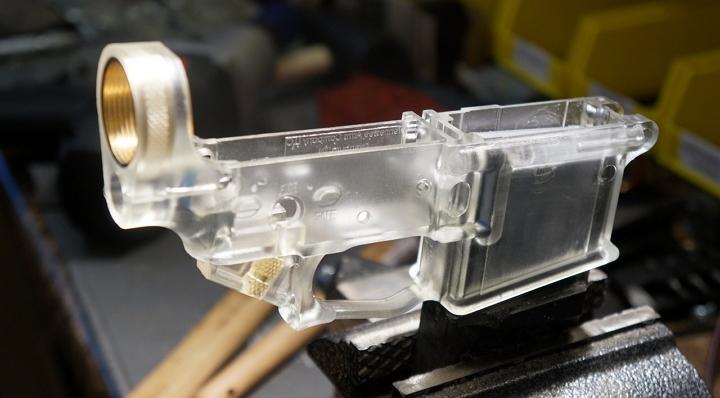
While it is possible to make a “working” lower receiver from plastic materials, a 3D printed version of the piece is not likely to withstand the stresses of firing for long.
Do you think Sheriff’s Deputies in California found members of alleged identity theft ring 3D printing the lower receiver for an AR-15? Let us know your thoughts in the Sheriffs Find 3D Printer Making an AR-15 Lower forum thread on 3DPB.com.
Subscribe to Our Email Newsletter
Stay up-to-date on all the latest news from the 3D printing industry and receive information and offers from third party vendors.
Print Services
Upload your 3D Models and get them printed quickly and efficiently.













You May Also Like
3D Printing News Briefs, September 26, 2026: Bioceramic Implants, 3D Concrete Printing, & More
In this weekend’s 3D Printing News Briefs, we’ll start with an integration between PanOptimization and AMCM, before moving on to healthcare news from KLS Martin and Lithoz, and then UltiMaker...
3D Printing News Briefs, September 24, 2026: Metallic Alloys, Nanobone, Alternative Meat, & More
In this week’s 3D Printing News Briefs, we’ll discuss some materials news: a reference material for standardizing photopolymer manufacturing, metallic alloys that help reduce energy loss in electric motors, a...
AMAsia Pulse: AM Investment Picks Up Across Asia-Pacific
The first half of September brought fresh investment and expansion activity across Asia-Pacific’s additive manufacturing sector. China’s Xinjinghe secured funding for an aerospace AM hub, South Korea’s Lincsolution outlined plans...
3D Printing News Briefs, September 17, 2026: 3D Printed Boat, UAS Development, & More
We’ll start with maritime manufacturing in this week’s 3D Printing News Briefs, and continue on to defense 3D printing. We’ll end with funding for Tripo AI. Read on for all...























































