One Cat Can Rest Easy Again, Thanks to This 3D Printed Automatic Cat Feeder

 3D printing really lends itself to those individuals with creative minds. I’m talking about people who have the ability to come up with an idea, put it on paper, and then make it happen. 3D printing has lent a huge hand to individuals who have this type of mindset, providing them with the tools needed to turn their ideas into tangible products.
For one man named Khing San Tan, of Heiloo, Holland, this was certainly the case. San Tan, a 43-year-old man who works as a programmer at an insurance company, recently purchased a da Vinci 1.0 3D printer in April of last year. He purchased the 3D printer to use in his free time, as he is one of those individuals who like to “make things.” After having successfully designed and 3D printed various items, such as gears for his RC car, an iPad wall dock, and other unique items, he decided to use his talent to solve a problem that his wife was having.
That problem was that their family cat would consistently wake them both up very early each morning, begging tirelessly to be fed. They had become thoroughly fed up with the annoyance, so San Tan decided to use his 3D printer to fabricate a solution.
“The idea was to make a cat feeder so we could sleep longer,” San Tan tells 3DPrint.com. “For this project I used a lot of things that I already had [sitting around the house].”
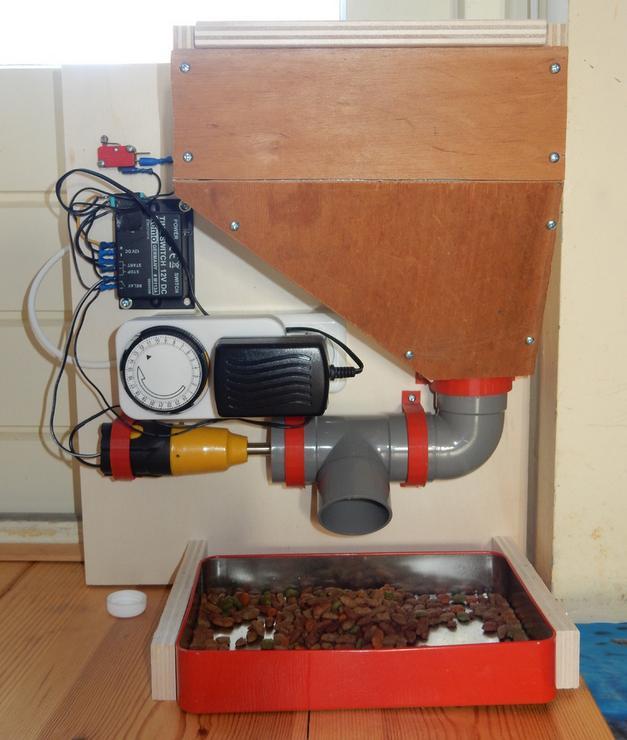 After having looked around Thingiverse for ideas, San Tan decided to construct an automatic cat feeder using a PVC drain pipe as well as a 3D printed auger which he found on Thingiverse. However, he needed to adapt the auger so that it would work with his custom feeder that he would create.
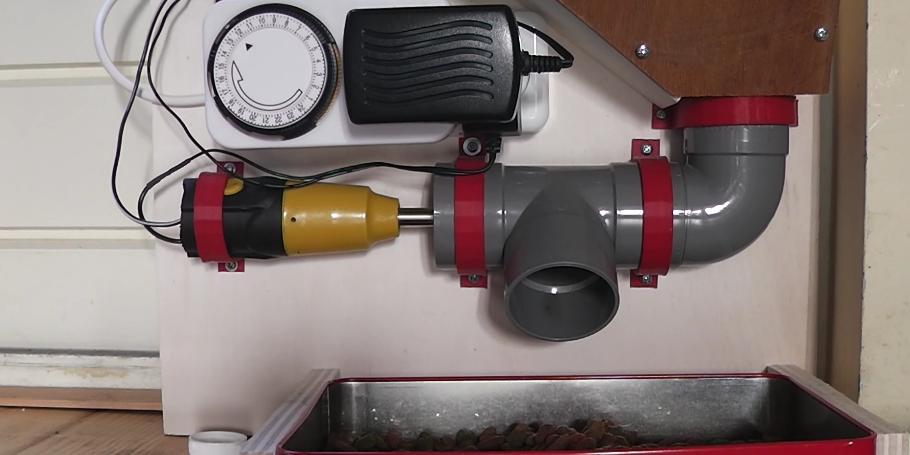
Using SketchUp, he modified the open source design file and had to create four separate iterations before he got it just right. For the electronics, San Tan used two timers, one programmed for the number of times in the day he wished to feed his cat, and the other for the duration between feedings. For the motor, he used one that he removed from inside of an electric screwdriver. He wasn’t using the screwdriver, so he thought the motor should go to good use.
He then made the food holder out of wood, and purchase a small tin container for the food to fall into when the timers were activated.
“For this project I used as many things as possible that I already had on hand,” he tells us.
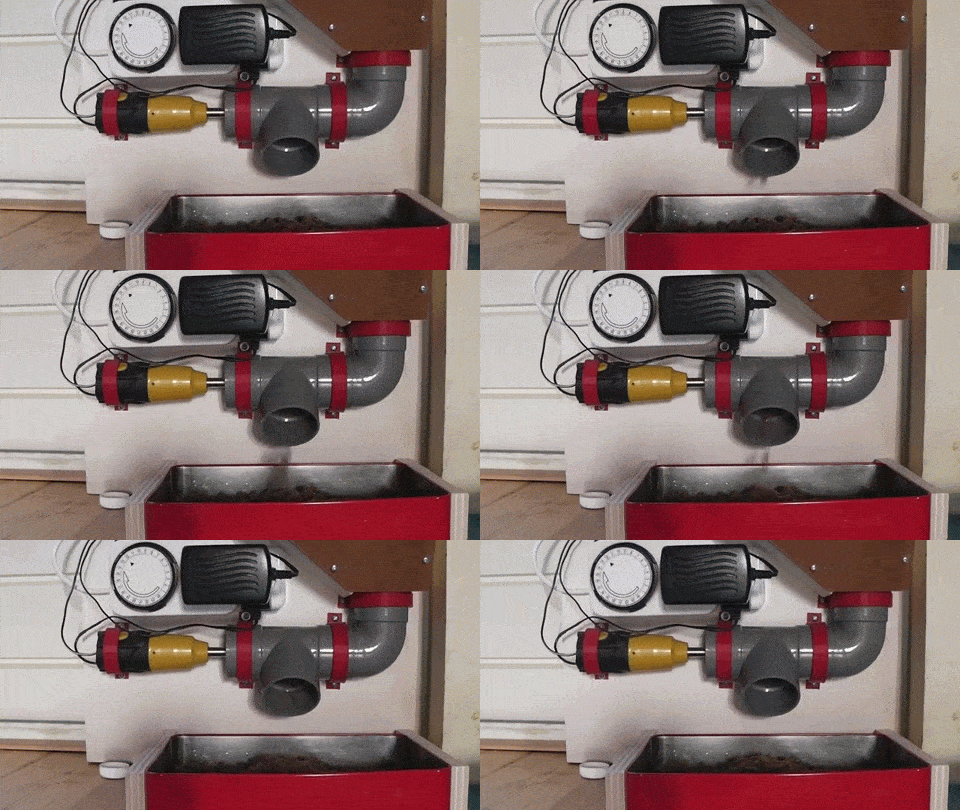
This allowed the final product to be created with only a few dollars in materials, something that surely his wife, and his cat were quite happy about. What do you think about this unique creation, which utilizes 3D printing to help a hungry cat receive his breakfast on time in the morning? Discuss in the 3D Printed Cat Feeder forum thread on 3DPB.com. Check out the video of the cat feeder in action below.
Subscribe to Our Email Newsletter
Stay up-to-date on all the latest news from the 3D printing industry and receive information and offers from third party vendors.
Print Services
Upload your 3D Models and get them printed quickly and efficiently.











You May Also Like
“A More Complete End-to-End Solution”: Stratasys Launches Post-Processing Partnership Program
I think it’s safe to say that post-processing is no longer considered the “dirty little secret” of 3D printing that it once was, with users realizing that finishing is just...
Why SiC-Dedicated Additive Manufacturing Is Gaining Industrial Relevance
Silicon carbide is not a material problem—it’s a manufacturing one. Silicon carbide (SiC) has become a critical material across semiconductors, aerospace, energy, and defense. Its exceptional thermal stability, chemical resistance,...
Championing a Made-in-America Future for Additive Manufacturing
As the additive manufacturing industry continues its rapid global evolution, one theme has risen to the top of strategic conversations: the importance of strengthening domestic production to support national competitiveness...
Friendshoring and Additive Manufacturing: Turning Australia’s Research Strength into Commercial Impact
Global supply chains are being re-written. After decades of globalisation driven primarily by cost efficiency, geopolitical tensions, trade disputes and pandemic-era disruptions have exposed the risks of concentrating manufacturing and...