LUXeXcel Collaborates with Lambda Research in 3D Printing Custom Lens Arrays


 Just last month, Netherlands-based LUXeXcel announced a new partnership with Edmund Optics to bring 3D printed plastic optics to the photonics industry. LUXeXcel‘s announcement then just got the ball rolling, as now they’ve just released news of progress on another front, as they’ve teamed up with a second optics company in another working partnership. Massachusetts-based Lambda Research, which designs optical design and illumination software, including their flagship TracePro software, is now working with LUXeXcel toward the production of custom-textured lens arrays.
“LUXeXceL’s printing process and TracePro are complementary for optics designers in their quest to design the best solution for every project, not having to compromise with standard, less optimal, products,” said Richard van de Vrie, president and founder of LUXeXcel. “[This provides] optical designers with full control over the light distribution, ensuring speed and reduction of project costs.”
By bringing these technologies together, the aim is to allow for “mass customization” of plastic-made optical components, including textured lenses, that can be created to exacting specifications.
 Their process starts with TracePro software, Lambda Research’s illumination and optical design software, in which optical designers create prototype designs that can be exported as CAD files for 3D printing.
“TracePro software simulates the distribution of the light and the luminous intensity,” said Lambda Research’s VP of Sales and Marketing, Michael Gauvin. “This will give designers insight into how the light distrbution of their printed product will look like.”
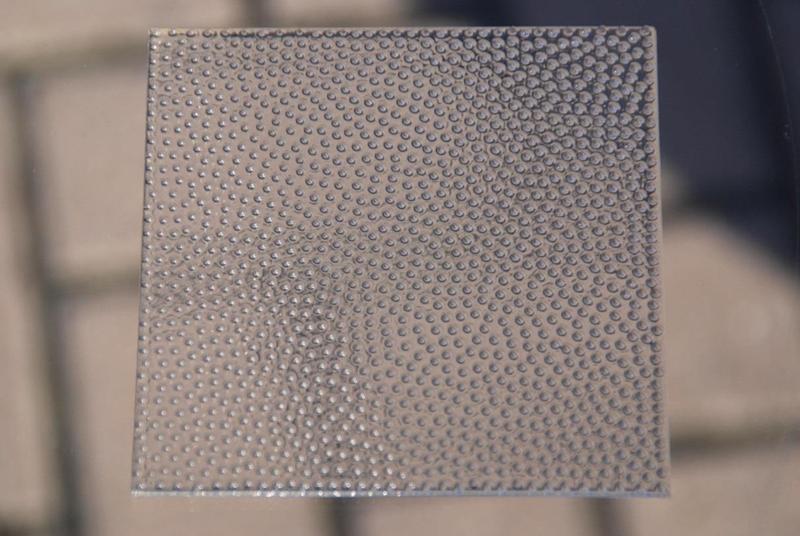
Custom textured lens array designed using TracePro software printed by LUXeXcel (photo: Lambda Research/LUXeXcel)
A “high-quality, commercially viable” lens array was created to showcase the integrated benefits of the partnership. Using TracePro Texture Optimizer, the design was created to diffuse light across the array due to texture and depth variations. TracePro is able to integrate LUXeXcel materials into its design consideration, so designers can see the qualities of the materials and how they will affect the product’s light output.
Once converted into and exported as a CAD file, LUXeXcel took the lead in 3D printing the pieces. The entire iterative process is shortened to a matter of days, a benefit of additive manufacturing enjoyed through a variety of industries where lowering both costs and lead times are hugely beneficial.
“T
he function of our created lens array is to provide randomized uniform light output with light either propagating through the part or reflecting off the part. The texture applied to the part is specific to take a non-uniform propagating light output and create uniform light,” said Lambda Research’s Gauvin. “This is achieved by varying the texture in such a way that strong light areas are reduced and weak light areas are supplanted by moving light from the strong light areas to the weaker ones.”
This partnership should provide some interesting results through the combination of the companies’ complementary technology offerings. Let us know what you think of LUXeXcel’s ongoing forays into 3D printing partnerships in the optics field in the LUXeXcel and Lambda Research forum thread over at 3DPB.com.
Subscribe to Our Email Newsletter
Stay up-to-date on all the latest news from the 3D printing industry and receive information and offers from third party vendors.
Print Services
Upload your 3D Models and get them printed quickly and efficiently.













You May Also Like
AM Asia Watch: Chinese Company Claims Advances in Titanium Powder Beyond 700C
They’re a familiar sight at trade shows: Chinese powder companies with barren stands lacking parts. There’s maybe some glass vessel with powder in it and a semi-complete data sheet, but...
Aires Tide Designed with AI, Supercomputers, and 3D Printing
The Department of Energy‘s National Nuclear Security Administration (DOE/NNSA) is part of the US government that manages the US nuclear stockpile, helping to upgrade, improve, and maintain nuclear weapons, and...
Largest Publicly Announced, Single Order in EOS History: Beehive Industries Spends $50M on M4 ONYX 3D Printers
Earlier this year, Beehive Industries received a $29.7 million contract to produce its Frenzy 6 and Frenzy 8 engines for the US Air Force. The metal additive manufacturing (AM) user...
Blue Origin’s New Glenn Explosion Comes During Major Manufacturing Push
Blue Origin‘s orbital New Glenn rocket exploded during a hot-fire test at Launch Complex 36 in Cape Canaveral on May 29, setting back the company’s launch ambitions at a time...