X-Winder Offering New 4-Axis Filament Winder

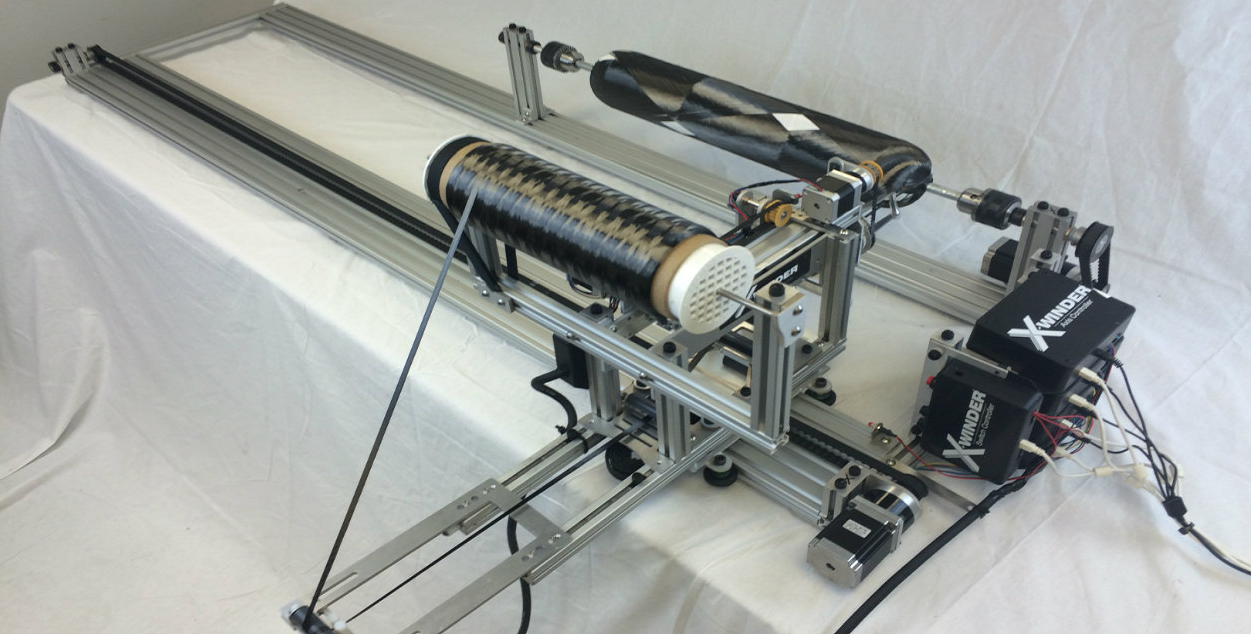
X-Winder LLC, maker of a small-scale desktop filament winder, has announced the release of their new 4-axis model 4X-23, and they say it represents the next step in the evolution of desktop filament winding technology.
Founded in 2011 by Turner Hunt, X-Winder builds compact and inexpensive filament winding machines. The original filament winding machines were invented during the space race of the 1960s.
Filament winding is a fabrication technique used to manufacture open cylindrical parts or closed end structures like pressure vessels or tanks. The process is carried out by winding filaments under tension over a male mandrel as the mandrel rotates while a “wind eye” moves horizontally to lay down fibers in a desired pattern.
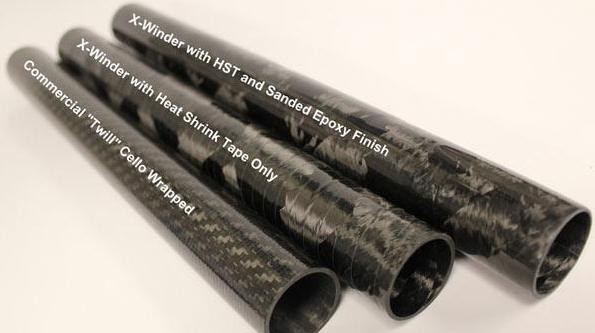 The machines generally use filaments such as carbon or glass fiber which is coated with synthetic resin during the process. As the mandrel is completely covered to the proper thickness, the resin can be cured with heat. Once the resin is cured, the mandrel is removed to leave the hollow final product.
The simplest winding machines have two axes of motion — the mandrel rotation and the carriage travel – and are suited to the fabricating pipes.
Four-axis machines like the X-Winder 4X-23 feature a radial, or cross-feed, axis set perpendicular to the travel of the horizontal carriage and a rotating fiber application head mounted to that cross-feed axis. Until now, such machines have typically been the size of a school bus — and very expensive.
Hunt, who has a masters in aerospace engineering, once worked at the former McDonnell Douglas aerospace corporation where he was involved with engineering teams developing derivatives of the F/A-18 Hornet, F-15 Eagle, and the hypersonic national aerospace plane.
He says that this latest model of the X-Winder, along with a newly upgraded 2-axis model 2X-23, lets fabricators build parts and tailor them to specific applications at a fraction of commercial prices.
So how strong are parts built with the X-Winder?
Unlike a metal, which features isotropic properties (similar in all directions), the properties of filament wound parts are determined by the orientation of the fibers in each layer. The strength of those parts depends on the manner and direction in which a load is applied to them. Turner says the torsion and bursting pressure of parts made with the X-Winder 4X-23 are nearly the same as other commercially available products for the same geometry and wall thickness. He adds that with a “zero degree winding angle” setting, most of that strength deficit goes away as well.
According to Turner, parts made with the X-Winder 4X-23 cost anywhere from 50% to 80% less than parts built for the equivalent geometric part from a commercial vendor, and the larger the part, the larger the savings.
For example, a 6 foot long, 3″ diameter carbon fiber tube costs about $300 from a commercial vendor and would be approximately 78% less with the X-Winder 4X-23.
Parts can be built up to 20 feet long – or longer – with the X-Winder.
X-Winder is based in Cincinnati, Ohio, and they’ve also gone live with a new web store which offers a host of new products along with their new desktop filament winding machines and supporting products.
Can you think of an application for Turner Hunt’s X-Winder technology? Let us know in the X-Winder 4-Axis Filament Winder forum thread on 3DPB.com.
Subscribe to Our Email Newsletter
Stay up-to-date on all the latest news from the 3D printing industry and receive information and offers from third party vendors.
Print Services
Upload your 3D Models and get them printed quickly and efficiently.













You May Also Like
3D Printing Financials: XTPL Adds New Semiconductor and Defense Customers in Q1 2026
Polish microprinting company XTPL (WSE: XTP) reported first-quarter 2026 revenue of PLN 1.6 million (roughly $441,000) as the company expands into the semiconductor and advanced electronics markets, while also launching...
3D Printing News Briefs, May 30, 2026: RIMPAC 2026, Acquisition, Ceramic Implants, & More
We’re kicking things off with materials news in this weekend’s 3D Printing News Briefs. Then it’s on to a hybrid manufacturing system for a maritime exercise, an expansion of industrial...
The University of Utrecht: “3D Printing Could Change Who Gets to Become a Manufacturing Power”
For decades, manufacturing has mostly been controlled by countries with huge factories, lower labor costs, and industrial systems that took years, sometimes decades, to build. But Utrecht University human geographers...
3D Printing News Briefs, May 28, 2026: Continuous Fiber Reinforcement, Bioprinted Trachea, & More
In today’s 3D Printing News Briefs, America Makes announced the winners of its JAQS-SQ Project Call. Axtra3D is partnering with Keystone Industries to expand its dental material ecosystem, while BigRep...