3D Printed Ventilator Manifold Might One Day Save Patients from Lung Damage


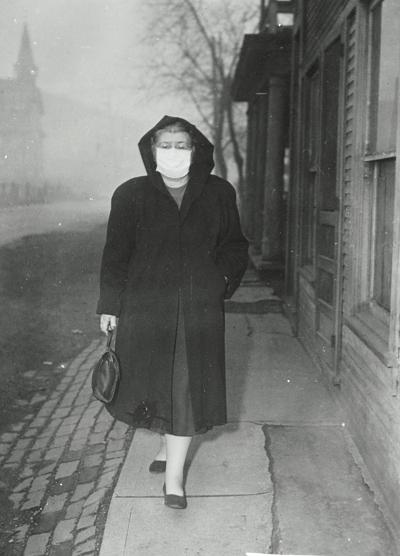
Woman Wearing Surgical Mask While Strolling on the Street in Donora
During October 1948, a cool snap descended on the small mill town of Donora, Pennsylvania.
The people in Donora were dependent on the steel and zinc factories that surrounded their town, and those plants regularly released a mix of nitrogen oxide, sulfur dioxide, and fluoride gas as a result of the work that went on inside. During normal weather conditions, the fumes were whisked away by prevailing winds.
But that October, the sudden influx of cold air created what’s known as an inversion, and that event trapped the toxic mix of gases at the bottom of the valley where the town sat. As the air turned progressively darker, the factories kept running, and at the end of just five days, 20 people were dead. Fifty more died over the course of the next month, and it was later discovered that all told, 6,000 had suffered permanent heart and lung damage.
It was the single most deadly air pollution disaster in American history.
During the disaster, patient after patient spent time hooked up to all the mechanical ventilators available in the small town of 13,000, and the local hospitals were pushed to the brink of their capability.
Ventilators are machines that it easier for patients to breathe, assisting breathing through a mask or mouthpiece by delivering oxygen and eliminating carbon dioxide, and in Donora, respiratory failure — or a low level of oxygen in the blood — became endemic as the levels of pollution rose.
While mechanical ventilators don’t actually repair diseases, they can keep a patient alive while the condition causing the difficulty is assessed.
Now a team of researchers have used 3D design, modeling, and printing to create a ‘manifold’ which can be attached to multiple respiration masks from a single ventilator machine — which may one day prove critical in dealing with disaster surges like the Donora incident.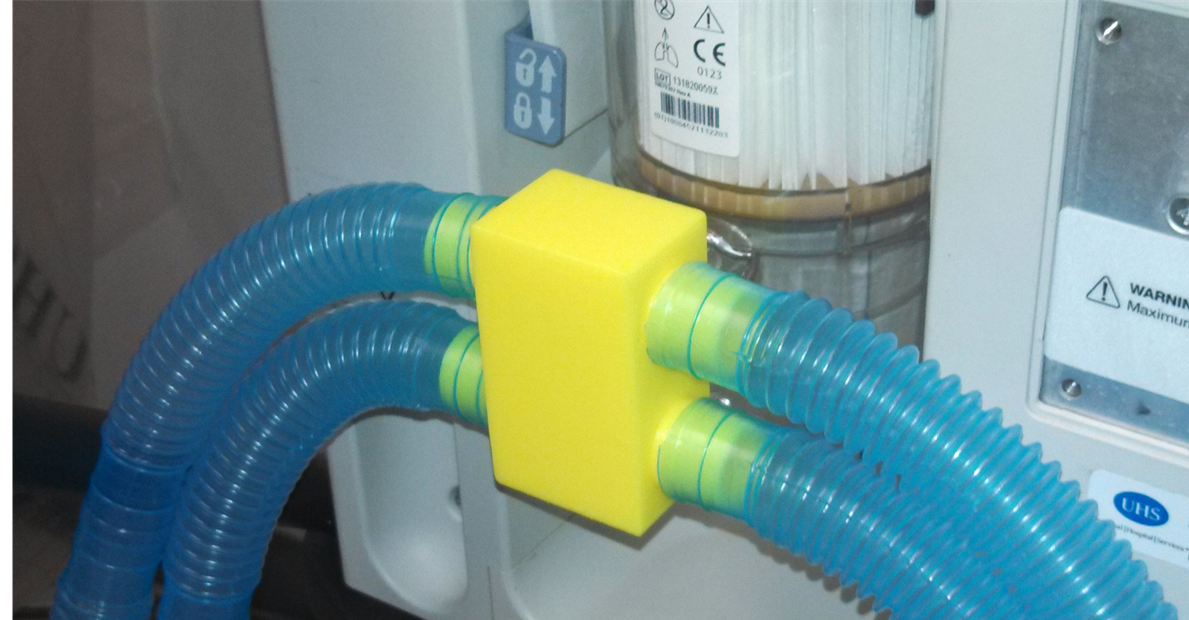
The manifold allows up to four masks to be connected to a single ventilator source, and the researchers used 3D printing via a Fused Filament Deposition (FDM) machine to build their prototype of a four-port ventilator manifold.
The team say by sharing the standard file format they used for the object, it can be made globally available through the internet, 3D printed anywhere and anytime at less than $2 per unit, and used to save patients in areas with limited healthcare resources.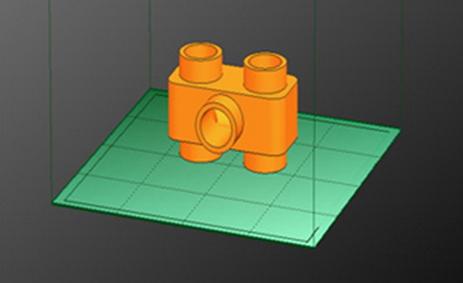
The developers used the CAD program TrueSpace to create their four-port Ventilator-Respirator Manifold, and the design was checked for surface integrity and water tightness in Netfabb before being printed in ABS. Printing time using an Up!3D Afinia printer was just about five hours, and by material weight used (61.4 grams) costs are estimated to stay under two dollars per manifold.
The manifold was created and built by Richard Siderits of the Robert Wood Johnson Medical School and Gregory Neyman of the Robert Wood Johnson University Hospital.
Do you know of other instances where researchers are using 3D printing to create modifications for medical devices? Let us know in the 3D Printed Ventilator-Respirator Manifold forum thread on 3DPB.com.
Subscribe to Our Email Newsletter
Stay up-to-date on all the latest news from the 3D printing industry and receive information and offers from third party vendors.
Print Services
Upload your 3D Models and get them printed quickly and efficiently.













You May Also Like
Australian OEM AML3D Closes Record Year, Eyes $54M Global Sales Pipeline
The US Department of Defense (DoD) finally seems to be implementing a strategy it has spent years refining, centered on bringing its international allies and partners more into the fold...
3D Printing News Briefs, July 30, 2026: Orthodontics, Digital Implants, & More
We’re starting with business news in today’s 3D Printing News Briefs, followed by news about an in-house center for engineering digital implants. We’ll end with research about thermal cloaking. Read...
IMDEA Materials & Lawrence Berkeley National Laboratory Work on Making 3D Printers Print in Unison
Spain’s IMDEA Materials Institute has worked with Lawrence Berkeley National Laboratory to detect and identify differences in different 3D printers. This could be important in eliminating run-to-run differences in prints and...
PanOptimization Gets Attaboy from AFRL for PanX Software
Published in the International Journal of Advanced Manufacturing Technology, a paper titled “Part scale prediction of residual stress through thermomechanical modeling of additively manufactured Ti-6Al-4V” seems to point to the...