MadeSolid Seeks Capital via Equity Investment on WeFunder, Divulges Future Plans


 If you own a 3D printer, particularly an SLA printer, then you have more than likely heard of the company MadeSolid. Founded in 2013 in Oakland, California, the company was quick to jump on the rapidly expanding market for 3D printing materials. Equipped with a team of scientists, researchers, and logistics personnel, MadeSolid has been able to put forth some of the most advanced resins and filaments we have seen yet. However, they seek to continue to expand their reach and are currently looking towards crowdfunding to do so.
You’ve all likely been to Kickstarter before, a rewards-based crowdfunding platform which helps individuals and companies launch innovative new products and ideas. What many of you may not have been aware of is that unlike Kickstarter where those chipping in receive only rewards, there are equity-based crowdfunding platforms as well, like WeFunder.com. Such platforms enable the  public to help partially fund a company in exchange for an actual ownership stake in that particular company.
MadeSolid chose WeFunder as their platform to raise capital, and for the next four days, if you are an accredited investor, you may purchase a stake (minimum $3,000 investment) in one of the fastest growing companies within the 3D printing material space. Currently the company has raised close to $900,000, and will have until February 2 to raise additional capital. This round of financing is being done at a valuation of $9 million with a 0% discount.
Regardless of your intentions to invest or not, the WeFunder campaign has provided a treasure trove in interesting statistics and plans that MadeSolid has been required to divulge. Most interestingly is that they plan to enter the materials space around metal, printed electronics, and dental/medical prostheses next.
“The market is growing rapidly: hobbyists get the hype, but the growth is in manufacturing,” states the company on their WeFunder campaign. “If MadeSolid continues to invent and protect IP around new materials — along with the print heads and software that control them — they have a chance to create an industry standard where every 3D printer is labeled ‘MadeSolid compatible.’ The analogy is not supplying commodity ‘ink’, but inventing new materials and processes for printing real-world objects, like electronics or a hip joint.”
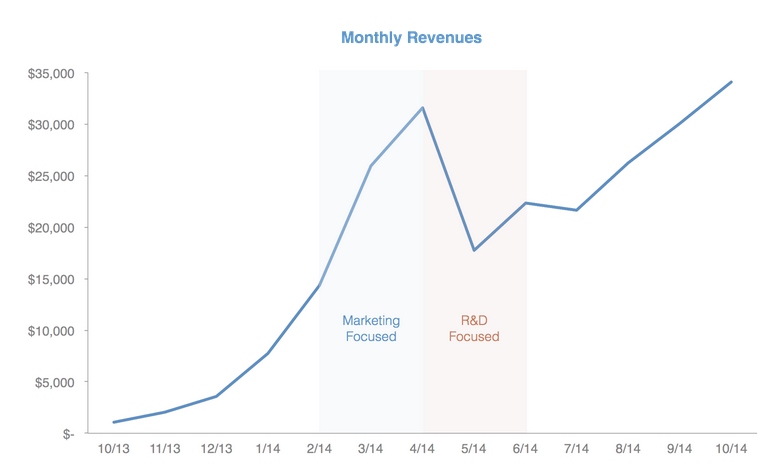
What’s also interesting are the key statistics that MadeSolid has released to potential investors. In October 2014, they realized $34,000 in revenue, and since the company’s launch in October 2013, until November 2014, they’ve generated over $255,000 in revenue. Month over month revenue growth over 12 months equated to 34%, and the company generated $119,458 in Q4 of 2014 compared to $78,056 in the quarter prior. MadeSolid states that they are close to profitability with a $35,000 burn. With an average margin on their products of 80%, you would think that profitability would not be too difficult to achieve, especially if they can scale back R&D a bit. With that said, R&D is certainly important, as the company tries to rack up patents to add to their small portfolio which currently includes 1 filed patent and 3 provisional patents. Additionally they have 7 patents lined up for filing.
It certainly will be interesting to watch as Madesolid begins to put this new capital to use. Although I personally have considered taking a stake, the $9 million valuation is a tough term for me to get past. Have you purchased an equity stake in MadeSolid? What are your thoughts on their future plans? Discuss in the ‘MadeSolid’s Future’ forum thread on 3DPB.com.

Subscribe to Our Email Newsletter
Stay up-to-date on all the latest news from the 3D printing industry and receive information and offers from third party vendors.
Print Services
Upload your 3D Models and get them printed quickly and efficiently.













You May Also Like
TDK Makes Sound AI Infrastructure Bet with Fabric8Labs Acquisition Worth Up to $400M
As I described in a recent PRO article, the bulk of global investment is currently premised on a bet that an AI infrastructure buildout can eventually result in a workable...
Continuum Powders Launches On-Demand Alloy Service for Small-Batch Production
The need to meet demand for high-mix, low-volume (HMLV) production is one of the dominant catalysts driving new manufacturing investment. One explanation for this lies in a rare dual transformation...
The Stories nScrypt Can’t Tell; and Why That Matters
This article is Part 3 of a three-part series based on 3DPrint.com’s visit to nScrypt’s Orlando headquarters and conversations with Ken Church. There’s an interesting dynamic inside nScrypt’s Orlando headquarters. The...
Blue Origin’s New Glenn Explosion Comes During Major Manufacturing Push
Blue Origin‘s orbital New Glenn rocket exploded during a hot-fire test at Launch Complex 36 in Cape Canaveral on May 29, setting back the company’s launch ambitions at a time...