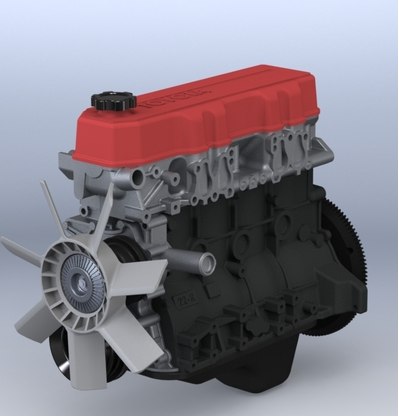
Thingiverse User Shares Files to 3D Print a Moving Toyota 4 Cylinder Engine 22RE

 While 3D printing enthusiasts cover the gamut with a wide range of projects from gaming figurines to avante-garde dresses and shoes, most of the serious automotive 3D printed parts and components we report on are left up to the big guns in the automotive industry. They have access, obviously, to powerful industrial 3D printers that these days are pumping out more and more 3D printed parts, leading to faster production times, greater efficiency, easier quality assurance of methods, and most of all — a more attractive looking bottom line.
As with many different types of innovation, groundbreaking production of parts often begins in the more industrial sectors with giant companies encompassing vast resources. Inevitably though, brave and creative souls decide they want to see if they can take a crack at it too, and from there — barriers are broken — and amazing products are made in home workshops and garages.
I’ve never met a car enthusiast or mechanic who didn’t love a project or a challenge, and timeframe is usually not a concern, as their idea of relaxing is tinkering with a large metal vehicle — or in this case — building parts for one. Auto enthusiast Eric Harrell, also a Thingiverse user, is a mechanical engineer who decided to try his hand at designing and 3D printing a Toyota 4 Cylinder Engine 22RE. Composed of 80 separate 3D printed parts, the engine took about 60 hours or more for design time, and over 72 hours to 3D print. While that might sound like a staggering amount of time, keep in mind that the end product is an engine.
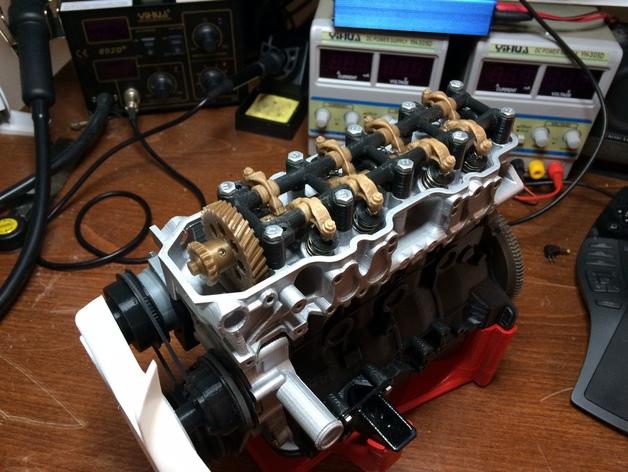 Harrell mentions that this is a complex design and it will require a commitment to taking quite a while to complete. Using SolidWorks, Harrell had to deal with capacity issues for his 3D printer, so he scaled the files to 35 percent. Using PLA filament with his RepRap original Prusa, Harrell recommends expecting to use about 1kg of filament for the complete print. Since it is a challenging project and requires skills and equipment, Harrell warns that you do need to pay attention to the limits of your 3D printer in terms of how well-calibrated and ‘robust’ it is, with the option of scaling files down further; however, smaller parts could be become an issue.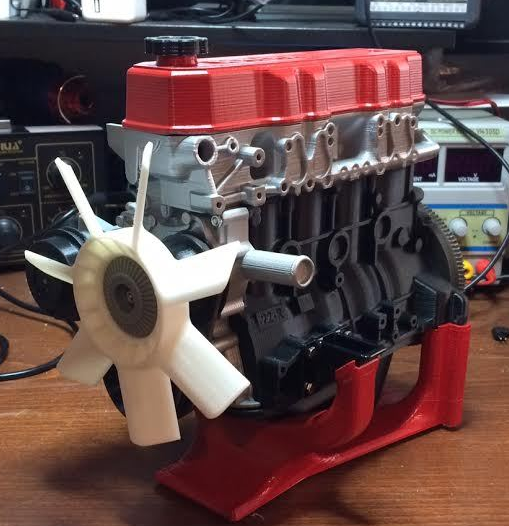
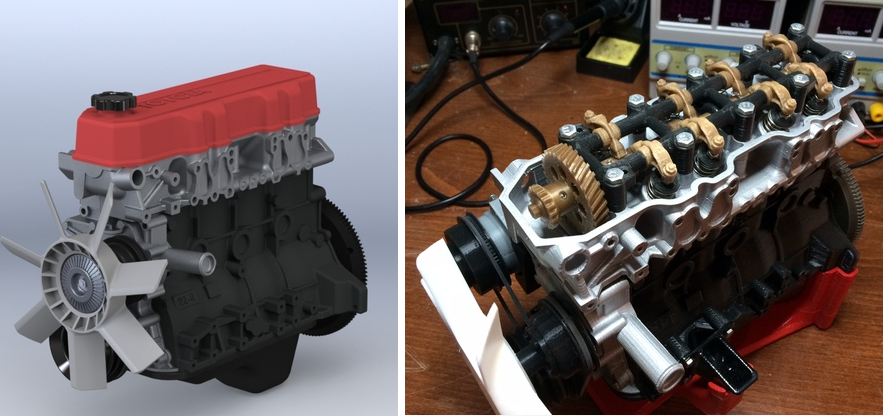
Rubber bands were used for connecting the fan pulley and electric motor. Harrell was not able to find pre-made springs at the right size, but improvised as follows, with the note that he would appreciate input from anyone in the community that does know of a spring that will work: “Valve springs were made with 1/4″ ratchet extension as a mandrel and 0.023″ steel mig welding wire. The outer diameter of the spring should roughly be 0.470″. Each spring has 10 loops, and you need to just stretch it long enough to keep the valve closed.”
With all the files available for download from Thingiverse, this is definitely more than a weekend project, unless you plan on entirely giving up on sleep, and while it’s challenging — what a reward at the end to build your own engine. It’s important to note that there could be various kinks that need to be worked out due to variations in 3D printers and materials. The files are also still somewhat of a work in progress, Harrell warns.
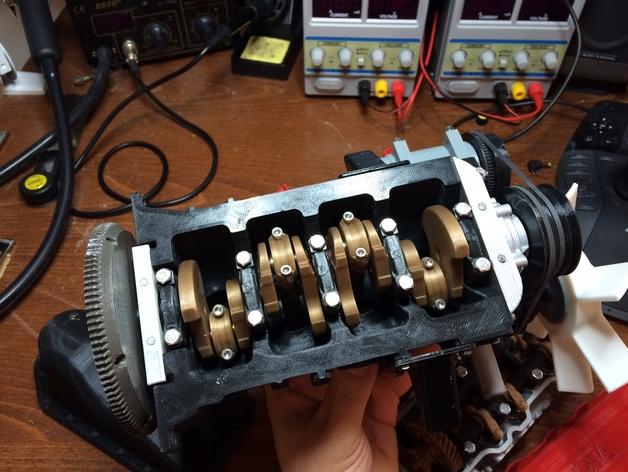
While it does take many hours to 3D print, the engine can be printed in installments, producing a fully rotating model, with a working crank, pistons, and valve train — with valves that open and close. Except for several bearings and fasteners, Harrell points out that all the parts are 3D printed.
Is this a project you would feel comfortable taking on? Have you 3D printed automotive parts or components previously? Tell us about it in the 3D Printing Your Own Toyota 4 Cylinder Engine 22RE forum over at 3DPB.com. Check out the video below as well as some additional images:
Subscribe to Our Email Newsletter
Stay up-to-date on all the latest news from the 3D printing industry and receive information and offers from third party vendors.
You May Also Like
3D Printing News Briefs, August 14, 2024: Reverse Engineering, STEM Learning, & More
We’re taking care of business first in 3D Printing News Briefs today, as Solideon has oversubscribed its pre-seed funding goals and Revopoint3D announced a global strategic partnership with KVS for...
3D Printing News Briefs, August 10, 2024: Centrifugal 3D Printer, Waveguides, & More
In 3D Printing News Briefs, a company has launched what it says is the first centrifugal 3D printer, AIM3D secured patents for pellet 3D printing, and micro-CT scanning is being...
US Navy Awards SBIR to Hyliion to Develop 3D Printed Megawatt Generator
Hyliion, an Austin-based company that uses metal additive manufacturing (AM) to produce power generation solutions with reduced carbon remissions, has received a Small Business Innovation Research (SBIR) grant from the...
RTX and America Makes Tap 6K Additive for Sustainable Metal 3D Printing R&D
Back in January, Manufacturing USA institute America Makes awarded the RTX Technology Research Center (RTRC) and the University of Arizona (UA) $1.2 million for the Environmental Additive Research for Tomorrow’s...