SWISSto12 Partners with Mitsubishi Electric Corporation

SWISSto12 will partner with Mitsubishi Electric Corporation. The duo has signed a memorandum of understanding (MoU) covering manufacturing payloads, RF products, and expansion in Asia. SWISSto12 will also manufacture phased-array antenna products for Japan’s GEO secure programs. This is a win for SWISSto12 since it means that Japan is outsourcing part of a super-critical communications infrastructure to the company.
The Memorandum of Understanding (MoU) centers on the Japanese firm’s “extensive satellite system expertise and integration capabilities,” combined with SWISSto12’s proprietary 3D printing designs and processes that form the foundation of its next-generation payloads—smaller, lighter, highly performant, yet built in materially shorter timeframes. The core SWISSto12 promise has been built up around this idea of faster production and more efficient products using additive manufacturing. To date, this has led to the startup, founded in 2011, recently raising $70 million in Series C funding and over $200 million overall. The total order book is over $500m, and the company has reported revenues of $140 million, with 2,000 parts in orbit right now.
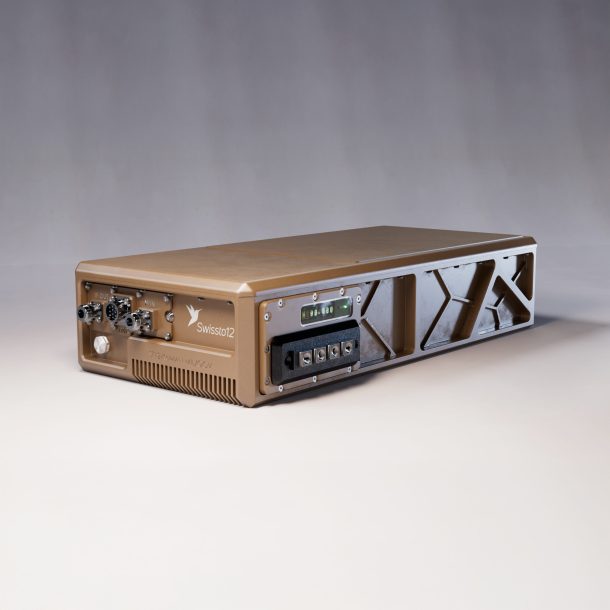
The HummingLink-SOTP, SWISSto12’s partially 3D-printed GEO satellite user terminal. Image courtesy of Swissto12.
SWISSto12 has built its business around its own Hummingsat and components supply, with the firm now working with SES & Viasat as well as national governments. Growing concerns over the US’ changing role in the world and instances of restricted access to US satellite capabilities have spooked many firms, with countries now needing to build out their own communications and imaging capabilities.
SWISSto12 CEO Emile de Rijk said,
“We are proud to partner strategically with MELCO and support the next-generation sovereign communications system of Japan. Demand in APAC is growing for innovative, advanced payloads and RF products across sovereign land, sea, air, and space applications and we are confident that together, we can scale our ability to meet it.”
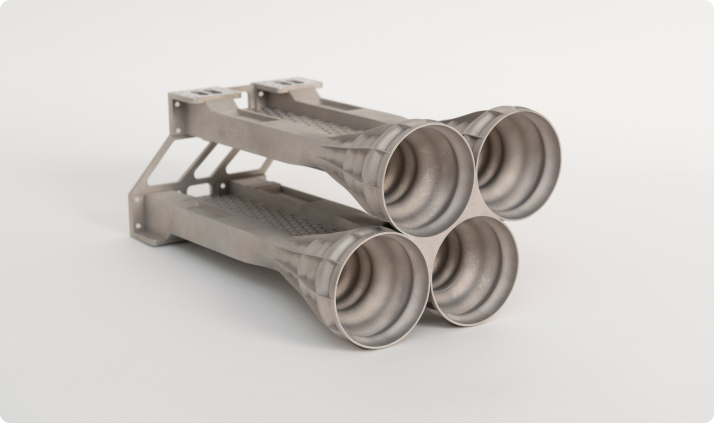
X GEO multibeam cluster. Image courtesy of Swissto12.
Masahiko Arai, Executive Officer Mitsubishi Electric Corporation, said,
“SWISSto12’s innovative technologies, including its 3D-printing-based component manufacturing technology and small geostationary satellite platform, hold tremendous potential. By combining these technologies with our expertise in the development and manufacturing of defense- and space-related systems, which we have cultivated over the years, we are confident that we can deliver unprecedented value to our customers. Through this collaboration, we will leveragethe respective strengths of both companies to pursue new business opportunities in Japan and international markets, while working to deliver advanced and highly competitive defense and space solutions.”
This is yet another data point validating the crucial position that SWISSto12 is creating for itself at the center of the global satellite industry. By being efficient and fast, the company can promise and deliver more efficient parts in shorter timeframes. When time and mass are of the essence, this is a key area to play. As a Swiss company, SWISSto12 can also offer customers an alternative supplier as governments increasingly focus on sovereign capabilities and supply-chain resilience. The firm has also played well with others, which is important in kindergarten and business. Previously, Japan’s Space Compass bought a satellite. Additionally, it partnered with SES, Northrop, and HPS, and bought Hanwha’s antenna portfolio. And that last acquisition gave it important phased-array assets.
A phased array uses a group of antenna elements working together as one high-performance antenna. They use beamforming to capture multiple signals without moving the entire antenna. A phased array is especially useful when you need to communicate with a fast-moving object like a plane or want to reduce jamming effectiveness. Phased arrays are especially useful in surveillance satellites and communications.
Mitsubishi meanwhile makes a lot of things. In satellites, the firm makes satellites and payloads, as well as satellite navigation systems and ground stations. Mitsubishi is also a key part of Japan’s defense systems, making GEO and comms satellites for the country. In February, Mitsubishi announced it had won a Japan Ministry of Defense contract to make new X-band defense communications satellites for Japan.
With X-band infrastructure, high-powered, high-gain, compact systems can be made with reduced rain fade. Importantly, they’re well suited for moving or stop-and-go targets, and the resulting terminals can also be very small. Throw in the beam steering, and you can deal with many signals at once while being more resistant to jamming. So the tie-up with SWISSto12 was written in the stars, really. I’m an unabashed fan of SWISSto12. Seriously, please replicate what these guys are doing to parlay production efficiency and more efficient final parts into an unmissable role at the center of an industry.
Subscribe to Our Email Newsletter
Stay up-to-date on all the latest news from the 3D printing industry and receive information and offers from third party vendors.
Print Services
Upload your 3D Models and get them printed quickly and efficiently.













You May Also Like
3D Printing News Briefs, August 22, 2026: Polymers for CubeSats, Animal Mobility Devices, & More
We’re starting with defense news in this weekend’s 3D Printing News Briefs, before moving on to polymers for CubeSats and 3D printed prosthetics. We’ll end with a story about engineering...
Pusan National University & ORNL Develop Elastomeric Liquid Crystal Actuators
Researchers from Korea’s Pusan National University and Oak Ridge National Laboratory (ORNL) have developed 3D printed elastomeric actuators. In a paper published in Nature, the team used elastomeric liquid crystal...
Scientists Use BMF to 3D Print Seal Whiskers That Track Prey Long After It’s Gone
Seals use their whiskers to hunt. Not Navy Seals, although they may in some way also, but this article is about lowercase seals. Not Seal the musician either; as far...
Harvard’s Jennifer Lewis Lab Is 3D Printing Artificial Muscles That Twist and Bend on Demand
Researchers at Harvard John A. Paulson School of Engineering and Applied Sciences (SEAS) have developed a new way to 3D print materials that can move on their own, bending, twisting,...