
The Evolution and Future of The AM Services Market (and How We’re Tracking It)

If it feels like additive manufacturing and 3D printing technologies are finding a place in the mainstream of everyday products and life, it’s because they are. It has been a long road to get here, but today additive technologies are finally in the conversations of engineers and product designers at the earliest planning and design stages of making things. Although there are still plenty of various challenges to solve and roadblocks to many different applications where additive could be used, lots of real, commercial things and parts are manufactured via additive processes around the world today.
In fact, earlier this year, Additive Manufacturing Research (AM Research) published a new iteration of one of its most ambitious additive market tracking projects, which attempts to put a number on this very phenomenon – how many parts are printed each year? Our best answer, which necessarily excludes at least some of the market, is about 28 million metal parts and an astounding 454 million parts in various polymers, for the year 2025. But the bigger change is not just how many parts are being printed. It is how they are being produced and what customers expect from service providers. What was once largely an “additive print services” market is becoming an “additive production services” market. Thus, we have launched into building a new model to track and forecast the 3DP/AM services market. We are pre-selling the complete report already, at a 50%+ discount to what the price will be upon the report publication (expected in Q4 2026 / Q1 2027).
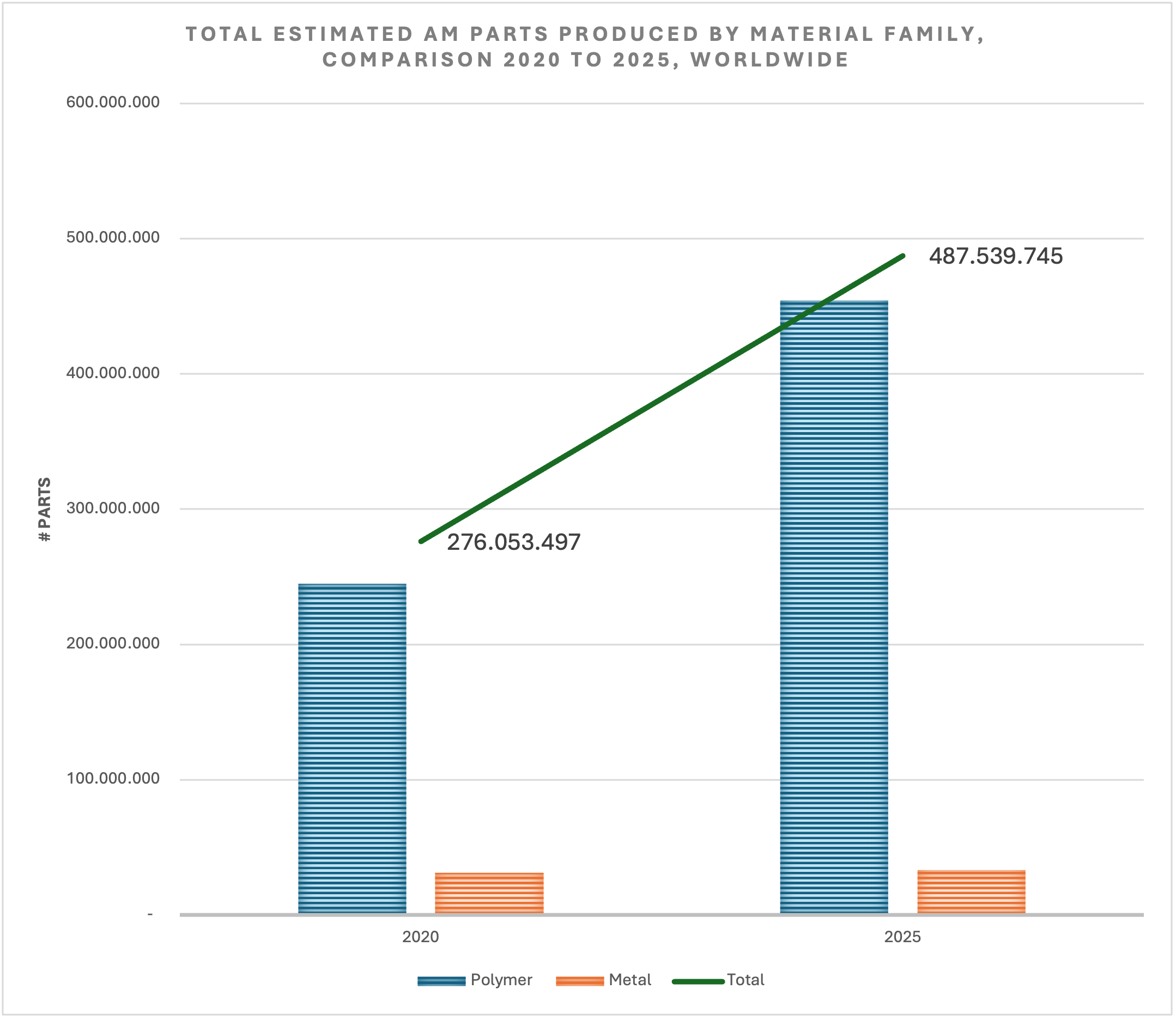
The print services market is a key driver of these numbers. Print services providers are evolving, and the business models associated with providing access to additive manufacturing services have also changed. Additive manufacturing services have played a massive role in the last three years of getting the world of AM to where it is today.
Print services are becoming an even larger, more pivotal part of AM’s advancement. At the same time, their evolution is making the market more dynamic and complex. At AM Research, we now have to consider many new factors and change agents when tracking the services sector. This has catalyzed the development of a new market model to better track the next evolution in the print services sector, a journey that we are just beginning (more on that later!).
What’s Changing in the Print Services Market Today
To help put into context our views on the evolution of the print services market, let’s look at how we track the market today.
When the original AM Research print services model was developed back in 2018, it goes without saying that the print services market looked a lot different. Back then, we looked at over one hundred print services businesses around the world, categorizing and sizing their activities based on reports, company interviews, and any published case studies or marketing materials available. A decent number of the 3D printing industry’s largest companies were operating parts printing services in addition to selling printers. To keep up with the market on a regular basis, we established a baseline by categorizing and segmenting many players, and then continued to monitor their progress.
A lot of the original basis for the model was done at a time when 3D printing services were essentially just rapid prototyping and modeling, with a few healthcare applications mixed in. The market was somewhat fragmented, with a few flagship names and bureaus. A good amount of focus was placed on providing print services as a trial for companies to then go and adopt internal 3D printing using the same printers the service group ultimately was selling. The economics were different, and the core strategy overall was more transactional. In essence, it was mostly understood that print service providers were not production partners, and that the road to actual 3D printed production was to eventually bring 3D printing in-house so that it could become scalable and affordable enough, or high enough in quality, to actually be a viable production tool. All the service provider needed to do was be a relatively costly bridge.
The other major agent of change in the entirety of the AM industry, but which is especially pertinent to the services market, is the ongoing embrace of additive manufacturing by the defense industry in an era of global conflict. Because governments have both the motivation and the budgets to incentivize AM to scale but need to leverage established partners to move into production quickly, service providers stand to benefit in a major way by locking down significant volume that can be critical to growing and sustaining their operations.
And finally, since 2018, there has been major growth in the development of specialized additive technologies operated as a private means of production rather than as a technological solution to be distributed and sold. Companies such as Seurat, VulcanForms, Divergent, Norsk Titanium, and others are all ‘additive manufacturing companies’ that have developed some form of AM technology, but are keeping the tech and operating it themselves, with the goal being to provide access to AM production.
Change is Inevitable, So Why Do We Care?
That distinction between the services market of before and today is important. Those companies succeeding now are very clearly focusing on providing more of the complete process, not just printing.
This shift is enabling all kinds of downstream market changes, and this is something AM Research needs to make sure our market data services are reflecting and adjusting for.
In our current model, print services revenues are accounted for by region and market because the basis for the model involves only a competitive analysis and categorization of many service providers and their capabilities in either metals or polymers.
However, with a move into major defense contracting projects in maritime, hypersonics, munitions, and beyond, we are seeing a lot of activity being driven by the printing of new and different high-performance metal alloys – not just the typical titanium and nickel alloys. Alloys based on refractory metals, alternatives to Inconel like MAR-M 247, maritime CuNi alloys, and others are all enabling new levels of premium differentiation. Not only that, but the use of binder jetting is also becoming more common as an alternative for certain performance alloys, as highlighted in the recent webinar produced by AM Research featuring Continuum Powders and AmPd Labs for binder jetting MAR-M 247.
In the prior model, none of these details, like specialty alloy or process type, would have been able to be accounted for, but these are important, not only for sub-categorizing growth areas, but also to understand the revenue and profitability potential of the print services sector in both the near and longer term.
A staggering expansion of low-cost, scaled production is also occurring in the services sector using print farms of networked desktop plastic extrusion printers. These businesses have mostly created their own markets by printing relatively simple parts at scale, with costs that rival injection molding and volumes that would make even the biggest recognized print services brands humble. Not all of the best success stories in print farms are actually in the business of providing print services—some make their own products directly using the same concept (such as Wigglitz, CruiseCup, Wooj, and others).
The impact on the services market that print farm service businesses are having is rapidly increasing. The speed and scale at which these companies are expanding makes it difficult to fully account for them in our current model. What’s more, by opening a new class of low-cost per part applications that are increasingly higher in quality, the volumes at which these companies can produce in a services-based model are much greater than at any point in the market’s history.
A Look Under the Hood of the AM Research Market Model Development
All of these things combined are making for not only a truly exciting time for the print services market, but they’re also bringing forth a new project here at AM Research which we will continue to develop. For the first time, we also want to bring the industry along for the ride. While this article introduces the changing market that is driving the need for new approaches, future articles will present and discuss the new services market model to take a look under the hood.
Currently, AM Research tracks the hardware and materials segments of the AM ecosystem through a ground-up modeling process tied to detailed machine placements and machine utilization. And key to these models is that all metrics and tracking tie back to the basis of production and active machines. This allows for a good deal of detail that can be modeled with proper research, because each AM technology is relatively unique in the applications it can serve and how it is being adopted.
This same dynamic has thus far not been possible in the services segment models because the emphasis has been on looking only at top-line growth, and not so much at the potential of the technologies and the production-readiness of the AM technologies across competitors. Now that the market has almost fully evolved beyond prototyping and modeling, the same ground-up approach focusing on the means of production can yield more beneficial model output and tracking capabilities.
To that end, our new services model will now also tie back to machines in the print services sector. This will allow for new levels of tracking detail to help identify trends and opportunity areas earlier.
As it stands today, print services is already the largest segment of the AM market. AM Research estimates the segment at about $8.9 billion in 2025 and projects it could reach nearly $38 billion in 2035. The chart below shows our current forecast for the overall AM value segment, based on early 2026 data.
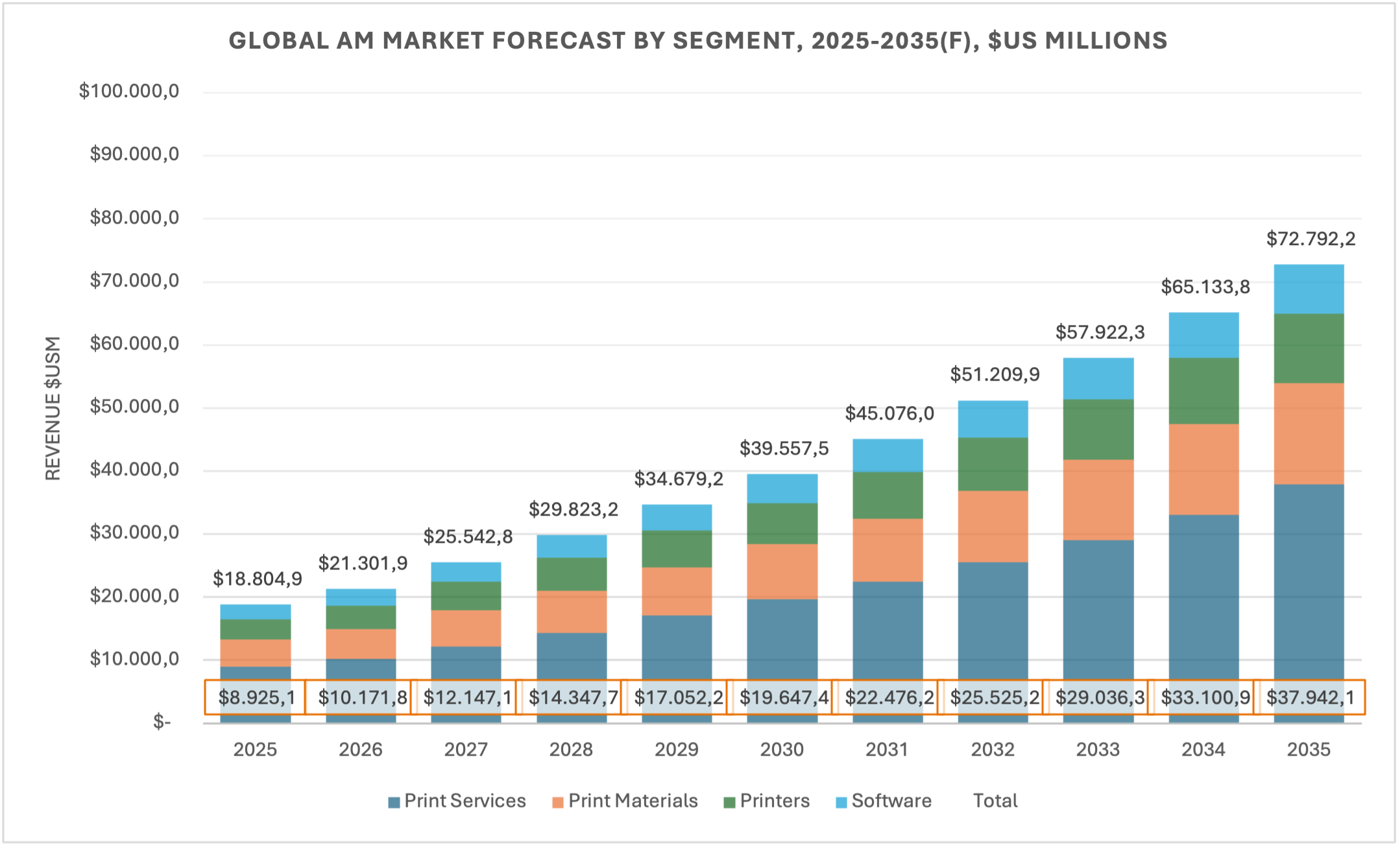
Our current forecasts for services show the print services sector growing to nearly $38 billion, up from around $9 billion at the end of last year. Clearly, the expectation is already that significant growth will occur in the services market. The current evolving dynamics described in the prior sections of this article look as if they are in support of the current expectations. However, what will really allow us to refine the outlook is the ability to estimate smaller pieces of the collective services market – something that the new machine-centric, ground-up approach should enable, in a similar way to our other hardware and material models.
What’s Next – Reports and Analysis As We Build
All of this development will culminate in the release of a new market data set and market report on the next generation of the print services market. We invite you, our audience and customers, to follow along as we present research trends that are informing our new model as it is developed. This semi-real-time approach will give further insight into what is driving our models, which, in turn, we believe drive the industry itself.
We will publish updates in the form of part-blog, part-analysis pieces on the print services market. A full market report covering all findings – and more – along with all output market data and forecasts will then be released. We have already made the end market study available on a pre-release basis at a discount leading up to its finalization and full release. Pre-purchase here at a 50%+ discount. The complete report and dataset will be delivered in Q4 2026 / Q1 2027.
If you are a provider of outsourced print services, please contact us at info@additivemanufacturingresearch.com. We welcome the chance to share ideas and further inform our approach.
Images courtesy of AM Research
Subscribe to Our Email Newsletter
Stay up-to-date on all the latest news from the 3D printing industry and receive information and offers from third party vendors.
Print Services
Upload your 3D Models and get them printed quickly and efficiently.













You May Also Like
Kickstarter is Testing the Next Wave of Desktop 3D Printing
3D printers are raising serious money again…on Kickstarter, that is. Over the last few months, a new group of 3D printer campaigns has attracted millions of dollars and thousands of...
Stratasys vs. Bambu Lab: What’s Really Behind the $27.6M Patent Verdict?
Editor’s note: This is Part 1 of a two-part series by Xu Fanglei examining the technology and patent issues behind the Stratasys-Bambu Lab dispute. Part 1 looks at the U.S....
Bambu Lab and SUSAN FANG 3D Print for London Fashion Week
At London Fashion Week, some of the more unusual pieces on the runway came from 3D printers. Chinese fashion designer SUSAN FANG presented her Spring/Summer 2027 Air-Illusion collection at the...
Stratasys Wins $27.6M in Patent Case Against Bambu Lab; Bambu Challenges Verdict
Update, September 21, 2026: This article has been updated with a statement from Bambu Lab responding to the verdict, along with additional information about the company’s ongoing patent challenges against...
























































