Apple Opens New US Advanced Manufacturing Center for Second Year in a Row


The US added 5,000 manufacturing jobs in July, although in its article on the subject, Wall Street Journal notes that there are still (slightly) fewer manufacturing workers in the US than there were a year ago. On the other hand, it is perhaps a positive sign that the pool of applicants for manufacturing jobs continues to skew younger: in July, 85 percent of US manufacturing applicants were under the age of 45, up from 79 percent compared to July 2025.
Among other reasons, this matters because millions of US manufacturing workers are expected to retire over the next decade. US manufacturing giants have still been rather cautious about putting their money where their mouth is when it comes to reshoring, but to the extent that they really are investing in domestic US manufacturing capacity thus far, trying to attract younger generations to manufacturing careers has been a primary reason.
Apple, for instance, announced last year that it would spend a half-trillion dollars over four years on its US manufacturing footprint. Early announcements included plans for Detroit’s Apple Manufacturing Academy, which opened last year, and the Advanced Manufacturing Center in Houston, which opened this month. Earlier this year, Apple also announced that it would invest $400 million from its US manufacturing budget to bolster the American operations of four of its suppliers, two of which include Bosch and TDK.
As everyone in the additive manufacturing (AM) industry knows, Apple includes titanium 3D printing in its repertoire of advanced manufacturing techniques and capabilities, and as Joris Peels wrote back in March, the company looks to be targeting aluminum next. It’s not clear precisely which manufacturing processes are at the heart of the 20,000-square-foot Houston location, but Apple does note the relevance of the site’s operations to the company’s efforts to build domestic US manufacturing capacity for products including the Mac mini and “advanced AI servers”.
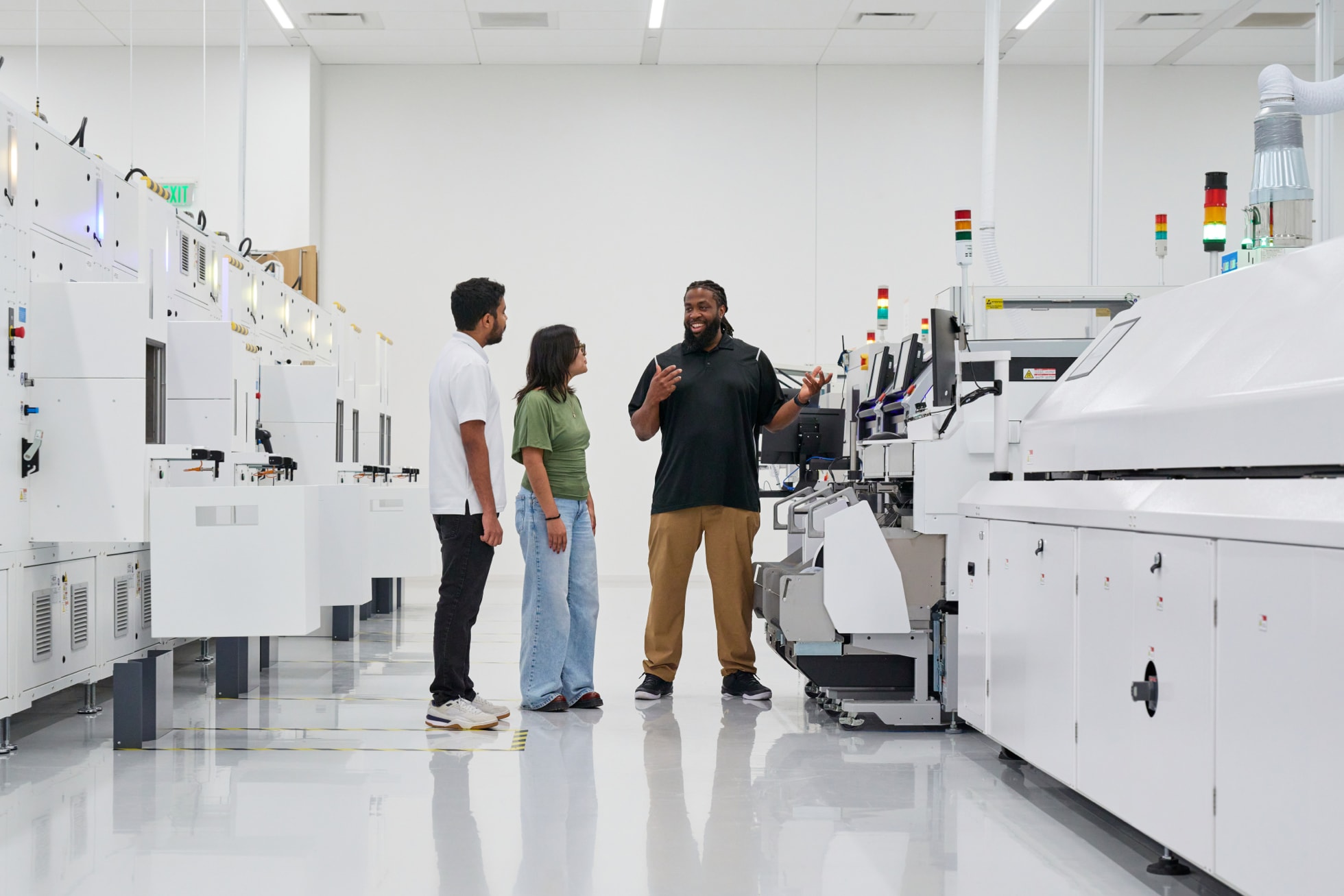
Apple’s Advanced Manufacturing Center Houston factory floor.
Additionally, Apple notes in the press release that the Detroit initiative has trained “nearly 1,000 American workers, students, and entrepreneurs to learn smart manufacturing techniques and integrate AI into their production processes.” That’s not a bad number for the first year; by comparison, the Accelerated Training in Defense Manufacturing Program (ATDM), which the US Navy is involved in, trained its thousandth worker after its fourth year, gradually working its way up to a target of 1,000 trained workers annually.
In my post on the Detroit program from about a year ago, I mentioned a connection to the Smart Manufacturing Forum in South Korea that Apple held in 2023, which took place at an R&D center at Pohang University of Science and Technology: a $55 million facility that Apple was compelled to commit to in 2021 as part of a settlement related to its antitrust violations in Korea. (I always find this detail fascinating!) I pointed out that it was noteworthy that this was around the first time we heard legit rumors about Apple’s use of (Chinese) metal 3D printing, given that we found out about Apple’s expanded use of 3D printing shortly after the Detroit academy officially began.
My suggestion was that Apple was using the synergy between the two media events to draw the attention of small and medium manufacturers who might be interested in participating in the hardware giant’s infrastructure buildup. In retrospect, I feel pretty justified in my theory for reasons that don’t have to be discussed here, but businesses who are interested in participating in Apple’s Houston activities are encouraged by the company to sign up for notifications, and we may want to be on the lookout in September for new revelations about what Apple is doing with 3D printing and/or any other advanced manufacturing techniques.
What I’m most interested in is everything implied here for the potential direction of Apple’s chip packaging strategy. I mentioned in a recent post on my favorite Polish microcap, XTPL, how Apple has been signaling that higher prices for memory chips will be passed on to consumers, and I should think that if Apple is in that position, everyone else will be, too. Apparently, advanced packaging is one of the main bottlenecks behind high memory chip prices, so if Apple can solve that problem first, it could turn a weakness into a strength.
It’s also intriguing in this regard for AM industry observers that TDK is one of the suppliers Apple is interested in supporting, in light of TDK’s recent Fabric8Labs acquisition. Fabric8Labs’ manufacturing process can do many different things for thermal management in electronics, but TDK may have been most immediately interested in the company for its advanced packaging potential. Let this serve as my latest reminder not to ignore the electronics 3D printing market!
Images courtesy of Apple
Subscribe to Our Email Newsletter
Stay up-to-date on all the latest news from the 3D printing industry and receive information and offers from third party vendors.
Print Services
Upload your 3D Models and get them printed quickly and efficiently.












You May Also Like
Hadrian Valued at $7.9B After Massive $1.4B Series D Funding Round
The industrial underpinnings of US military readiness have been hampered by an overcommitment to weapons systems whose long-term value is increasingly questionable. This isn’t so much a generational problem as...
3D Printing Financials: 6K Additive Reports Record Quarter as Demand Grows for U.S.-Made Metal Powders
Demand for metal powders made in the United States continues to grow, particularly from aerospace and defense customers. That was one of the biggest takeaways from 6K Additive‘s (ASX: 6KA)...
Hadrian and Fortastra Bet on Automated Factories to Fix Satellite Production Bottlenecks
Demand for satellites continues to grow, and manufacturers are looking for ways to build spacecraft faster without affecting performance. One way to do that is to involve manufacturing companies earlier...
Beehive Industries Invests $70M in Ohio to Support Its Advanced Manufacturing Buildup for Propulsion
Beehive Industries and the state of Ohio have each been killing it in the metal 3D printing game. Naturally then, it was only logical for Beehive and Ohio to combine...