Industrial Designer Creates The ‘Exo’ 3D Printed Prosthetic Leg with Aesthetics in Mind

Brooklyn, New York industrial designer William Root is using 3D scanning, modeling, and printing to create customized prosthetic limbs. Currently, he is working on the prototype for what he calls the “Exo-Prosthetic Leg.”
Each year in the US around 185,000 amputations are performed, 90% of which involve the loss of lower extremities. There are approximately 2 million amputees in the country. The financial, physical, and psychological effects of such a procedure can and often do cause additional trauma to patients, as does adapting to an awkward and sometimes ill-fitting new limb.
Prosthetic limbs range in functionality, appearance and, of course, expense. The most expensive prosthetics are the robotic ones that are prohibitively expensive to most amputees but are quite remarkable in their intricacy and capacity to restore almost complete function of a limb to amputees. As the technology improves and manufacturing of such high-tech prostheses becomes affordable, probably via 3D printing whenever design aspects permit, these devices will become more affordable to people with amputations.
Another problem with the current system of prosthetic production is the customization process of traditional prosthetic limbs, which is typically time consuming, requiring a painstaking measuring process and often numerous fittings and adjustments. Ultimately, amputees must make extreme adjustments in order to adapt to prosthetic limbs, which are often not particularly attractive or lifelike.
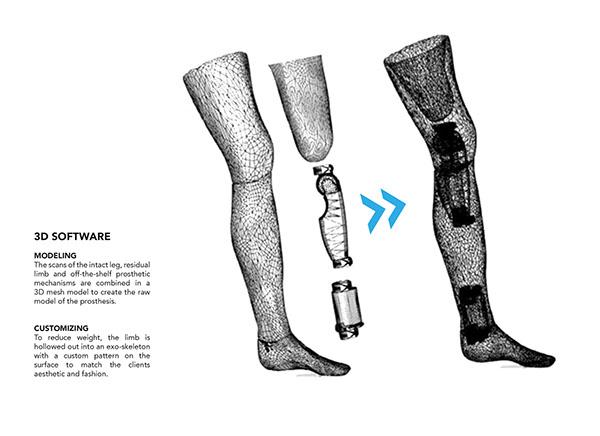
Understandably, form has been considered secondary to function where prosthetic devices are concerned. Root, however, doesn’t think that appearance needs to suffer for the sake of increased function. Root has designed the Exo-Prosthetic Leg, which is produced using 3D scanning of the residual and the remaining limb to create a precisely matched and properly fitting prosthetic replica.
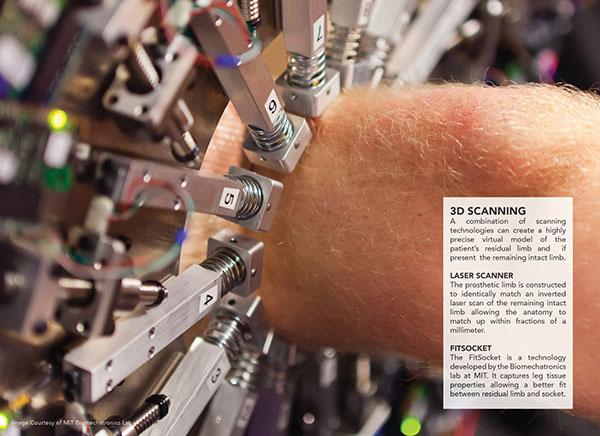
Following the 3D scanning process, Root creates a model for the prosthetic leg using 3D modeling software. To aid in precise fitting, FitSocket technology, which was developed in the Biomechatronics lab at MIT, is used to analyze the tissue properties of the leg (or, ultimately, other missing extremities). Measurements are taken that fit down to the millimeter so patients do not experience some of the more awkward and physically uncomfortable effects of wearing and managing prosthetic devices.
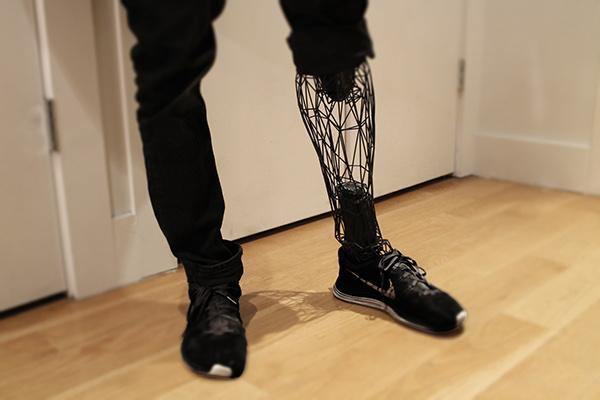
A 3D mesh model of the prosthesis is produced and is combined with standard, manufactured prosthetic mechanisms, which fit inside the Exo-Prosthetic Leg. Root can customize the prostheses by using different patterns with the super lightweight but durable titanium mesh of the prosthetic’s surface. Customers can also choose a color they prefer. Root envisions the Exo-Prosthetic Leg as scaffolding for customers who’d like to cover the artificial limb with a custom-designed silicone sleeve.
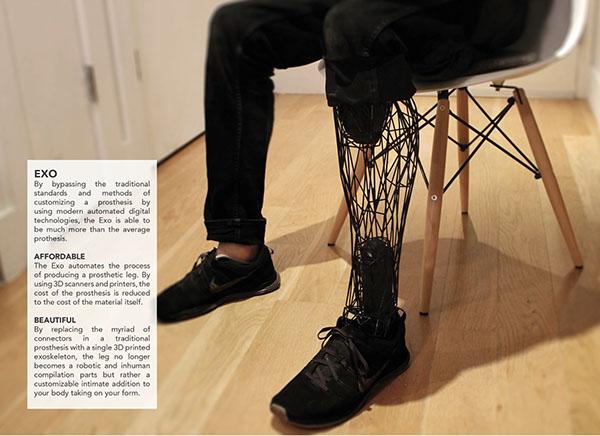
In addition to 3D printing the attractive design of the mesh surface, Root prints customized connectors for the separate components, that fit within the prosthesis. The Exo-Prosthetic Leg is still in the development phase as Root refines its design to produce a fully-functional prototype. At all stages, 3D technology has been key to the project, which is garnering a great deal of attention and clearly provides real promise for millions of people.
Let us know what you think of this artistic and functional design at the Exo-Prosthetic Leg forum thread at 3DPB.com.
Subscribe to Our Email Newsletter
Stay up-to-date on all the latest news from the 3D printing industry and receive information and offers from third party vendors.
Print Services
Upload your 3D Models and get them printed quickly and efficiently.











You May Also Like
AM Research Releases Q3 Market Data & Market Insights Report as 3D Printing Hits First-Ever $4B Quarter
It might not always feel like it, but the additive manufacturing (AM) industry is having a decent year, all things considered. As usual, AM Research (AMR) is busy analyzing and...
Registration Rates for Additive Manufacturing Strategies 2026 Increasing This Week
It may not seem like it, but February is right around the corner, and that means it’s almost time for our 9th annual Additive Manufacturing Strategies event. Returning to New...
Thinking Strategically: AM Industry Consultant Tali Rosman on AM for the Defense Market
By now, more or less everyone in the AM industry seems to grasp the central role in accelerating AM adoption played by the defense sector in general, and the U.S....
AMS Quotes From the Host, Part 2: An Interview with Layered Ltd’s CEO, Peter Rogers
Peter Rogers has held many different titles within the additive manufacturing (AM) industry over the years, with the latest title being CEO of Layered Ltd, the consultancy Peter founded, headquartered...